

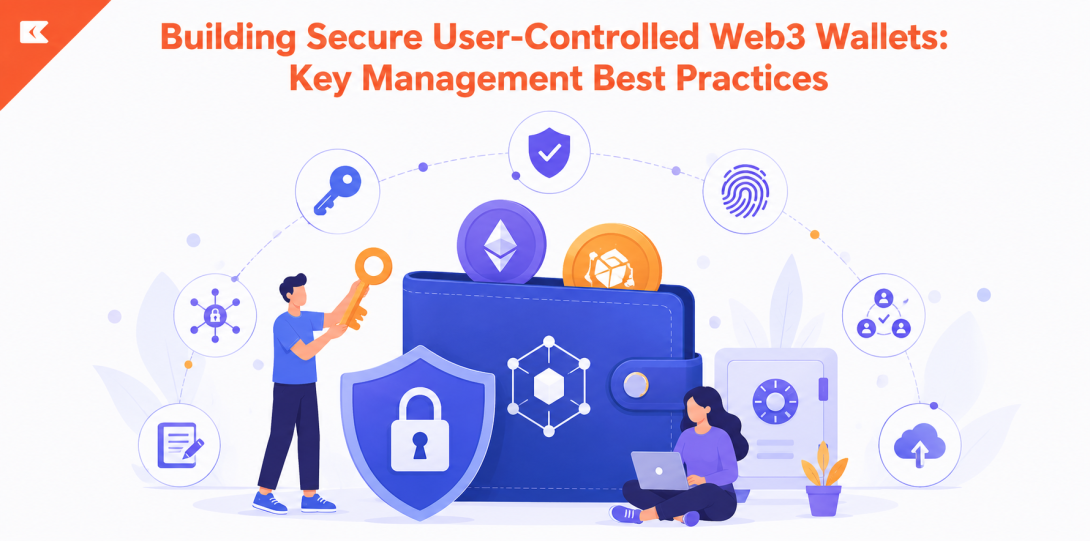
Web3 wallet development demands a security-first approach, since private keys and seed phrases are the sole gateway to a user's digital assets.
Unlike custodial exchanges, non-custodial wallets place full ownership in the user's hands, shifting the entire security burden onto how developers architect key generation, storage, and recovery.
This guide breaks down the key management practices, common pitfalls, and essential features that define a genuinely secure, user-controlled wallet.
What Is a User-Controlled Web3 Wallet?
A user-controlled Web3 wallet, often called a non-custodial wallet, gives the individual sole ownership of their private keys rather than delegating custody to a third party.
Every transaction, from a token swap to a smart contract interaction, requires the user's own cryptographic signature. This model underpins decentralized finance and NFT ecosystems.
Still, it also means there is no password-reset button if the key is lost, so is access, which is why specialized web3 wallet development gets key architecture decisions right from day one.
Why Key Management Is Critical in Web3 Wallet Security
Key management sits at the center of wallet security because private keys are mathematically irreplaceable there is no central authority to reissue them. A single point of failure in generation, storage, or transaction signing can expose a user's entire asset portfolio.
Robust key management isn't a feature layered on top of a wallet, it is the wallet's core security architecture, and it directly determines whether users trust the product with meaningful value.
The Role of Private Keys and Seed Phrases
Private keys are the cryptographic proof of ownership over blockchain assets, while seed phrases (typically 12 or 24 words) act as a human-readable backup that can regenerate those keys.
Anyone who obtains the seed phrase gains full control of the wallet, regardless of device or password protections, which makes safeguarding it the single highest-priority task in any wallet's design.
Multi-signature setups, which require several independent keys to approve a transaction, are increasingly used to remove that single point of failure altogether.
Common Risks of Poor Key Management
Weak key management exposes users to several recurring threats that wallet developers must design against directly, and that also shape broader fintech app security posture across financial products:
- Lost private keys: Without a recovery mechanism, a lost key means permanent, irreversible loss of the associated assets.
- Seed phrase theft: Phrases stored in plain text, screenshots, or cloud notes are prime targets for attackers.
- Malware attacks: Keyloggers and clipboard hijackers can silently capture keys or swap wallet addresses mid-transaction.
- Phishing scams: Fake wallet interfaces and support messages trick users into voluntarily surrendering keys or seed phrases.
- Unauthorized wallet access: Weak or absent authentication layers let attackers open and drain a wallet even without the underlying key.
Core Components of Secure Web3 Wallet Architecture
A secure wallet is built from five interlocking components, each of which must be hardened independently, since a weakness in any one undermines the rest, even if the other four are implemented flawlessly. Each carries its own implications for overall development cost and timeline.
Private Key Generation
Keys must originate from a cryptographically secure random number generator, never from predictable seeds like timestamps or user-chosen passwords, to prevent brute-force reconstruction.
Secure Key Storage
Keys should live in hardware-backed enclaves, such as a device's Secure Enclave or Trusted Execution Environment, with encryption applied at rest a discipline a dedicated security architecture review helps validate before launch.
Transaction Signing
Signing should occur locally on the user's device, with the raw private key never leaving secure storage, so a compromised network connection cannot expose it.
Wallet Recovery Mechanisms
Recovery options seed phrases, social recovery, or multi-signature schemes must balance usability against the risk of creating a new attack surface.
Authentication and Access Controls
Layered authentication, from device PINs to biometrics, ensures that possessing the device alone isn't sufficient to authorize a transaction.
Key Management Best Practices for Building Secure User-Controlled Web3 Wallets
These ten practices form the baseline for any team building or auditing a non-custodial wallet:
1. Generate Keys Using Cryptographically Secure Randomness: Rely on audited CSPRNG libraries rather than custom entropy sources to eliminate predictable key generation.
2. Store Private Keys Securely on the User's Device: Use platform-native secure storage (Keychain, Keystore) instead of application-level databases or shared preferences.
3. Never Transmit or Store Private Keys on Your Servers: A truly non-custodial architecture keeps keys off backend infrastructure entirely, removing the server as an attack target.
4. Encrypt Sensitive Wallet Data at Rest: Apply strong, vetted encryption (e.g., AES-256) to any locally cached wallet metadata, not just the key itself.
5. Implement Secure Backup and Recovery Options: Offer encrypted cloud backup or social recovery as alternatives to a single point-of-failure seed phrase.
6. Protect Against Phishing and Social Engineering: Build in domain verification and transaction-preview warnings that flag suspicious contract interactions before signing.
7. Enable Multi-Factor Authentication for Wallet Access: Combine biometrics with device-level PINs so a stolen device alone can't authorize transfers.
8. Secure Transaction Signing: Use hardware-backed signing wherever possible and display clear, human-readable transaction details before every approval.
9. Regularly Audit Wallet Security: Commission independent, ideally open-source, security audits on a recurring schedule rather than a one-time launch review.
10. Keep Cryptographic Libraries Updated: Patch signing and encryption dependencies promptly, since outdated libraries are a common source of exploitable vulnerabilities.
Common Key Management Implementation Mistakes to Avoid
Even well-intentioned teams fall into predictable traps during implementation:
Storing Keys in Plain Text
Writing unencrypted keys to local storage or debug logs turns a routine device compromise into a total asset loss, and it's a mistake that automated security scanning catches quickly during code review.
Sending Private Keys Over the Network
Any API call that transmits a raw key, even to your own backend, defeats the purpose of a non-custodial design and reintroduces exactly the custodial risk users are trying to avoid.
Insecure Backup Mechanisms
Backing up seed phrases to unencrypted cloud drives or screenshots exposes them to account-level breaches entirely unrelated to the wallet itself, such as a compromised email or photo-sync account.
Ignoring Device Security Features
Failing to leverage built-in Secure Enclave, biometric APIs, or OS-level sandboxing wastes protection the platform already provides for free, forcing developers to rebuild weaker versions of the same safeguards.
Essential Security Features Every Web3 Wallet Should Include
Beyond core key management, these features distinguish a production-ready wallet from a prototype:
Biometric Authentication
Fingerprint or facial recognition adds a fast, phishing-resistant layer that doesn't rely on a memorized secret, while still falling back gracefully to a PIN when biometric hardware is unavailable.
Hardware Wallet Support
Integration with devices like Ledger or Trezor lets advanced users keep keys in cold storage while still transacting through the app, combining offline key protection with day-to-day usability.
Multi-Chain Compatibility
Supporting multiple blockchains from a single interface is an area where development expertise is directly transferable, reducing the need for users to juggle separate wallets.
Transaction Risk Detection
Real-time scanning for malicious contracts or suspicious approval requests catches threats before the user signs.
Secure Wallet Recovery
A recovery flow that doesn't depend solely on a single seed phrase, such as social recovery or multi-signature guardianship, meaningfully reduces the accidental-loss risk covered in our digital wallet app development guide.
Security, Privacy, and Compliance Considerations for Web3 Wallet Development
Security engineering has to sit alongside privacy and regulatory obligations, particularly as wallets increasingly intersect with regulated financial rails:
Privacy by Design
Minimize data collection and avoid linking wallet addresses to identifiable user data unless explicitly required for compliance, keeping on-chain activity separate from off-chain identity wherever possible.
Secure Development Lifecycle (SSDLC)
Bake threat modeling and code review into every sprint rather than treating security as a pre-launch checklist, so vulnerabilities surface while they're still cheap to fix.
Open-Source Code Audits
Publishing signing and key-management modules for public review builds trust and surfaces vulnerabilities before attackers do, a practice increasingly expected across the broader DeFi ecosystem.
Data Protection and User Privacy
Apply data protection principles consistent with regulations like GDPR, even for wallets that don't custody user funds directly a discipline covered in depth by our security and compliance services team.
Security Monitoring and Incident Response
Maintain real-time monitoring for anomalous transaction patterns and a documented incident response plan for suspected key compromise.
Conclusion
Secure web3 wallet development isn't a single feature it's a discipline spanning key generation, encrypted storage, authentication, and ongoing audits.
Teams that treat private keys as the product's core asset, rather than an implementation detail, build wallets users can trust with real value.
Following the practices outlined here turns a functional wallet into a genuinely secure one, ready for production and regulatory scrutiny alike.