
Air Density Separator Market Overview Analysis By Fortune Business Insights
Market at a Glance
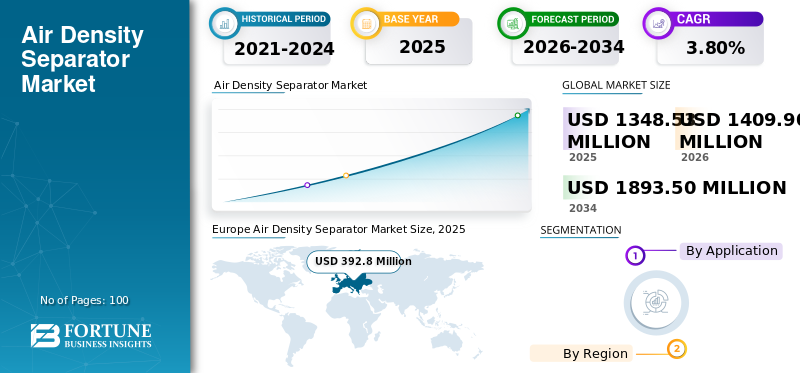
According to Fortune Business Insights: The global air density separator market was valued at USD 1,348.53 million in 2025 and is projected to grow from USD 1,409.90 million in 2026 to USD 1,893.50 million by 2034, exhibiting a compound annual growth rate (CAGR) of 3.80% over the forecast period. Europe led the global market with a 29.10% share in 2025, while Asia Pacific is positioned as the fastest-growing region, fueled by expanding industrialization and increasing waste management investment across China, India, and ASEAN economies.
Market Overview
An air density separator is an industrial equipment used to segregate lighter materials from heavier ones through a controlled air stream. The machinery directs materials through an opening, using airflow to carry lighter particles — such as plastic, paper, and dirt — while heavier particles, including metals, rocks, and glass, are separated by gravity. This technology is widely deployed in sectors ranging from recycling and waste processing to food and beverages, chemicals, minerals and mining, and agriculture.
The market is underpinned by the global push toward circular economy principles, resource recovery, and green business models. Europe and North America collectively drive a substantial share of market activity, backed by well-established manufacturers, integrated distribution networks, and robust regulatory frameworks that mandate efficient waste processing and recycling practices. The effective combination of automation integration and ongoing cyclic innovation is further propelling product adoption across both mature and emerging markets.
Get a Sample Research PDF: https://www.fortunebusinessinsights.com/enquiry/request-sample-pdf/106087
Key Market Trend
Tackling Micro-Plastic Pollution Through Density Separation One of the most significant emerging trends shaping the air density separator market is the growing application of separation equipment to combat the global micro-plastic pollution crisis. Governments worldwide are intensifying efforts to build sustainable ecosystems, given that approximately 80% of all plastic produced is never recycled and is instead discarded into the environment. Air density separators are increasingly being deployed in waste processing and recycling facilities to address this challenge, and their adoption is set to gain considerable momentum across major economies through 2034.
Manufacturers are responding by investing heavily in the development of bulk recycling models that apply density separation techniques at scale. The focus is on creating systems that minimize total operating costs while delivering optimal separation outcomes. Companies are also working to develop integrated selection algorithms that determine the most efficient processing sequences for isolating target materials from mixed waste streams — an innovation that promises to enhance both throughput and material recovery rates.
Key Growth Driver
Cyclic Innovation and Green Business Model Adoption The separator application industry is actively transitioning toward cyclic innovation — redesigning processes to minimize resource consumption, reduce waste, and align with green business objectives. Air density separators serve as a key enabler of this transition, helping industries in recycling, mining, and waste processing improve material efficiency and reduce environmental impact.
The development of Magnetic Density Separation (MDS) technology represents a particularly notable advancement. MDS is capable of separating materials with different densities at a faster pace, with greater accuracy, and at a lower operational cost compared to conventional methods. This technology is anticipated to meaningfully expand the addressable market and serve as a decisive growth catalyst over the forecast period.
Additionally, growing scarcity of metals and the resulting volatility in commodity prices are increasing the strategic importance of mineral processing and recycling operations globally, driving further demand for efficient separation solutions.
Key Restraint
High Capital Investment and Space Requirements The primary constraint on market growth is the substantial upfront investment required to procure and install air density separator systems at industrial facilities. Beyond acquisition costs, these systems traditionally require large physical footprints, making them impractical for facilities with limited floor space. Operational limitations also pose challenges — elevated feed rates and higher table frequencies can reduce particle settlement time, degrading the quality and precision of separation outputs. Together, these factors — high capital expenditure and operational sensitivity to load — create meaningful barriers to adoption, particularly among smaller operators and cost-constrained markets.
Segmentation Insights
By Application The recycling and waste processing segment dominates the market, holding a 40.11% share in 2026. Growth in this segment is driven by rising awareness of waste segregation, increasing adoption of biofuel generation from processed waste, and strengthening regulatory mandates around material recovery. The food and beverages segment holds the second-largest share, supported by growing demand for gravity and density-based solutions to clean and sort food products. The development of compact, high-capacity separator models is accelerating adoption in this segment. Minerals and mining, chemicals, and agriculture round out the application landscape, each benefiting from the broader industry shift toward precision material processing.
Regional Insights
Europe led the global market with USD 392.8 million in 2025, driven by strict EU regulations on waste management, recycling efficiency, and circular economy targets. The U.K. and Germany are key contributors within the region. North America generated USD 301.1 million in 2025, supported by infrastructure modernization and automated separation technology deployment. Asia Pacific, valued at USD 391.6 million in 2025, is the fastest-growing region, with China, India, and Japan at the forefront of demand growth. Latin America contributed USD 98.92 million in 2025, with gradual adoption supported by improving regulatory alignment. The Middle East & Africa, at USD 164.1 million in 2025, represents an early-stage but steadily growing market driven by urban expansion and sustainability initiatives.
Connect with Our Expert for any Queries: https://www.fortunebusinessinsights.com/enquiry/speak-to-analyst/106087
Competitive Landscape
The air density separator market features a mix of globally established players and specialized regional manufacturers. Leading companies include ANDRITZ (Denmark), Metso Outotec (Finland), LYBOVER (Belgium), Blue Group (U.K.), Hillenbrand Inc. (U.S.), Acrowood (U.S.), M&K (U.K.), Nihot Recycling Technology B.V. (Netherlands), Neuenhauser Recycling Technology GmbH (Germany), and CSS Recycling Equipment Solutions (Australia). Key competitive strategies include mergers and acquisitions of smaller entities, diversification of product portfolios across multiple application verticals, and the development of smart, automation-enabled separation systems to meet evolving industry demands.
Conclusion
The global air density separator market is on a steady and sustainable growth path through 2034, anchored by rising environmental awareness, tightening waste management regulations, and the accelerating transition to circular economy models. As micro-plastic concerns intensify and demand for efficient material recovery grows across industries, air density separation technology is set to play an increasingly vital role in global industrial and recycling ecosystems.