
Air Filters Market Overview Analysis By Fortune Business Insights
Market at a Glance
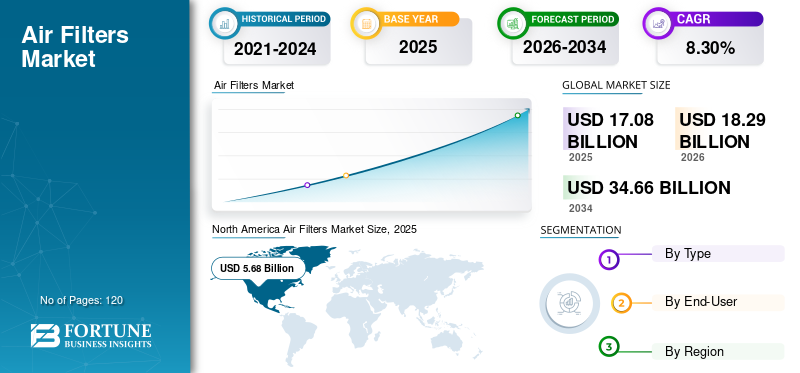
According to Fortune Business Insights: The global air filters market was valued at USD 17.08 billion in 2025 and is projected to rise from USD 18.29 billion in 2026 to USD 34.66 billion by 2034, at a compound annual growth rate (CAGR) of 8.30% over the forecast period. North America led the global market with a 33.20% share in 2025, while Asia Pacific is identified as the fastest-growing region, driven by rapid urbanization and industrial expansion across China, India, and Southeast Asia.
Market Overview
Air filters are a critical component of heating, ventilation, and air conditioning (HVAC) systems, designed to capture airborne particles such as dust, pollen, pet dander, mold spores, and bacteria. They serve a vital function across residential, commercial, and industrial environments by improving indoor air quality (IAQ) and reducing health hazards associated with airborne pollutants.
The market's growth is underpinned by increasing awareness of air quality risks, tightening environmental standards, and the expanding footprint of industries such as automotive, healthcare, and semiconductor manufacturing — all of which require controlled, clean-air environments for safe and efficient operations.
The COVID-19 pandemic further reinforced the importance of indoor air quality globally. While many industries faced disruption, the air filters market remained relatively resilient. Recommendations from organizations like the American Society of Heating, Refrigerating, and Air-Conditioning Engineers (ASHRAE) — including a two-step filtration approach to curb viral transmission — accelerated demand for high-efficiency filtration solutions such as HEPA filters and dust collectors.
Get a Sample Research PDF: https://www.fortunebusinessinsights.com/enquiry/request-sample-pdf/101676
Key Growth Drivers
Rising Demand from the Automotive Industry The automotive sector is a significant and growing end-use market for air filters. These systems help remove fine dust and prevent microbiological contamination in vehicles, from small passenger cars to heavy machinery. According to the OECD, excessive pressure on contaminated air filters can increase fuel consumption by 1% to 15%, highlighting the critical role of proper filtration in vehicle efficiency. Rising consumer preference for luxury vehicles with advanced filtration systems is further accelerating demand.
Urbanization and Population Growth According to the World Bank, approximately 55% of the global population lived in urban areas in 2020, with that figure forecast to reach 68% by 2050. This rapid urbanization is driving construction activity and expanding demand for HVAC filtration across new residential, commercial, and industrial buildings, creating a sustained long-term growth runway for the market.
Green Building and Sustainability Trends The global shift toward green building standards — including LEED certifications and other environmental frameworks — is elevating demand for high-efficiency, reusable, and washable air filters. According to the World Green Building Council, green building focus stands at nearly 46% in Australia and 40% in Ireland. Reusable filters offer compelling economics: their payback periods are short since they eliminate the need for filter replacements every four to six months, making them attractive for environmentally and cost-conscious buyers alike.
R&D and Capacity Expansion Leading manufacturers are investing heavily in expanding production capabilities. In November 2022, Daikin Industries Ltd announced plans to invest approximately USD 711 million to boost production capacity across India and Southeast Asian countries — a move that signals strong long-term confidence in regional demand growth.
Key Restraint
High Installation and Maintenance Costs The primary barrier to market penetration is the cost burden associated with high-efficiency filter systems. Replacement filters typically range from USD 35 to USD 60 per unit, and filters generally require changing every four to six months. In cost-sensitive markets, many end-users opt for cheaper, lower-efficiency alternatives that offer reduced filtration performance, limiting the market's overall growth potential in certain geographies and segments.
Segmentation Insights
By Type Dust collectors held the dominant position in 2026 with a 27.06% revenue share, owing to their near-total particle removal efficiency of 99.9% and broad applicability across healthcare, commercial, residential, and automotive sectors. HEPA filters, cartridge filters, and baghouse filters are expected to grow at moderate rates, supported by green technology integration and compatibility with smart building systems. HEPA filters are anticipated to record the highest CAGR among all type segments.
By End-User The industrial segment led the market in 2026 with a 48.55% share, driven by demand from healthcare, automotive, semiconductor, and pharmaceutical facilities — environments where air purity is operationally critical. Commercial and residential segments are growing steadily, fueled by urbanization and expanding construction activity worldwide. The industrial segment is expected to continue holding the highest CAGR through 2034.
Regional Insights
North America generated USD 5.68 billion in 2025 and remains the global leader, driven by automotive and healthcare sector growth across the U.S., Canada, and Mexico. The U.S. alone is projected to reach USD 7.31 billion by 2032. Europe accounted for 28.80% of the global share in 2025, at USD 4.93 billion, with Germany, Italy, and Spain as key contributors. Asia Pacific contributed USD 4.82 billion in 2025 and is the fastest-growing region, with China projected at USD 1.89 billion, India at USD 1.24 billion, and Japan at USD 0.9 billion by 2026. The Middle East & Africa and Latin America regions are expanding steadily, with values of USD 1.07 billion and USD 0.59 billion respectively in 2025.
Connect with Our Expert for any Queries: https://www.fortunebusinessinsights.com/enquiry/speak-to-analyst/101676
Competitive Landscape
The global air filters market is competitive and innovation-driven. Leading players include Daikin Industries Ltd (Japan), Camfil (Sweden), MANN+HUMMEL (Germany), Parker Hannifin Corp (U.S.), Cummins Inc. (U.S.), Donaldson Company Inc. (U.S.), Freudenberg Filtration Technologies (Germany), Absolent Group (Sweden), Lydall Gutsche (Germany), and Purafil Inc. (U.S.). Acquisitions, facility expansions, and new product launches are the primary strategies used to strengthen market positioning. Key recent milestones include MANN+HUMMEL's acquisition of Pamlico Air in January 2022, Camfil's new manufacturing facility in Arkansas, and Donaldson's 50,000-square-foot expansion in Pune, India.
Conclusion
The global air filters market is on a strong and sustained growth trajectory, propelled by health awareness, urbanization, green building adoption, and surging industrial demand. As air quality standards tighten globally and consumer priorities continue to shift toward healthier indoor environments, both established players and new entrants have significant opportunities to capitalize on this expanding market through 2034.