
Fraud Detection and Prevention Market Overview Analysis By Fortune Business Insights
Market Summary
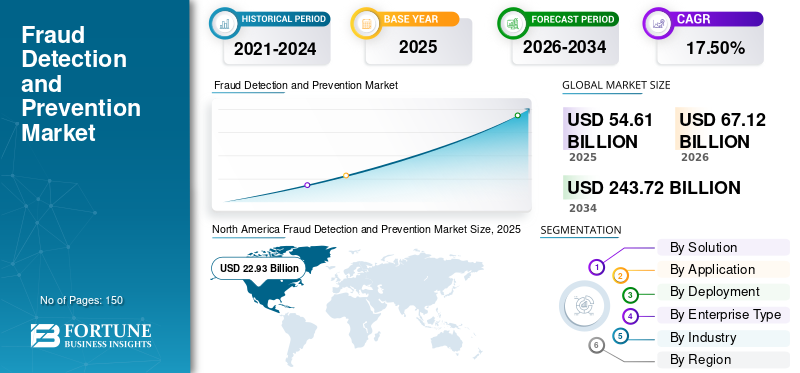
According to Fortune Business Insights: The global fraud detection and prevention (FDP) market was valued at USD 54.61 billion in 2025 and is projected to grow from USD 67.12 billion in 2026 to USD 243.72 billion by 2034, exhibiting a CAGR of 17.50% during the forecast period. North America dominated the market with a 42.00% share in 2025, reflecting the region's advanced digital infrastructure and the concentration of major FDP solution providers.
The market is propelled by increasing investments from enterprises and governments across the U.S., India, Brazil, China, Germany, and the U.K. in deploying enhanced fraud prevention platforms. Industries including BFSI, healthcare, manufacturing, and retail are among the primary adopters. The broader shift in consumer behavior toward e-commerce and digital financial services continues to intensify the need for robust fraud detection capabilities globally.
Get a Sample Research PDF: https://www.fortunebusinessinsights.com/enquiry/request-sample-pdf/100231
Key Market Drivers
Surge in Online Applications and Mobile Banking The widespread adoption of mobile banking and digital payment platforms has created new vulnerabilities, with fraudsters developing sophisticated fake websites and applications that closely mimic legitimate services to deceive consumers. According to the Boston Consulting Group, approximately 70% of global users are digitally influenced to purchase financial products through mobile banking or e-banking applications. This digital shift is directly driving demand for FDP solutions capable of real-time threat detection and transaction monitoring.
Growth in Digital Payments and Internet Penetration The rising volume of online transactions, the proliferation of internet users, and the rapid growth of start-ups are collectively widening the attack surface for financial fraud. According to the Federal Trade Commission (FTC), global e-commerce losses from online payment fraud reached USD 41 billion in 2022 alone — a figure that underscores the urgency for advanced detection and prevention infrastructure across financial institutions, retailers, and payment processors.
Cloud Adoption and Emerging Technologies Cloud technology is a key enabler of FDP growth, offering scalable processing power, rapid tracing of cyber-crimes, and cost-effective deployment for small and mid-sized enterprises. Integration of machine learning, predictive analytics, Big Data, IoT, and blockchain into FDP platforms is further enhancing the capability to detect anomalous patterns and prevent fraud in real time. In 2019, ACI Worldwide partnered with Salesforce to integrate real-time fraud prevention with customer profiling and predictive analytics capabilities, illustrating the direction of the industry's technological evolution.
Market Restraints
The principal barrier to market expansion is the shortage of skilled professionals and limited awareness in developing nations, particularly across parts of the Middle East and Africa, Asia Pacific, and South America — including Mexico, Argentina, Chile, Peru, Colombia, and Caribbean markets. Additionally, as cyber-attacks grow in sophistication, traditional FDP solutions face challenges in keeping pace with novel, anonymous threats, requiring continuous investment in R&D and talent development.
Segmentation Analysis
By Solution The authentication segment commands the largest market share, driven by the growing adoption of multi-factor authentication (MFA) across digital services. Microsoft has noted that MFA can block approximately 99.9% of automated attacks, reinforcing its strategic importance in enterprise security frameworks. The fraud analytics segment — encompassing predictive, behavioral, customer, social media, and Big Data analytics — is also expanding rapidly as organizations seek proactive rather than reactive fraud management.
By Deployment Cloud-based deployment accounted for 46.44% of the market share in 2026, underpinned by advances in AI and data analytics and the limited IT budgets of SMEs that make cloud solutions particularly attractive. The on-premise segment maintains steady growth in government and education sectors, where data sovereignty and operational dependability remain paramount.
By Enterprise Type Large enterprises led the market with a 64.09% share in 2026, driven by their extensive digital transformation programs and heightened exposure to fraud. The SME segment, however, is expected to register the highest CAGR over the forecast period, as tailored security solutions become increasingly accessible and the number of start-ups — particularly in Germany, Brazil, Canada, and Israel — continues to rise.
By Application Electronic payment is the dominant application segment, holding a 42.18% share in 2026, owing to the sheer volume of digital transactions and the associated fraud risks. The insurance claims segment is projected to grow at the highest CAGR, fueled by rising incidences of disaster insurance, life insurance, and contractor-related fraudulent claims.
By Industry The BFSI sector leads all verticals, as digitalization within banking and financial services has made identity theft and account takeover among the most prevalent and costly fraud types. The FTC received 2.8 million fraud reports in 2021 alone, with total consumer losses of approximately USD 5.8 billion. The healthcare and life sciences segment is expected to post the highest CAGR, driven by growing demand for fraud analytics and authentication solutions to combat fraudulent medical claims. Government, manufacturing, IT and telecom, and energy and utilities segments are also projected to grow substantially over the forecast period.
Regional Insights
North America generated USD 22.93 billion in 2025, with the U.S. market projected to reach USD 21.47 billion in 2026. The region benefits from a mature technology ecosystem, active government-backed cybersecurity frameworks, and major players in mobile payment and fraud prevention.
Asia Pacific is expected to record the highest CAGR during the forecast period, supported by surging digital transformation across China, India, Japan, South Korea, and Southeast Asia. China's market is projected to reach USD 5.50 billion in 2026, Japan at USD 2.41 billion, and India at USD 2.26 billion.
Europe is growing significantly, with governments and enterprises in France, Germany, Italy, Spain, and the Netherlands among the most active adopters of FDP solutions. The U.K. market is projected to reach USD 6.46 billion in 2026, with Germany at USD 5.08 billion.
South America and the Middle East & Africa are emerging markets with growing momentum, particularly in Brazil, which leads South American adoption, and in Gulf Cooperation Council nations investing in digital financial infrastructure.
Connect with Our Expert for any Queries: https://www.fortunebusinessinsights.com/enquiry/speak-to-analyst/100231
Key Industry Players
Leading companies include IBM Corporation (U.S.), ACI Worldwide Inc. (U.S.), BAE Systems (U.K.), Experian Information Solutions Inc. (U.S.), Fair Isaac Corporation — FICO (U.S.), LexisNexis (U.S.), NICE Actimize Ltd. (Israel), Gemalto/Thales Group (France), Fidelity National Information Services (U.S.), and Uplexis (Brazil). Notable recent developments include Experian and NeuroID's 2023 partnership to combat AI-powered bots, Oscilar's launch of the industry's first generative AI-powered fraud prevention platform in 2023, and Fiserv's 2022 fraud mitigation service that reduced fraud losses by 10–15% for community banks and credit unions.
Outlook
The fraud detection and prevention market is entering a period of accelerated, sustained growth through 2034. The convergence of digital financial services, AI-driven fraud tactics, and escalating regulatory scrutiny will continue to compel organizations across all industries to invest heavily in advanced FDP technologies. AI, generative AI, and behavioral analytics are set to define the next frontier of fraud prevention capabilities in the years ahead.