
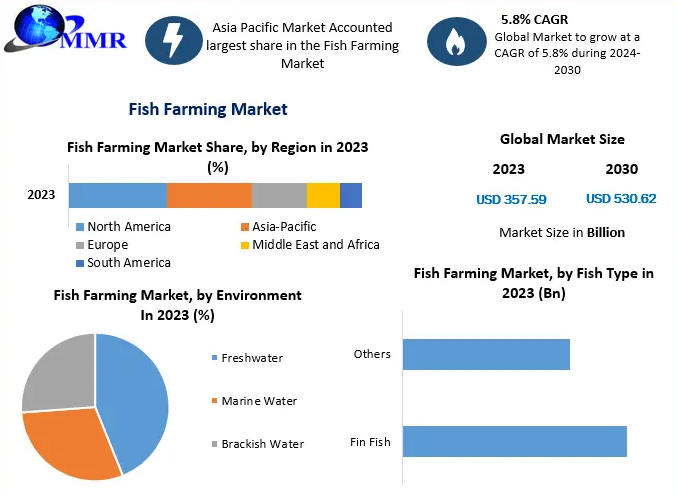
The Fish Farming Industry is undergoing a major transformation as rising demand for seafood, protein diversification, and sustainable practices fuel innovation and expansion. A recent market analysis reveals that the fish farming industry—also known as aquaculture—is expected to grow from approximately USD 323 billion in 2023 to over USD 550 billion by 2031, with a compound annual growth rate (CAGR) of 6–7% over the forecast period.
This press release highlights the key takeaways from the comprehensive report, focusing on market estimation, methodology, segmentation, growth drivers, and country-level insights—especially for the United States and Germany. An expert commentary and press release conclusion wrap up the findings.
Gain Valuable Insights – Request Your Complimentary Sample Now @ https://www.maximizemarketresearch.com/request-sample/30238/
Market Estimation & Definition
The fish farming market refers to the controlled cultivation and harvesting of aquatic species including fish, crustaceans, mollusks, and aquatic plants in various aquatic environments. This includes freshwater ponds, brackish water bodies, and marine systems. The growing shift from wild-caught to farmed seafood due to environmental constraints and rising demand is fueling the sector’s growth trajectory.
By 2031, the global fish farming market is projected to cross the USD 550 billion mark, up from an estimated USD 323 billion in 2023. This growth is attributed to population increases, dietary shifts, technological innovation, and policy support.
Report Scope and Methodology
The report offers a detailed assessment of the global fish farming market, covering:
- Historical Analysis (2019–2022)
- Base Year (2023)
- Forecast Period (2024–2031)
The analysis spans key regions including North America, Europe, Asia Pacific, Latin America, and the Middle East & Africa. A combination of top-down and bottom-up market sizing methods, expert interviews, trend mapping, and economic modeling was used to derive insights.
Analytical tools such as PESTEL, SWOT, and Porter’s Five Forces were applied to understand competitive dynamics, market risks, and strategic opportunities.
Market Growth Drivers & Opportunity
Key Market Drivers:
- Growing Global Population and Protein Demand: With a global population approaching 10 billion, the demand for nutritious, sustainable protein sources such as fish is increasing significantly.
- Depletion of Wild Fish Stocks: Overfishing and climate change have led to stagnation or decline in wild-capture fisheries, making fish farming a necessary and scalable alternative.
- Technological Advancements: The rise of Recirculating Aquaculture Systems (RAS), AI-powered water quality monitoring, and automated feeding systems is improving yield, efficiency, and sustainability.
- Governmental and Regulatory Support: Subsidies, biosecurity standards, and environmental certifications from governments and regulatory bodies are encouraging investments and innovation.
Market Opportunities:
- Expansion in Emerging Markets: Developing regions in Asia, Africa, and Latin America present high growth potential due to increasing consumption and government support for local production.
- Rising Demand for Premium and Organic Seafood: Consumer preference for sustainably raised, antibiotic-free, and traceable fish products is driving diversification in aquaculture offerings.
- Development of Offshore and Urban Aquaculture: Technological improvements are making offshore cage systems and land-based aquaponics viable, reducing land and water usage.
Feel free to request a complimentary sample copy or view a summary of the report: https://www.maximizemarketresearch.com/request-sample/30238/
Segmentation Analysis
Based on the structure of the market, the report classifies the fish farming market into the following key segments:
By Type:
- Freshwater Fish Farming: Dominates the global market due to widespread adoption, especially for species like tilapia, catfish, and carp.
- Marine Water Fish Farming: Focuses on species such as salmon, sea bass, and cod, often conducted in offshore cages.
- Brackish Water Fish Farming: Primarily used for species like shrimp and some mollusks.
- Others: Includes ornamental fish, seaweed, and emerging species.
By Process:
- Extensive Systems: Traditional, low-input farming methods with minimal intervention.
- Semi-Intensive Systems: Incorporates supplemental feeding and improved management.
- Intensive Systems: Highly controlled environments including RAS and biofloc systems to maximize output.
By End User:
- Food Industry: Largest consumer segment, driven by household, restaurant, and processed food demand.
- Ornamental Use: Grows steadily in urban pet and hobby markets.
- Seed Production and Hatcheries: Critical for supplying high-quality fingerlings to farms.
- Others: Includes pharmaceutical, nutraceutical, and research applications.
Country-Level Analysis
United States:
The U.S. is a leading market in North America for fish farming. Salmon, trout, catfish, and tilapia dominate production, with both freshwater and marine aquaculture gaining traction.
- Growth Factors: Rising health-consciousness, demand for locally sourced fish, and technological innovation.
- Challenges: Regulatory hurdles and public concerns about sustainability.
- Outlook: Accelerated adoption of land-based RAS and government funding for sustainable fisheries are expected to boost domestic production.
Germany:
Germany is a key player in the European aquaculture sector. It emphasizes sustainability and high-quality production, especially in freshwater systems like trout farms.
- Growth Factors: Strong regulatory framework, demand for eco-labeled products, and integration of aquaponics.
- Technological Edge: Urban aquaculture and indoor farming facilities are gaining popularity.
- Outlook: Innovation in sustainable feed, disease control, and circular economy integration is expected to enhance competitiveness.
Commentator Analysis
According to industry experts, fish farming is evolving from a traditional agricultural practice into a high-tech, data-driven food production system. This transformation is being driven by advancements in aquaculture engineering, biotechnology, and sustainability practices.
“Fish farming is no longer a secondary solution—it’s a global food system cornerstone,” said a senior market analyst. “The integration of AI, real-time monitoring, and closed-loop farming systems ensures not only high productivity but also responsible environmental management.”
Experts predict that digital transformation will continue to play a central role, particularly in disease prediction, precision feeding, and waste recycling technologies. As the sector matures, collaboration among governments, private investors, and research institutions will be vital for scaling responsible aquaculture worldwide.
Press Release Conclusion
The global fish farming market is poised for dynamic expansion as it aligns with the future of food security, nutrition, and environmental stewardship. With its ability to provide high-quality protein at scale, aquaculture is becoming increasingly vital to the global food chain.
By 2031, the market is projected to exceed USD 550 billion, driven by strong consumer demand, government policies, and industry innovation. As more countries implement sustainability benchmarks and smart aquaculture systems, new growth avenues will open across developed and emerging economies alike.
EXPLORE MORE REPORTS
Gourmet Salt Market https://www.maximizemarketresearch.com/market-report/gourmet-salt-market/195243/
Monk Fruit Sweetener Market https://www.maximizemarketresearch.com/market-report/monk-fruit-sweetener-market/262033/
Rennet Market https://www.maximizemarketresearch.com/market-report/global-rennet-market/103653/
About Us
Maximize Market Research is one of the fastest-growing market research and business consulting firms serving clients globally. Our revenue impact and focused growth-driven research initiatives make us a proud partner of majority of the Fortune 500 companies. We have a diversified portfolio and serve a variety of industries such as IT & telecom, chemical, food & beverage, aerospace & defense, healthcare and others.
Contact Maximize Market Research
MAXIMIZE MARKET RESEARCH PVT. LTD.
2nd Floor, Navale IT park Phase 3,
Pune Banglore Highway, Narhe
Pune, Maharashtra 411041, India.
+91 9607365656