
Market Estimation & Definition
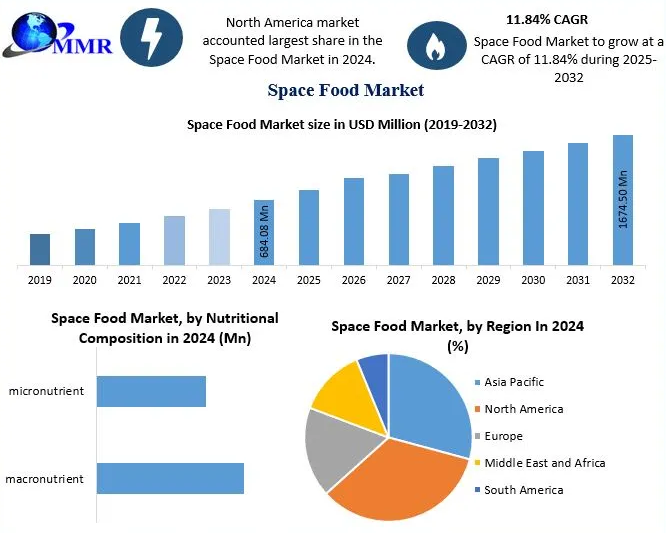
The Space Food Industry—covering the research, development, production, and supply of meals engineered for consumption by astronauts in microgravity—was valued at around USD 684 million in 2024. By 2032, it is projected to nearly double, reaching USD 1.674 billion, expanding at a Compound Annual Growth Rate (CAGR) of approximately 11.8 % . Products include freeze‑dried, dehydrated, irradiated, thermostabilized, and bioregenerative foods designed to meet the stringent nutritional, storage, and preparation needs of space environments.
Ask for Sample to Know US Tariff Impacts on Space Food Industry @ https://www.maximizemarketresearch.com/request-sample/215884/
Market Growth Drivers & Opportunities
- Extended duration missions (to the Moon, Mars, and beyond) are increasing demand for space foods that remain nutritious, lightweight, and palatable over long periods .
- Public–private R&D investment from agencies and space organizations—estimated in the tens of millions—is pushing advancements in packaging, personalized nutrition, and novel food production technologies.
- Commercial space tourism—led by private companies—requires high-quality food solutions tailored for civilian travelers, expanding the customer base .
- Integrated technology innovations, such as 3D-printed meals, hydroponics aboard spacecraft, and microbial or meat cell culture, present fresh opportunities to enhance food diversity, reduce weight, and improve sustainability .
Emerging Trends Shaping the Future
- 3D‑printed cuisine allows personalized, on-demand meals with minimal storage burden.
- Bioregenerative systems, featuring micro- or plant cultivation aboard spacecraft, offer in-situ fresh produce.
- Cultivated meat production is gaining traction—efforts have already been made in low-Earth orbit experiments, providing sustainable protein without traditional livestock supply chains.
- Eco-friendly packaging, including lightweight, recyclable, or edible materials, is reducing waste and payload mass.
- Precision nutrition—AI-enabled dietary tailoring—ensures astronauts receive balanced macronutrient/micronutrient profiles suited to their physiological needs during long missions.
Segmentation Analysis
The market can be broken down along four dimensions (all sourced from the report):
- By Food Type: Freeze‑dried, Dehydrated, Irradiated, Thermostabilized, Bioregenerative.
- By Packaging Method: Vacuum‑sealed, Modified atmosphere, Controlled temperature
- By Nutritional Focus: Macronutrient‑rich vs. Micronutrient‑focused
- By Region: North America, Europe, Asia‑Pacific, Middle East & Africa, South America
Explore the full report here: https://www.maximizemarketresearch.com/market-report/space-food-market/215884/
Country-Level Analysis
- USA: Leading market thanks to the presence of major institutions (FAA, NASA), aerospace contractors, and collaborations with food giants. The strategic focus on freeze-dried meals, nutritionally advanced foods, and packaging innovations supports robust market growth.
- Germany: As part of Europe’s push into space via ESA, Germany is growing its space-food R&D, particularly in freeze-dried and bioregenerative systems. Its advanced engineering ecosystem supports reliable cold-chain and packaging advancements.
Competitor Analysis
- Space agencies & aerospace firms: NASA, ESA, Roscosmos, SpaceX, Blue Origin, Boeing, Lockheed Martin and Northrop Grumman lead the foundational development of space-grade foods .
- Food manufacturers & specialty startups: Companies including Argotec, BeeHex, ISSpresso, Kraft Heinz, and Cargill are delivering nutritional and gourmet solutions. Emerging startups are pioneering 3D‑printing and cultivated‑food technologies.
Competitive Landscape:
NASA, the premier space agency of the United States, assumes a pioneering role within the space food market. Over several decades, NASA has cultivated an extensive portfolio of space food solutions, spanning from freeze-dried repasts to sophisticated nutrient-enhanced products. The agency's unwavering commitment to research, synergistic collaborations with food scientists, and a culture of innovation have established a definitive benchmark for space food technology. NASA's unceasing dedication to refining taste, nutritional profiles, and packaging has culminated in the formulation of nourishing meals impeccably tailored to address astronauts' requisites throughout protracted space missions.
Press Release Conclusion
With a trajectory boosting market size from USD 684 million in 2024 to USD 1.674 billion by 2032, at a CAGR around 11.8 %, the space food sector is experiencing dynamic growth. Key drivers include prolonged astronaut missions, commercial travel, and innovations in food production technologies like 3D printing and bioregenerative systems. The U.S. continues to lead, backed by strong aerospace infrastructure, while Germany and other European players accelerate contributions through ESA collaborations. For stakeholders—in aerospace, food tech, packaging, or R&D—the evolving space food market offers rich opportunities to support humanity’s next giant leaps, from low Earth orbit to deep-space exploration.
About Us
Maximize Market Research is one of the fastest-growing market research and business consulting firms serving clients globally. Our revenue impact and focused growth-driven research initiatives make us a proud partner of majority of the Fortune 500 companies. We have a diversified portfolio and serve a variety of industries such as IT & telecom, chemical, food & beverage, aerospace & defense, healthcare and others.
Contact Maximize Market Research
MAXIMIZE MARKET RESEARCH PVT. LTD.
2nd Floor, Navale IT park Phase 3,
Pune Banglore Highway, Narhe
Pune, Maharashtra 411041, India.
+91 9607365656