
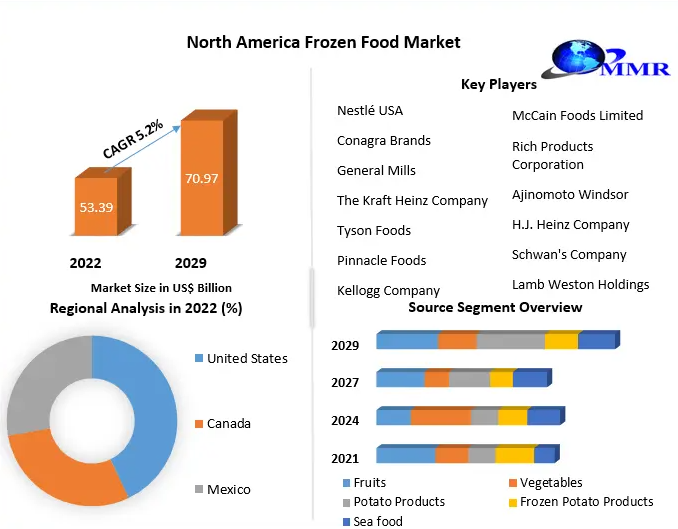
The North America Frozen Food Industry is on a robust growth trajectory, with new research estimating the market to reach USD 70.97 billion by 2029. From its valuation of USD 53.40 billion in 2022, the market is forecasted to grow at a steady 3.62% CAGR from 2023 to 2029. The study presents a comprehensive view of the industry, outlining growth drivers, market segmentation, country-specific trends, competitive insights, and future opportunities for industry players and investors.
Market Estimation & Definition
Frozen foods are defined as perishable food items preserved through advanced freezing techniques that maintain their nutritional, sensory, and textural qualities over extended storage periods. This category encompasses a diverse range of products, including fruits, vegetables, seafood, potato products, ready-to-eat meals, and beverages.
In 2022, the North American market stood at USD 53.40 billion, driven by a surge in consumer demand for convenient, quick-preparation foods without compromising on taste or nutrition. With steady investments in cold storage and logistical infrastructure, the sector is anticipated to achieve a valuation of USD 70.97 billion by 2029.
Gain Valuable Insights – Request Your Complimentary Sample Now @ https://www.maximizemarketresearch.com/request-sample/208032/
Report Scope and Methodology
This extensive market study spans historical data from 2018 to 2022 and provides forecasts from 2023 to 2029. Employing a bottom-up approach for market estimation, the report integrates quantitative data from financial statements, regulatory filings, and primary interviews with manufacturers, distributors, and retail stakeholders.
Analytical frameworks such as SWOT analysis, Porter’s Five Forces, and PESTLE analysis were utilized to assess market dynamics, competitor positioning, and macroeconomic influences. The report offers a detailed segmentation analysis and country-specific insights focused on the United States, Canada, and Mexico for North America.
Market Growth Drivers & Opportunity
Key Growth Drivers
- Cold-Chain Infrastructure Expansion: Ongoing investment in refrigerated storage and distribution facilities is significantly enhancing the efficiency and safety of frozen food supply chains.
- Demand for Convenient, Quick-Serve Options: With increasingly urbanized lifestyles and a rise in dual-income households, consumers are opting for ready-to-eat and ready-to-cook meals that save time without compromising nutritional value.
- Growth of Online Grocery & E-Commerce: Digital grocery platforms have transformed frozen food retail, allowing for home delivery and pick-up services while expanding product variety. This shift is accelerating frozen food consumption in both urban and suburban markets.
- Technological Innovation in Freezing & Packaging: Advances in individual quick freezing (IQF), blast freezing, and eco-friendly packaging solutions are improving product quality and reducing food wastage.
- Health & Wellness Trends: Rising consumer preference for organic, plant-based, gluten-free, and clean-label frozen food products is reshaping market offerings across North America.
Market Opportunities
- Product Innovation: There’s growing potential in developing premium frozen snacks, plant-based options, and ethnic meal solutions, reflecting evolving consumer tastes.
- Sustainable and Smart Packaging: Innovations in biodegradable, recyclable, and smart packaging can enhance product shelf life and brand differentiation.
- Expansion of Cold Storage Networks: Opportunities exist for extending cold-chain logistics to underserved rural and remote areas through third-party and shared distribution models.
- Multicultural & Ethnic Cuisine Segments: With increasing cultural diversity, demand for global and ethnic frozen foods is rising steadily, especially in metropolitan markets.
Segmentation Analysis
The market is segmented based on offering, end-user, product category, and freezing technique.
- By Offering
- Fruits & Vegetables
- Potato Products
- Seafood
- Others
- By End-User
- Food Service (Hotels, Restaurants, Catering)
- Retail Customers
- By Product Category
- Ready-to-Eat
- Ready-to-Cook
- Ready-to-Drink
- Others
- By Freezing Technique
- Individual Quick Freezing (IQF)
- Blast Freezing
- Belt Freezing
- Other Techniques
Feel free to request a complimentary sample copy or view a summary of the report: https://www.maximizemarketresearch.com/request-sample/208032/
Key Segment Trends:
- Ready-to-Eat Meals remain the highest contributing category due to increasing demand for time-saving food options.
- Frozen Fruits & Vegetables are witnessing the fastest growth, driven by heightened health awareness and home cooking trends.
- E-commerce Distribution Channels are experiencing strong growth momentum, with online grocery purchases expanding rapidly across North America.
Country-Level Analysis
United States
The United States holds the largest market share within the North American frozen food industry, accounting for approximately 84.5% of total sales. This dominance is attributed to:
- High consumer acceptance of convenient food formats.
- Extensive cold-storage infrastructure and advanced distribution systems.
- Strong presence of leading frozen food brands.
- Rapid expansion of online grocery shopping and home delivery services.
- Increasing demand for plant-based, gluten-free, and organic frozen food products.
Germany
Though primarily a North American market report, Germany offers valuable comparative insight. Similar trends are evident in the German market, including:
- A growing preference for organic and health-oriented frozen meals.
- Rising demand for ethnic and convenience frozen foods.
- Significant e-commerce and digital grocery penetration.
- Investment in sustainable, energy-efficient cold-chain systems.
Leading Market Players Include:
1. Nestlé USA - Arlington, Virginia, United States
2. Conagra Brands - Chicago, Illinois, United States
3. General Mills - Minneapolis, Minnesota, United States
4. The Kraft Heinz Company - Chicago, Illinois, United States
5. Tyson Foods - Springdale, Arkansas, United States
6. Pinnacle Foods - Parsippany, New Jersey, United States
7. Kellogg Company - Battle Creek, Michigan, United States
8. JBS USA Holdings - Greeley, Colorado, United States
9. McCain Foods Limited - Florenceville-Bristol, New Brunswick, Canada
10. Rich Products Corporation - Buffalo, New York, United States
11. Ajinomoto Windsor - Ontario, California, United States
12. H.J. Heinz Company - Pittsburgh, Pennsylvania, United States
13. Schwan's Company - Bloomington, Minnesota, United States
14. Lamb Weston Holdings - Eagle, Idaho, United States
15. Nomad Foods - Feltham, England, United Kingdom
Press Release Conclusion
As the North America Frozen Food Market advances toward a projected USD 70.97 billion by 2029, opportunities abound for manufacturers, distributors, and investors. Key success factors include capitalizing on the rising demand for convenience-driven, health-conscious frozen products, leveraging cold-chain infrastructure investments, and embracing digital grocery retail trends.
Explore More Reports
Global Mineral Salt Ingredients Market https://www.maximizemarketresearch.com/market-report/global-mineral-salt-ingredients-market/104283/
Fresh Compressed Yeast Market https://www.maximizemarketresearch.com/market-report/fresh-compressed-yeast-market/147114/
Global Bone Broth Protein Market https://www.maximizemarketresearch.com/market-report/global-bone-broth-protein-market/93767/
About Us
Maximize Market Research is one of the fastest-growing market research and business consulting firms serving clients globally. Our revenue impact and focused growth-driven research initiatives make us a proud partner of majority of the Fortune 500 companies. We have a diversified portfolio and serve a variety of industries such as IT & telecom, chemical, food & beverage, aerospace & defense, healthcare and others.
Contact Maximize Market Research
MAXIMIZE MARKET RESEARCH PVT. LTD.
2nd Floor, Navale IT park Phase 3,
Pune Banglore Highway, Narhe
Pune, Maharashtra 411041, India.
+91 9607365656