
Introduction: Why Agile Matters in Modern Software Development
In today’s fast-paced digital economy, software development is no longer just about writing code it’s about delivering value quickly, adapting to change, and meeting evolving customer needs. Traditional development models often fail to keep up with rapid market demands, leading to delayed releases and dissatisfied stakeholders.
This is where Agile methodology in software development has become a game changer. Agile promotes flexibility, collaboration, transparency, and continuous improvement qualities essential for building successful software products today.
Among various Agile frameworks, Agile Scrum stands out as the most widely adopted and industry-recognized approach. Organizations across domains from IT and healthcare to finance and e-commerce are actively hiring professionals skilled in Scrum roles such as Scrum Master, Scrum Project Manager, and Agile Product Owners.
At H2K Infosys, we specialize in job-oriented Agile and Scrum training, combining real-world projects, live instructor-led sessions, and career support to help working professionals transition into high-demand Agile roles.
What Is Agile Methodology?
Agile methodology is an iterative and incremental approach to software development that emphasizes:
- Customer collaboration over contract negotiation
- Responding to change over following a fixed plan
- Working software over comprehensive documentation
- Individuals and interactions over processes and tools
Agile is guided by the Agile Manifesto, created in 2001 by a group of software practitioners who wanted a better way to build software. Instead of rigid phases, Agile encourages frequent feedback, adaptability, and continuous delivery of value.
Core Principles of Agile
Agile is built on 12 principles, including:
- Early and continuous delivery of valuable software
- Welcoming changing requirements, even late in development
- Delivering working software frequently
- Close collaboration between business and technical teams
- Sustainable development pace
- Continuous attention to technical excellence
These principles form the foundation of Agile Scrum methodology.
Agile Frameworks: Where Scrum Fits In
Agile is an umbrella term that includes multiple frameworks and methodologies such as:
- Scrum
- Kanban
- Extreme Programming (XP)
- Lean Software Development
- SAFe (Scaled Agile Framework)
Among these, Scrum is the most popular and widely implemented framework, especially for complex product development.
Understanding Agile Scrum Methodology
What Is Scrum?
Scrum is a lightweight, iterative Agile framework designed to help teams deliver value in short cycles called Sprints (usually 2–4 weeks). It focuses on accountability, transparency, inspection, and adaptation.
The Agile Scrum methodology is not a rigid process but a framework that teams tailor to their organizational needs while maintaining its core principles.
Key Components of Scrum
Scrum consists of three main pillars:
- Roles
- Events
- Artifacts
Scrum Roles Explained
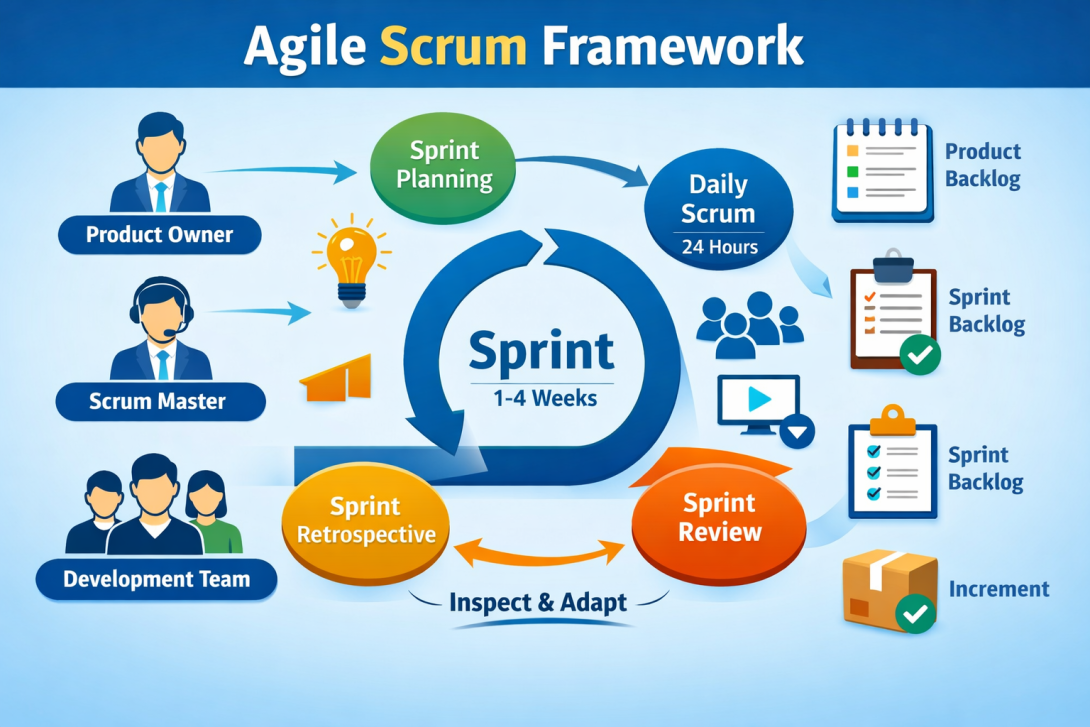
1. Product Owner
The Product Owner represents the customer and business stakeholders. Responsibilities include:
- Managing and prioritizing the Product Backlog
- Defining product vision and goals
- Ensuring maximum value delivery
2. Scrum Master
The Scrum Master is a servant leader who ensures Scrum principles are properly followed.
Key responsibilities:
- Facilitating Scrum ceremonies
- Removing impediments
- Coaching the team on Agile practices
- Supporting organizational Agile adoption
This role is one of the most in-demand positions, and many professionals enroll in scrum master training and placement programs to transition into this career.
3. Development Team
A cross-functional, self-organizing team responsible for delivering potentially shippable increments of the product at the end of each Sprint.
Scrum Events (Ceremonies)
Sprint
A fixed-length iteration during which a usable product increment is created.
Sprint Planning
Defines what can be delivered in the Sprint and how the work will be achieved.
Daily Scrum
A 15-minute stand-up meeting where the team synchronizes progress.
Sprint Review
Stakeholders review the increment and provide feedback.
Sprint Retrospective
The team reflects on what went well and what can be improved.
Scrum Artifacts
- Product Backlog – Ordered list of requirements
- Sprint Backlog – Selected items for the current Sprint
- Increment – The sum of all completed backlog items
These artifacts promote transparency and shared understanding.
Benefits of Agile Scrum Methodology
Organizations adopt Agile Scrum for several compelling reasons:
- Faster time to market
- Improved product quality
- Enhanced stakeholder satisfaction
- Better risk management
- Increased team productivity
- Continuous improvement
These benefits have driven massive demand for professionals with agile scrum methodology certification and real-world Scrum experience.
Agile vs Traditional Waterfall Model
Aspect Agile Scrum Waterfall
Flexibility High Low
Customer Feedback Continuous End of project
Delivery Incremental One-time
Risk Lower Higher
Adaptability Excellent Limited
Agile Scrum’s adaptability makes it ideal for today’s uncertain and fast-changing environments.
Career Opportunities in Agile Scrum
With Agile becoming the standard across industries, career opportunities are expanding rapidly.
Popular Scrum Roles:
- Scrum Master
- Scrum Project Manager
- Agile Coach
- Product Owner
- Business Analyst (Agile)
Many professionals from QA, development, project management, and business backgrounds transition into Scrum roles through agile training classes.
Scrum Project Manager vs Scrum Master
While traditional project management differs from Scrum, many organizations still use the term scrum project manager to describe professionals managing Agile projects using Scrum principles.
Key differences:
- Scrum Masters focus on process and team facilitation
- Scrum Project Managers may handle budgeting, reporting, and stakeholder communication
Both roles benefit greatly from structured Agile and Scrum training.
Importance of Agile and Scrum Certification
Certifications validate your knowledge and significantly improve employability.
Popular certifications include:
- Certified ScrumMaster (CSM)
- Professional Scrum Master (PSM)
- PMI-ACP
- SAFe Agilist
A recognized certification scrum agile credential demonstrates your ability to apply Agile concepts in real-world scenarios.
Why Choose Agile and Scrum Training at H2K Infosys?
At H2K Infosys, we go beyond theory. Our agile and scrum training is designed for working professionals who want practical, job-ready skills.
What Sets H2K Infosys Apart?
- Live Instructor-Led Agile Training Classes
- Real-time Scrum project simulations
- Hands-on tools like JIRA and Confluence
- Interview preparation and resume workshops
- One-on-one career mentoring
- Dedicated scrum master training and placement support
Our instructors are industry practitioners who bring real-world Agile challenges into the classroom.
Hands-On Learning with Real Scrum Projects
Our Agile Scrum course includes:
- Sprint planning exercises
- Backlog grooming sessions
- Realistic user story creation
- Daily Scrum facilitation practice
- Sprint review and retrospective simulations
This hands-on exposure helps learners confidently handle Scrum roles in real organizations.
Who Should Enroll in Agile Scrum Training?
This course is ideal for:
- Software Developers
- QA/Test Engineers
- Business Analysts
- Project Managers
- Product Managers
- IT Professionals seeking leadership roles
No prior Agile experience is required our structured learning path supports beginners and experienced professionals alike.
Agile Scrum in the Real World
Agile Scrum is used by top companies such as:
- Google
- Amazon
- Microsoft
- IBM
- Accenture
- Infosys
Organizations are actively hiring certified professionals with practical Agile knowledge, making agile scrum methodology certification a smart career investment.
One Suitable Visual Representation of Agile Scrum
Future of Agile and Scrum Careers
As digital transformation accelerates, Agile skills will continue to dominate job requirements. Hybrid models like Scaled Agile (SAFe) and enterprise Scrum are expanding opportunities for certified professionals.
Upskilling through agile training classes ensures long-term career growth, adaptability, and leadership potential.
Conclusion
Agile methodology in software development is no longer optional it’s essential. The Agile Scrum methodology provides a proven framework for delivering high-quality software, improving collaboration, and driving business success.
For professionals aiming to transition into leadership roles, enhance employability, or stay relevant in a competitive IT market, enrolling in structured agile and scrum training with a recognized certification scrum agile pathway is a strategic move.
At H2K Infosys, we are committed to empowering professionals through practical learning, expert guidance, and career-focused outcomes.
Ready to Start Your Agile Scrum Journey?
Explore H2K Infosys’ Agile Scrum training program today and take the next step toward becoming a successful Scrum Master or Agile professional.