

For developers building in the travel and aviation space, the combination of an airline API, an airport API, and real-time flight data is the foundation of virtually every meaningful product feature. Yet many development teams approach these integrations in isolation, treating each data source as a separate concern rather than as interconnected pieces of a larger system. This article explores how to think holistically about your aviation data integrations covering airline ticket APIs, air ticket APIs, and airport data and how to extract maximum value from each layer.
What Is an Airline API and Why Does It Matter?
An airline API is a programmatic interface that exposes data about airline carriers — including their names, IATA and ICAO codes, logos, active routes, and sometimes contact information. For developers building travel applications, having access to reliable airline API data means you can display properly branded carrier information in your UI, power search filters by airline, and cross-reference flight data with carrier-specific details. This creates a more coherent, professional user experience that builds trust with your audience. It is a small integration with a disproportionate impact on product quality.
Understanding the Airport API
Alongside the airline API, the airport API is an equally important data layer for travel applications. An airport API provides detailed information about airports around the world, including their full names, city and country, geographic coordinates, timezone, elevation, and the IATA and ICAO codes that uniquely identify each facility. This data powers location-based features — like showing the nearest airport on a map, converting user-entered city names into airport codes, or displaying timezone-aware departure and arrival times. Without a solid airport API, these features require fragile hardcoded lookups that are difficult to maintain.
How the Air Ticket API Fits Into Travel Platforms
The air ticket API occupies a distinct but complementary space to flight status and tracking APIs. While a flight API tells you what is currently happening with a given flight, an air ticket API or airline ticket API is concerned with the commercial availability and pricing of seats on future flights. For developers building fare comparison tools, travel booking platforms, or corporate travel management systems, the air ticket API is the backbone of the user's ability to search and select routes. Integration with this layer typically requires a relationship with a GDS provider or a travel aggregator that exposes ticketing inventory.
Combining Airline and Airport APIs for Richer Experiences
The real magic happens when you combine your airline API and airport API data with real-time flight information. Imagine a flight status page that not only shows whether a flight is delayed, but also displays the airline's logo, the departure terminal with a link to the airport map, the local time at both origin and destination (drawn from the airport API's timezone data), and a weather summary for the arrival city. Each of these enrichments requires data from a different API layer, but when woven together correctly they create an experience that feels genuinely useful rather than like a raw data dump.
Airline Ticket API Architecture Considerations
Building on an airline ticket API introduces architectural considerations that differ from purely informational APIs. Because ticketing involves transactional data — pricing that changes in real time, seat availability that can vanish in seconds, and booking flows that require session management — your integration needs to be more robust. You need to handle session tokens, manage shopping cart state, and implement tight error handling for cases where a fare changes between the time a user selects it and the time they try to book. Using a backend-for-frontend (BFF) pattern, where a dedicated server mediates between your UI and the airline ticket API, is a common and sensible approach.
Data Consistency Across Airline and Airport APIs
One practical challenge when working with multiple aviation APIs simultaneously — airline API, airport API, and flight status API — is maintaining data consistency. Different providers may use slightly different naming conventions, code formats, or data structures for the same entities. For example, one API might return airline names in title case, while another returns them in uppercase. Establishing a normalization layer in your backend that maps all incoming data to a consistent internal schema is the cleanest way to handle this. This abstraction layer also makes it much easier to swap out a data provider later without cascading changes throughout your application.
Using Aviationstack for Unified Aviation Data
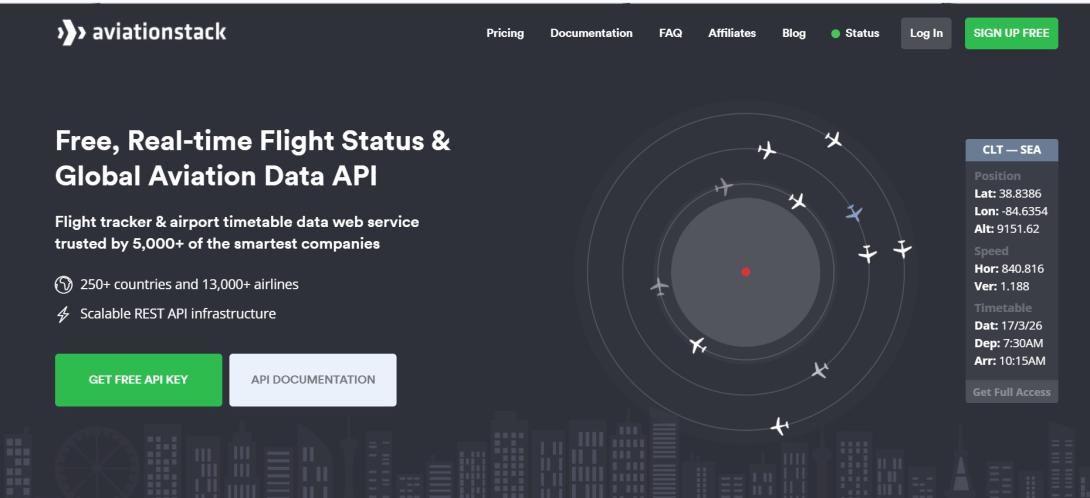
Rather than integrating separate providers for your airline API, airport API, and flight tracking needs, many developers choose a unified aviation data platform that covers all these use cases through a single API key and a consistent interface. Aviationstack is one such platform, offering endpoints for real-time flights, schedules, airports, airlines, and aircraft in a unified, well-documented REST API. This approach simplifies your integration architecture significantly, reduces the number of vendor relationships you need to manage, and ensures that all your aviation data fields are consistent and cross-referenced correctly from a single source of truth.
Building a Better User Experience With Aviation Data
Ultimately, the goal of integrating an airline API, airport API, air ticket API, and airline ticket API is not the integration itself — it is the user experience those integrations enable. Travelers are increasingly sophisticated in their expectations. They want to see real airline branding, not generic placeholders. They expect timezone-correct times without doing the math themselves. They demand instant alerts when their flight status changes. And they expect booking flows that are fast, reliable, and transparent. Each API layer you integrate correctly is another dimension of user trust you earn. Focus on the end user's needs, and let that guide your technical decisions.
Conclusion
The combination of airline API, airport API, air ticket API, and airline ticket API integrations forms the complete data backbone of any serious travel or aviation application. While each layer serves a distinct purpose, their real value is unlocked when they work together cohesively within a well-architected system. As you build or refine your aviation data integrations, think holistically — design for consistency, plan for scalability, and always keep the user experience at the center of your decisions. The developer who masters this integration stack is well positioned to build products that travelers genuinely love and return to.
Frequently Asked Questions
1. What is the difference between an airline API and an airline ticket API?
An airline API provides data about carriers — names, codes, logos, and routes. An airline ticket API provides commercial booking data — seat availability, pricing, and fare rules for future flights. They serve different but complementary purposes in a travel application.
2. Can I get airport timezone data from an airport API?
Yes. Most airport APIs include timezone identifiers (typically in IANA format) for each airport, which you can use to display departure and arrival times in the correct local time for users.
3. How do I handle price changes between a user selecting a fare and completing a booking?
Implement a fare verification step that re-queries the airline ticket API immediately before the user reaches the payment screen. If the price has changed, display the updated fare and prompt the user to confirm before proceeding.
4. Do aviation data APIs support multiple languages?
Some providers offer localized data fields for airport and city names, but most core aviation data (IATA codes, flight numbers, statuses) is standardized in English. Check your provider's documentation for internationalization support.
5. Is it better to use a single unified aviation API or multiple specialized providers?
A unified provider like Aviationstack simplifies integration, reduces vendor management overhead, and ensures data consistency. Specialized providers may offer deeper coverage in specific niches, but the added complexity of multiple integrations often outweighs the benefits for most use cases.