

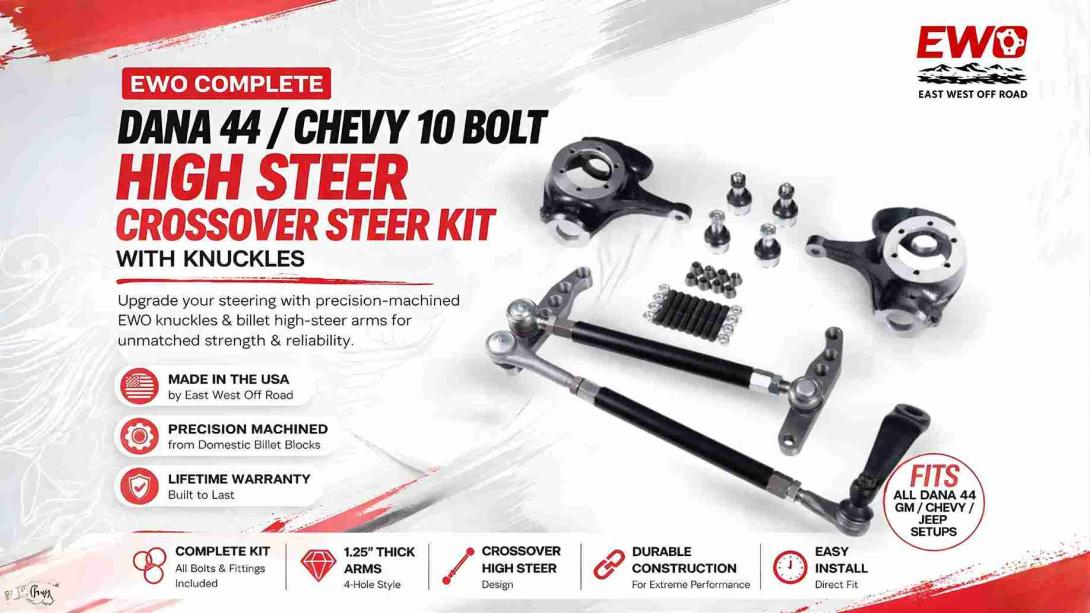
If you own a lifted classic GM truck, Blazer, or Suburban, you are likely all too familiar with the terrifying sensation of steering feedback over highway bumps. Installing a premium Chevy 10 Bolt Crossover Steering Kit is the single most effective chassis upgrade you can perform to fix these geometry flaws. Factory push-pull steering configurations were never engineered to accommodate modern suspension lifts, larger off-road tires, or aggressive trail obstacles. When you lift a solid-axle GM truck, the drag link angle becomes steeply inclined, severely compromising your handling predictability and creating a hazardous driving experience on and off the pavement.
By upgrading to an EWO complete Dana 44 high steer kit, you fundamentally transform your front axle configuration. This comprehensive upgrade converts your outdated stock steering linkage into a true cross-axle system, routing the primary drag link from a driver-side pitman arm over to the passenger-side steering knuckle. In this definitive engineering guide, we will break down the structural physics behind crossover conversions, explore the secondary benefits of integrating high-steer arms, and outline exactly how to execute this heavy-duty upgrade on your rig.
The Physics of Handling: Why Factory Push-Pull Steering Fails
To appreciate the value of a high-performance steering conversion, you must first understand the severe mechanical limitations of the stock General Motors layout. From the factory, K10, K20, and K5 Blazer models utilize a push-pull steering gear design. In this configuration, the steering box output shaft rotates a pitman arm forward and backward along the vehicle's frame rail. This mechanical motion transfers force via a short drag link connected directly to the driver-side steering knuckle arm.
While this layout functions adequately at stock ride height, introducing a suspension lift forces the short drag link into a steep, non-horizontal operational angle. This spatial misalignment triggers a series of handling abnormalities:
- Involuntary Steering Inputs: As the front leaf springs compress and rebound, the axle naturally moves vertically. Because the drag link operates at a steep angle, it pulls or pushes on the steering knuckle during suspension travel, forcing the wheels to turn independently of your steering wheel input.
- Reduced Steering Radius: The steep angular bind restricts full mechanical throw, meaning your turning radius becomes severely limited in one direction compared to the other.
- Component Fatigue: Extreme angles put massive leverage and stress on your steering box sector shaft, frame rails, and tie rod ends, accelerating component failure.
Fix Bump Steer Lifted Chevy K5: The Crossover Solution
The only engineering-approved solution to permanently Fix Bump Steer Lifted Chevy K5 platforms, Suburbans, or square body pickups is to change the direction of structural forces. A crossover steering setup discards the push-pull mechanics completely. Instead, the steering box forces the pitman arm to move laterally (left-to-right) across the chassis. The new, significantly longer drag link spans across the entire front axle housing to attach to the passenger-side wheel assembly.
Because the new drag link is much longer, its operational arc is vastly wider and flatter. The mathematical change in angular deflection can be represented by analyzing the vertical displacement vectors. When the drag link approaches a flat horizontal plane, the horizontal displacement error ($\Delta x$) relative to suspension vertical travel ($\Delta y$) is minimized according to the geometric relationship:
$$\Delta x = L \cdot (1 - \cos(\theta))$$
Where $L$ is the length of the drag link and $\theta$ is the operational angle relative to the horizontal axle plane. By maximizing $L$ and keeping $\theta$ close to zero, your unwanted steering inputs drop to virtually nothing, delivering true modern tracking and precise feedback.
The High Steer Advantage: Maximizing Trail Clearance
While standard crossover steering resolves your geometry issues, hard-core off-roaders demand something more robust. A Square Body Chevy High Steer Upgrade takes this conversion a step further by relocating both the drag link and the tie rod to the top side of the steering knuckles. In a stock setup, the tie rod hangs low beneath the axle centerline, acting as a magnet for boulders, tree stumps, and trail debris.
By incorporating a Bolt-On High Steer Kit GM 10 Bolt system, your vital tie rod links are elevated by several inches. This provides unmatched protection against structural damage during technical rock crawling. Furthermore, high steer configurations place your critical links in a highly protected zone directly behind or above the axle tube housing, ensuring you never get stranded on the trail with a bent, unserviceable tie rod.
Anatomy of a Professional Grade Heavy Duty Steering Kit
When selecting a steering upgrade, materials engineering is paramount. Off-road steering components face extreme torsional stresses when pushing large 35-inch to 40-inch tires through mud, ruts, or technical rock gardens. A premium kit must be built from robust, unyielding materials to handle these extreme demands.
USA Made Dana 44 Steering Arms
The core structural backbone of any high steer conversion lies within the secondary steering arms. Premium kits feature USA Made Dana 44 Steering Arms CNC-machined from solid blocks of domestic billet steel. These arms boast a whopping 1.25-inch thickness and utilize a rugged 4-hole mounting pattern. Unlike cheap imported cast components that can fracture under sudden shock loads, heavy-duty domestic billet steering arms carry a lifetime warranty against breakage, giving you ultimate peace of mind on remote expeditions.
Heavy Duty Tubing and Machined Components
Linkage wall thickness dictates whether your steering setup flexes or remains rigid under load. High-quality systems leverage thick-wall 1.50 x .250 DOM tubing steering kit links. Cold-drawn over a mandrel (DOM) steel tubing delivers superior structural uniformity, higher tensile strength, and excellent resistance to bending impacts compared to standard welded pipe. These heavy-wall DOM tubes are paired with precision-machined 7/8-18 left and right-hand weld bungs, matching jam nuts, and heavy-duty 3/4-ton truck taper steering links.
Component Specification & Bill of Materials
Component Name
Technical Specifications / Sizing
Material / Manufacturing Origin
High Steer Arms
1.25" Thick, 4-Hole Mounting, Tapered Holes
Domestic Billet Steel / CNC Machined USA
Drag Link End (Right)
ES2026R Grea sable Castle Nut Tie Rod End
Forged Alloy Steel / Metal-on-Metal Spec
Drag Link End (Left)
ES2027L Grea sable Castle Nut Tie Rod End
Forged Alloy Steel / Metal-on-Metal Spec
Tie Rod Ends
ES2234L & ES2234R Heavy Duty 3/4-Ton Taper
Internal Spring Tech / Metal-on-Metal
Linkage Tubing
1.50" OD x 0.250" Wall Thickness DOM Steel
Cold-Drawn Over Mandrel / Seamless USA
Pitman Arm
3" Dropped Drop Forged, 32-Spline Indexable
High-Tensile Forged Steel
Knuckle Hardware
9/16" High-Strength Studs, Conical Washers
Grade 8 Equivalent Hardened Steel
Dana 44 vs 10 Bolt Crossover Steering: Interchangeability Explained
A common point of confusion among classic GM truck enthusiasts is the technical distinction between a Corporate 10-Bolt front axle and an open-knuckle Dana 44 front axle. When it comes to planning a Dana 44 vs 10 Bolt Crossover Steering conversion, the good news is that these two front axles share identical architecture from the inner knuckles outward. The spindle bolt patterns, wheel bearing configurations, brake calipers, and steering knuckles are completely interchangeable.
Because of this shared heritage, a single engineered Complete Dana 44 Crossover Steering System integrates flawlessly with both GM 10-Bolt and Dana 44 axle housings. However, factory assemblies present a major obstacle: stock driver and passenger side knuckles do not feature a flat top surface or the necessary mounting holes to accept aftermarket high steer arms. Resolving this issue requires transitioning to specialized, heavy-duty replacement hardware.
The Flat Top Knuckle Conversion: Essential Axle Modification
To safely mount heavy-duty 1.25 inch billet high steer arms, your front axle must feature passenger and driver side knuckles with precision-machined top surfaces. A complete Chevy 10 bolt high steer with knuckles kit simplifies this entire engineering process by providing premium, pre-machined Dana 44 driver passenger flat top knuckles.
These upgraded knuckles undergo meticulous internal machining to provide a perfectly level mounting deck, which is then drilled and tapped to accept high-strength 9/16" tapered studs, locking conical washers, and torque nuts. To ensure maximum chassis durability, these replacement knuckles are bundled with a fresh, heavy-duty Dana 44 upper lower ball joints kit. Replacing your aging, high-mileage ball joints with premium metal-on-metal spring-loaded assemblies ensures your refreshed front end remains tight, responsive, and completely free of unwanted shimmy or rotational play under extreme trail use. This architecture can also be used as a rugged Jeep Dana 44 high steer upgrade for high-pinion custom conversions.
Step-by-Step Installation & Practical Integration Notes
Upgrading to a high-clearance hd crossover steering kit requires careful mechanical planning. Before turning a single wrench, review these critical fabrication and integration requirements to ensure a smooth, professional installation.
1. The 2WD Steering Box Requirement
The single most important technical prerequisite for this conversion is upgrading your steering sector box. You must swap out your stock 4WD steering gear for a 2wd steering box crossover setup. The stock 4WD steering box sector shaft rotates forward and backward (ideal for push-pull systems). Conversely, a 2WD steering box rotates side-to-side, which is mandatory to push and pull the new cross-axle drag link assembly across your vehicle's frame track.
2. Installing the Dropped Pitman Arm
To keep your steering linkage operating on an optimal, flat horizontal plane, your conversion kit includes a rugged 3 inch dropped pitman arm 32 spline configuration. This drop-forged component features a fully indexable master spline layout, allowing you to fine-tune your center point position regardless of your truck's specific ride height or lift brand. Securely mount the pitman arm to the 2WD steering box output shaft and torque it down to factory engineering specifications.
3. Prepping and Mounting the Flat Top Knuckles
Begin by safely elevating your front axle on heavy-duty jack stands. Remove the wheels, brake calipers, rotors, spindles, and outer axle shafts. Disconnect your worn factory tie rod linkages and use a heavy-duty ball joint press to remove the old knuckle units. Install your fresh, premium Dana 44 upper lower ball joints kit into the axle C-extensions, seat the new flat top driver and passenger knuckles, and torque the lower and upper ball joint nuts to spec. Reinstall your outer spindle components and braking hardware.
4. Tor quing the Billet High Steer Arms
Clean the machined mating decks on top of your new knuckles. Thread the high-strength 9/16" studs deep into the pre-tapped holes until they bottom out securely. Slip your 1.25-inch thick billet steering arms over the studs, drop in the precision split conical washers, and thread on the heavy-duty lock nuts. Tighten these nuts in a progressive cross-pattern, setting final torque values to ensure a rock-solid mechanical bond that won't loosen under high torsional loads. Note that these setups are engineered with a clean K10 crossover steering kit no reaming design when utilizing our matched knuckles.
5. Mocking, Welding, and Centering Your Links
Your comprehensive kit arrives with oversized lengths of raw, ultra-strong DOM steel tubing. This provides ample material to build custom-length links tailored exactly to your truck's track width and suspension height. Measure, cut, and chamfer the 54-inch and 43-inch DOM tubes to fit your axle span perfectly. Tack-weld the heavy-duty 7/8-18 left and right-hand threaded tube adapters into place. Thread your premium ES2026R ES2027L drag link ends and ES2234L ES2234R tie rod ends into the linkages, adjusting the overall lengths until your front tires achieve a perfect zero-toe alignment and your steering wheel sits perfectly straight.
⚠️
Important Mechanical Safety Warning: Final welding of the 7/8-18 threaded tube adapters/bungs to the DOM steel steering links must be executed by a certified professional welder using structural-grade MIG or TIG processes. Structural integrity here is critical, as a failure of a steering link at speed can result in a catastrophic loss of control.
California Proposition 65 Warning: This high-performance kit may expose users to trace chemical materials, including lead, known to the State of California to cause cancer, birth defects, or other reproductive harm. Wash hands thoroughly after handling uninstalled or unpainted metal parts.
Why the East West Off Road System Stands Out
When you choose an East West Off Road steering kit, you are investing in premium, field-tested trail engineering. Every element of the system is optimized for extreme off-road abuse and reliable daily driving. From the heavy-duty spring-loaded internal seat technology embedded within our premium tie rod ends to our ultra-thick domestic billet steering arms, we manufacture components that consistently outlast the competition.
Whether you are tackling challenging trail sections, navigating an overlanding route, or building a dedicated custom rock crawler, our complete crossover and high steer conversion ensures your truck responds accurately to every driver input. Eliminate dangerous bump steer, secure vital trail clearance, and upgrade your square body GM truck with the ultimate steering system today.
Frequently Asked Questions (FAQs)
Can I use my factory 4WD steering box with this crossover steering kit?
No, you cannot use your stock 4WD steering box. A factory 4WD box moves its pitman arm front-to-back, which cannot actuate a cross-axle drag link. You must swap in a 2WD steering box, which rotates side-to-side to provide the necessary lateral movement across the chassis frame rails.
What is the difference between a standard crossover steering kit and a high steer kit?
A standard crossover kit moves the drag link over to the passenger side knuckle to fix steering angles but leaves your tie rod in its low-hanging factory position. A high steer upgrade relocates both the cross-axle drag link and the main tie rod link to the top of the knuckles using thick billet arms, maximizing trail clearance and protecting your linkages from impacts.
Will this kit fit an un lifted, stock-height Chevy 4x4 truck?
Crossover steering configurations require a minimum of 3 inches to 4 inches of suspension lift clearance. On a stock-height truck, the new high-clearance drag link and heavy-duty billet steering arms will physically interfere with the engine oil pan and engine crossmember during normal front suspension compression.
Do I need to ream my factory steering knuckles to install this kit?
No reaming is necessary when purchasing our full system. The comprehensive kit includes premium replacement flat top knuckles that are pre-machined, drilled, and tapped right out of the box. This provides a true bolt-on upgrade that completely bypasses the tedious fabrication work of modifying cast factory parts.
What tires can I safely run with 1.50" x .250" DOM steering links?
Our heavy-wall 1.50" x .250" DOM steel tubing is exceptionally rigid. It is specifically engineered to control large, heavy off-road tire sizes ranging from 35 inches up to 44 inches in extreme rock crawling, mud bogging, or deep trail riding environments without experiencing structural deflection or bending.