

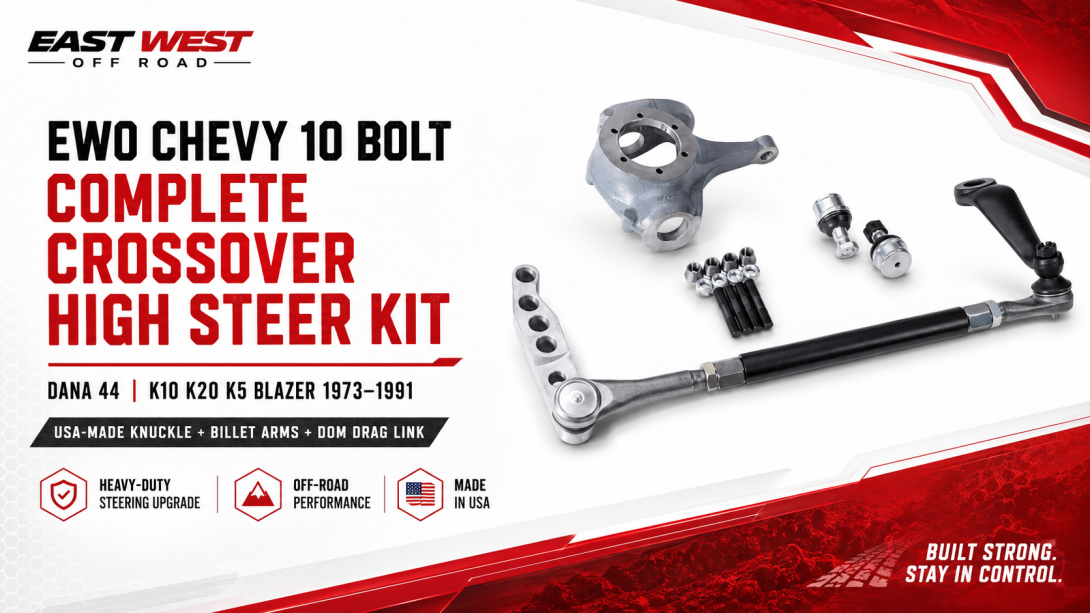
Buy Now: https://www.eastwestoffroad.com/product/ewo-chevy-10-bolt-complete-crossover-high-steer-kit
The phrase Dana 44 1-ton crossover high steer kit is commonly used by buyers searching for heavier-duty steering components for a lifted solid-axle vehicle. However, “1-ton” can be used loosely in the aftermarket, and it should not be treated as proof that every component in a kit has a published or certified one-ton load rating.
A more useful comparison focuses on component design, steering path, drag-link geometry, knuckle configuration, fabrication, and vehicle use.
Factory steering can perform reliably on an unmodified truck with healthy components and correct alignment. A crossover high-steer configuration becomes relevant when suspension lifts, axle swaps, larger tires, or technical terrain move the vehicle outside that factory design envelope.
Factory Steering Was Engineered as a Complete System
The original steering arrangement on a K5 Blazer, K10, K20, or similar vehicle was developed around:
- Factory ride height
- Factory axle position
- Original pitman-arm travel
- Stock tire size
- Original steering-knuckle design
- Factory suspension travel
- Production alignment settings
- Intended street and work use
When those conditions remain close to stock, the original system may provide predictable service.
Problems often begin when modifications change only part of the system. A lift may raise the frame and steering box while the axle remains lower. Larger tires increase leverage. Softer springs increase articulation. Axle swaps may introduce different knuckles, widths, or steering connections.
A heavy-duty crossover system is not inherently better in every application. It is better suited to a build when its geometry and components are matched to the modified vehicle.
How a Dana 44 1-Ton Crossover High Steer Kit Changes the Steering Path
A crossover arrangement uses a compatible steering box to move a drag link laterally across the vehicle to a passenger-side steering arm.
In a high-steer layout, the connection sits above the knuckle rather than remaining in a lower factory position.
This changes several things:
- The direction in which steering force reaches the knuckle
- The height of the drag-link connection
- The relationship between drag-link movement and axle travel
- The available clearance beneath the steering linkage
- The steering-box and pitman-arm requirements
- The fabrication required to establish the correct link length
The objective is not simply to place the drag link as high as possible. It is to create a path that clears surrounding parts and operates properly throughout steering and suspension movement.
Component Comparison
Component
Typical factory configuration
EWO crossover high-steer configuration
Steering box
Factory 4WD box
Compatible 2WD Saginaw-style box
Knuckle
Original production knuckle
USA-made EWO knuckle
Steering arm
Factory steering connection
1.25-inch billet high-steer arm
Drag link
Factory-diameter formed linkage
43-inch heavy-duty D.O.M. tube
Steering ends
Factory application components
ES2026R and ES2027L ends
Ball joints
Existing or replacement factory-style parts
Included metal-on-metal upper and lower joints
Pitman arm
Original 4WD steering arm
Fully indexable 3-inch drop-forged arm
Taper orientation
Fixed by original component
Bottom-up with insert for alternative orientation
Assembly
Production system
Build-specific measuring and fabrication
This comparison does not establish a certified load capacity. It explains the physical differences between the systems.
Knuckle and High-Steer Arm Design
The EWO system uses a USA-made steering knuckle and a passenger-side billet high-steer arm.
The arm is:
- 1.25 inches thick
- Machined in-house
- Made from domestic billet material
- Mounted with four Dana 9/16-inch studs
- Secured with conical washers and lock nuts
A high-steer arm places the drag-link connection above the knuckle. That can help protect the linkage from lower obstacles and create a more favorable drag-link location.
The mounting system must resist movement between the knuckle and arm. Conical washers help seat into the matching arm interface, while the studs and lock nuts provide clamping force.
Installation quality is critical. Dirty mating surfaces, damaged tapers, loose studs, improper seating, or inadequate inspection can allow movement under steering load.
Factory Linkage vs. Heavy-Duty D.O.M. Tubing
Factory drag links are designed for the original vehicle’s steering geometry and tire load.
The EWO kit supplies a 43-inch D.O.M. drag-link tube with:
- 1.50-inch outside diameter
- 0.250-inch wall thickness
- Left and right 7/8-18 tube adapters
- Left and right jam nuts
D.O.M. tubing provides consistent dimensions and is commonly used in fabricated off-road steering systems.
The strength of the completed drag link depends on more than tube dimensions. It also depends on:
- Correct final length
- Weld preparation
- Adapter alignment
- Weld penetration and quality
- Thread engagement
- Jam-nut security
- Avoidance of bending loads
- Clearance throughout travel
A poorly fabricated heavy tube may be less reliable than a correctly installed lighter component.
Steering-Box Differences
The original 4WD steering box is not appropriate for a conventional crossover drag-link layout.
A compatible 2WD Saginaw-style box is required because its pitman-arm output travels in the direction needed to move the crossover link.
The EWO system includes a fully indexable, 3-inch drop-forged pitman arm with a 32-spline configuration.
Indexability helps the installer position the arm relative to the centered steering box and desired drag-link path. It does not remove the need to verify:
- Steering-box center
- Equal left and right travel
- Steering-stop adjustment
- Pitman-arm clearance
- Frame interference
- Drag-link angle
- Sector-shaft compatibility
The box should be centered before the drag link is measured and assembled.
Steering Geometry Through Suspension Travel
A factory system works within a specific suspension range. Once the suspension is lifted or substantially modified, the drag link may travel through an arc that produces unwanted toe or steering input.
A crossover system can be configured to improve that relationship, but there is no universal angle that works for every solid-axle vehicle.
The builder should cycle the axle through:
- Full compression
- Full droop
- Driver-side compression with passenger-side droop
- Passenger-side compression with driver-side droop
- Full left steering
- Full right steering
- Combined articulation and steering lock
During this process, watch for:
- Drag-link binding
- Steering-end misalignment
- Contact with springs or shocks
- Contact with the differential cover
- Pitman-arm interference
- Steering-arm contact
- Tire interference
- Brake-line stretching
- Changes in steering-wheel position
A safe street alignment should be completed after fabrication.
High Steer Does Not Replace Front-End Diagnosis
A Dana 44 1-ton crossover high steer kit should not be used to cover up worn or damaged parts.
Before installation, inspect:
- Wheel bearings
- Ball joints
- Tie-rod connections
- Steering-box play
- Frame condition
- Spring bushings
- Shackles and U-bolts
- Tires and wheels
- Axle alignment
- Caster
- Toe
- Steering shaft and rag joint
The included metal-on-metal ball joints replace two important wear components, but the remainder of the axle and suspension still requires inspection.
Use-Case Comparison
Factory-oriented build
Factory steering may remain appropriate when the vehicle has:
- Near-stock suspension height
- Moderate tire size
- Healthy original linkage
- Correct alignment
- Limited articulation
- Primarily street or mild-trail use
Crossover high-steer build
The Dana 44 crossover steering upgrade may be better suited to a vehicle with:
- A confirmed compatible axle
- Lifted suspension
- A planned 2WD steering-box conversion
- Larger off-road tires
- Increased articulation
- Technical rock-crawling use
- A need for improved drag-link clearance
- Fabrication and alignment support
Common Comparison Mistakes
Assuming “heavy duty” means universal
A physically stronger component can still be incompatible with the axle, taper, steering box, or suspension.
Selecting components before measuring
Drag-link length should be determined with the axle, steering box, pitman arm, and steering arm in their intended positions.
Ignoring caster
Caster affects straight-line stability and return-to-center. A new drag link cannot compensate for fundamentally incorrect caster.
Treating high steer as a bolt-on cosmetic upgrade
High steer affects a safety-critical system. Welding, fabrication, clearance checks, and alignment may be required.
Calling every large steering system “1-ton rated”
Use “1-ton” as a common buyer-search category unless the manufacturer supplies a specific tested rating. Do not invent or imply a certified load capacity.
Conclusion
Factory steering and a Dana 44 1-ton crossover high steer kit serve different build requirements.
The factory system can be appropriate within its original operating range. A crossover high-steer configuration provides a new steering path, elevated passenger-side arm, heavy-duty D.O.M. drag-link material, USA-made knuckle, forged pitman arm, and build-specific adjustment for modified off-road vehicles.
Before choosing the EWO system, confirm the actual axle, knuckle, 2WD steering box, taper direction, drag-link length, fabrication plan, and alignment needs. Use the “1-ton” phrase as a search category—not as an unsupported component rating.
FAQs
Is this complete kit officially rated for one ton?
The supplied product information does not provide a certified one-ton load rating for every component. “1-ton” is commonly used by buyers searching for heavy-duty steering systems, but claims about tested capacity should not be made without manufacturer data.
Is high steer always better than conventional crossover steering?
Not automatically. Raising the steering connection can improve clearance and geometry in some builds, but it can also introduce interference or unsuitable angles if installed incorrectly. The suspension and steering must be cycled and measured together.
Does the supplied drag-link tube arrive fully assembled?
The kit includes a 43-inch heavy-duty D.O.M. tube, steering ends, weld bungs, and jam nuts. Measuring, cutting, welding, and final adjustment may be required to create the completed drag link for the specific vehicle.
Why are conical washers used with the steering arm?
Conical washers seat into matching surfaces in the steering arm and help create a secure clamped connection around the mounting studs. Correct seating, clean surfaces, and proper installation are important to prevent movement.
Does high steer improve rock clearance?
It can raise the drag-link connection and reduce exposure to lower obstacles. Actual clearance depends on the axle, arm, drag-link path, wheels, tires, suspension travel, and surrounding components.