

When you lift a classic rig or build a dedicated trail rig, factory steering geometry completely falls apart. If you are running an off-road beast with a front axle swap or a lifted classic truck, installing a high-quality Dana 44 Crossover Steering Kit is the absolute best upgrade you can make to regain control, eliminate dangerous handling characteristics, and bulletproof your front end. Standard push-pull steering configurations simply cannot cope with steep suspension angles, resulting in massive dead spots and terrifying axle wrap steering feedback. By moving to a true crossover system, you separate the steering forces from suspension travel, ensuring your rig handles predictably on both the highway and the hardest rock-crawling trails.
For those running solid axle setups, a factory push-pull steering link operates front-to-back on the driver's side. When the driver's side wheel drops or stuffs, it forces the steering wheel to jerk involuntarily. A crossover system solves this completely by running a heavy-duty drag link from the pitman arm across the vehicle to a passenger-side steering arm. This lateral orientation dramatically improves leverage, restores proper steering geometry, and gives you the confidence to wheel harder without fear of mechanical failure.
Why Your Lifted Rig Needs a Crossover Steering Upgrade
If you own a lifted classic truck or an SUV built for the dirt, you have likely experienced the white-knuckle terror of steering feedback over bumps. This section covers exactly why the stock setup fails and how a high-quality steering upgrade saves your driving experience.
The Problem with Push-Pull Steering Geometry
On stock leaf-sprung trucks, the push-pull steering system works fine at factory ride height. However, once you introduce a suspension lift, the angle of the drag link becomes incredibly steep. When the front axle moves up and down over terrain, that steep angle forces the axle to steer itself. This phenomenon is known as bump steer. To permanently fix bump steer lifted Chevy trucks and custom Jeeps, you must transition to a lateral crossover system that keeps the drag link parallel to the axle housing.
Eliminating Bound Up Steering and Dead Spots
With an excessive lift, the factory drag link is already extended to its physical limits just sitting at ride height. When trying to turn right or left, the steering box pushes down or pulls up instead of forcing the wheels side-to-side. This results in a massive, sloppy dead spot in the center of your steering wheel. Upgrading to a premium crossover system restores a precise, tight steering feel, giving you full control over where your tires are pointed.
The Ultimate 1-Ton Solution: EWO Complete Kit Breakdown
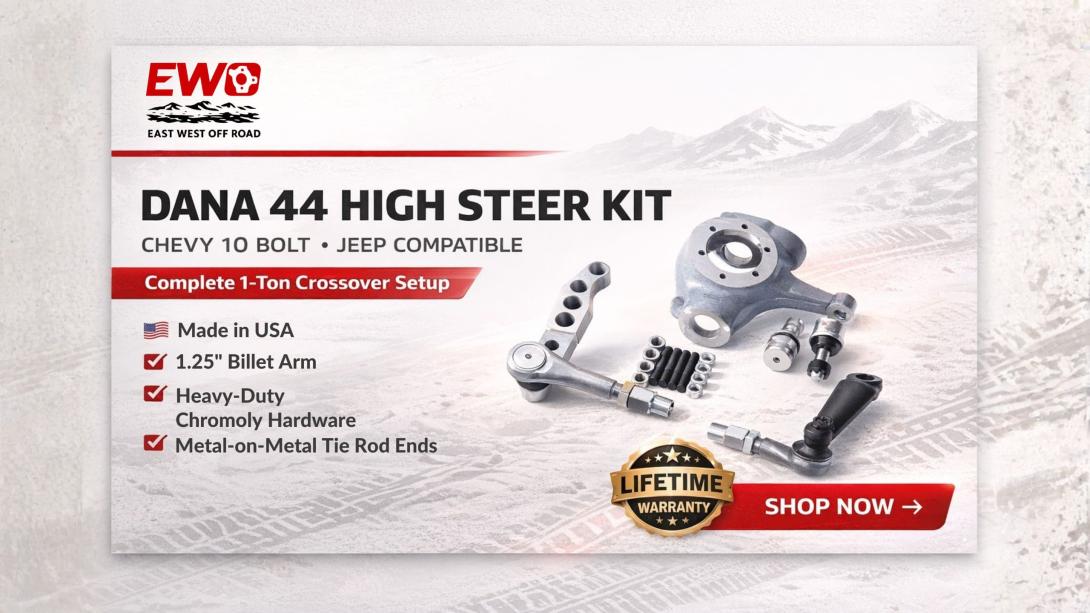
When it comes to strength, not all aftermarket kits are created equal. The EWO complete 1-ton crossover high steer kit represents the absolute pinnacle of American engineering for the Dana 44 and GM 10-bolt front axles. Built to handle massive torque and oversized tires, this heavy-duty kit replaces weak factory components with components designed for abuse.
Premium US-Made Knuckle and High Steer Arms
At the heart of this system is the specialized passenger side steering knuckle. A factory passenger knuckle does not have a flat top or the bolt pattern required to accept an aftermarket steering arm. The Dana 44 passenger side flat top knuckle included in this kit is a premium, US made Dana 44 knuckle manufactured directly by East West Off Road.
Bolting directly to this heavy-duty flat top knuckle is an absolute monster of a steering arm. These 1.25 inch thick billet steering arms are CNC machined by American workers from domestic billet steel blocks. Featuring a robust 4-hole mounting pattern, they are engineered to eliminate the shearing risks associated with old-style 3-hole configurations, allowing them to carry a lifetime warranty.
Industrial Strength 1-Ton Tie Rod Ends and Fasteners
Steering links are only as reliable as the joints on either end. Cheap replacement ends use plastic or nylon races that deform under the strain of large 35-inch to 40-inch off-road tires. The EWO kit utilizes industrial-grade ES2026R ES2027L drag link ends, which feature advanced metal to metal tie rod ends with integrated spring technology. These joints automatically adjust for wear, self-lubricate via built-in grease fittings, and refuse to deflect under high-torque steering loads.
To secure the massive billet arm to your new knuckle, the kit includes high-tensile Chromoly 9/16 studs Dana 44 hardware, complete with custom conical washers and lock nuts to prevent any loosening from trail vibrations.
Axle Compatibility: Chevy 10-Bolt and Dana 44 Cross Over Set Up
One of the greatest advantages of the EWO steering layout is its dual compatibility across two of the most popular front axles in off-road history: the open-knuckle Dana 44 and the corporate GM 10-bolt.
The Chevy 10 Bolt High Steer Conversion
Many enthusiasts assume they need to hunt down an expensive Dana 60 axle just to get reliable steering. However, a Chevy 10 bolt high steer conversion using the EWO kit allows you to retain your existing axle while upgrading to full 1-ton strength. This kit features a highly engineered Chevy 10 bolt bottom up taper knuckle, ensuring flawless clearance and perfect steering geometry for your classic Bowtie rig. Whether you are building a dedicated trail rig or modifying a Chevy 10 bolt Jeep crossover steering hybrid project, this component handles the transition smoothly.
Perfect Fit for Classic Square Body and K5 Rigs
For owners of vintage iron, this is the ultimate 1 ton steering upgrade Chevy K5 Blazer and suburban owners have been looking for. The Square body Crossover Steering Kit configuration effortlessly clears the engine crossmember and leaf springs on 1973–1987 Chevy trucks. To ensure a full range of steering motion without binding, the system includes a 3 inch drop forged pitman arm 32 spline unit that is fully indexable, allowing you to align your steering box center output perfectly with your new high-clearance drag link.
Heavy Duty Crossover vs. Full High Steer: Understanding the Options
When planning your front-end upgrades, it is crucial to understand the structural differences between standard crossover setups and full high-steer configurations. Both use specialized steering arms, but they serve different clearance needs on the trail.
Feature
Crossover Steering
Full High Steer
Drag Link Placement
Mounted on top of passenger knuckle arm
Mounted on top of passenger knuckle arm
Tie Rod Placement
Stays in factory low position
Relocated above axle using dual high steer arms
Primary Benefit
Eliminates bump steer, fixes geometry
Maximum ground clearance, protects tie rod
Best For
Multi-use trail rigs, 4-6" lifts, daily drivers
Rock crawlers, ultra-clearance rigs, 6"+ lifts
By utilizing premium Dana 44 high steer arms, builders have the flexibility to run a high-clearance drag link to eliminate bump steer immediately, while retaining the factory tie rod location if low-clearance obstacles are not a primary concern. The EWO kit functions as an exceptionally robust hd crossover steering kit that can be adapted or expanded depending on your specific clearance requirements.
Smart Builder Strategy: The "Buy Local DOM" Advantage
One of the unique, builder-first aspects of the East West Off Road package is that it is explicitly sold as a crossover steering kit without DOM tubing. While this might seem unusual at first glance, it is actually a major cost-saving benefit for the end consumer.
Save Massive Money on Freight Shipping
Steel tubing is incredibly heavy and awkward to ship via traditional parcel carriers. Shipping a 4-foot piece of heavy-wall steel across the country frequently costs more than the raw material itself. By providing the ultra-strong DIY Dana 44 steering kit components—including the custom 7/8 – 18 left inserts/tube adapters/weld bungs and matching jam nuts—EWO allows you to source your 1.5-inch OD x .250-wall DOM steel tubing from a local metal supply yard. This keeps money in your pocket instead of wasting it on corporate shipping fees.
True Custom Length Tuning
No two custom vehicle builds are exactly identical. Suspension lifts, axle widths, and steering box relocations vary from rig to rig. By welding the heavy-duty threaded inserts into your locally sourced DOM tubing yourself, you can customize the drag link to the exact millimeter your specific suspension demands. This guarantees a perfect fit, dead-on steering wheel centering, and absolute geometric perfection.
Step-by-Step Installation Overview
While installing an upgraded steering system is straightforward, it requires careful mechanical attention since it controls your vehicle. Here is an overview of what the installation process looks like.
1. Knuckle and Ball Joint Installation
Begin by safely supporting your vehicle on jack stands and removing the passenger side wheel, brake caliper, rotor, and spindle assembly. Remove the old factory knuckle. Press in the premium metal on metal upper ball joint and lower ball joint supplied with the kit into your new US-made flat top knuckle. Install the new knuckle onto the axle housing and torque the ball joint nuts to factory specifications.
2. Tor quing the Billet High Steer Arm
Clean the flat-top surface of the new knuckle thoroughly. Thread the high-tensile Chromoly 9/16 studs Dana 44 hardware firmly into the knuckle. Place the 1.25-inch thick billet steering arm over the studs. Drop the conical washers into place and secure them using the provided lock nuts. Torque these hardware components in a cross-pattern to ensure an even, bulletproof clamping force that will never shift on the trail.
3. Pitman Arm and Linkage Mockup
Remove your stock pitman arm using a heavy-duty puller. Install the new 3 inch drop forged pitman arm 32 spline component onto your steering box steering shaft. Measure the exact distance between the pitman arm hole and the taper hole on your new passenger billet high steer arm with the tires pointed dead straight. Cut your locally sourced DOM tubing to size, bevel the edges, weld the 7/8-18 left and right threaded tube adapters into place, and thread in your greaseable 1-ton drag link ends. Bolt the completed linkage into place, secure it with the castle nuts and cotter pins, and grease all joints.
Frequently Asked Questions (FAQs)
What is the advantage of a crossover steering kit?
A crossover steering kit replaces the archaic factory push-pull steering layout found on older leaf-sprung vehicles with a lateral drag link design. This change eliminates bump steer, corrects improper steering geometry caused by suspension lifts, and provides significantly more leverage to turn larger aftermarket tires without binding or dead spots.
Will this kit fit a Jeep with a Dana 44 front axle swap?
Yes, this system is highly versatile. If you are performing a Jeep Dana 44 high steer conversion or integrating a Chevy front axle under a custom off-road vehicle, this kit provides the heavy-duty steering components required to make the swap work seamlessly with heavy-duty 1-ton hardware.
Why does the kit not include DOM steel tubing?
The package is intentionally sold without the heavy DOM tubing to save customers significant money on freight shipping costs. Heavy steel tubing is highly expensive to ship. By providing the heavy-duty machined knuckle, billet arms, 1-ton tie rod ends, and weld-in threaded bungs, you can easily purchase the raw steel tubing at a local metal vendor and cut it to the exact length required for your specific custom lift.
What size tie rod ends are used in the EWO kit?
The kit features premium 1-ton ES2026R ES2027L drag link ends with a 7/8-18 thread pitch. These are classic heavy-duty GM style 3/4-ton / 1-ton tie rod ends that use robust metal-to-metal internal construction and include built-in grease fittings, castle nuts, and cotter pins for ultimate field serviceability and maximum strength.
Do I need to machine my passenger side knuckle for this kit?
No. The East West Off road 1 ton steering kit completely eliminates the hassle of hunting down a rare factory core and paying a machine shop. It includes a brand-new, premium heavy-duty passenger side flat top knuckle that is fully machined, drilled, and tapped right here in the USA.