

When you lift a classic solid-axle 4x4, you are instantly working against the laws of steering geometry. Factory push-pull steering configurations were never designed to handle extreme suspension articulation, oversized off-road tires, or aggressive trail obstacles. If you're running a lifted rig, a Dana 44 Flat Top Knuckle Conversion is the single most effective way to eliminate steering bind, correct bad drag link angles, and restore predictable handling. By converting your stock steering knuckles to a high-clearance crossover setup, you move your crucial steering linkages out of harm's way while unlocking maximum front axle articulation.
For owners of vintage full-size trucks, SUVs, and custom trail rigs, the choice often comes down to choosing a Dana 44 Flat Top Knuckle Conversion or struggling with severe handling issues. When dealing with a lifted truck, factory push-pull layouts cause the drag link to operate at extreme angles, creating severe binding and terrible geometry. Moving to a high steer configuration fixes these problems at the root, delivering a night-and-day difference whether you're navigating highway speeds or crawling over jagged boulders.
Understanding the Limits of Factory Steering Layouts
To understand why a Complete Dana 44 Crossover Steering System is necessary, you first need to understand the structural failures of the stock design. Factory setups utilize a push-pull system where the drag link runs from the pitman arm back to the driver-side steering knuckle. When you introduce a suspension lift, that drag link becomes steeply angled.
What is Bump Steer?
Every time your front tires hit a bump, the axle moves up and down. With a steeply angled drag link, this vertical suspension movement forces the steering axle to push or pull against the steering box independently of your steering wheel input. This violent, unintended steering feedback is known as bump steer. If you are trying to Fix Bump Steer Lifted Chevy K5 platforms, swapping out the stock push-pull configuration for a true crossover geometry is the only permanent solution.
The Weakness of Factory Materials
Stock tie rods and drag links are thin-walled, hollow tubes. Once you pair them with 35-inch or larger mud-terrain tires, the sheer physical leverage applied to these steering components during rock crawling can easily cause them to bend or snap entirely. Furthermore, stock configurations leave your tie rod hanging low below the axle centerline, turning it into a vulnerable target for rocks, logs, and trail debris.
Dana 44 vs 10 Bolt Crossover Steering: Clearing Up the Confusion
A common point of confusion for Chevy Square Body and GMC K-series owners centers on the differences between standard axles. When comparing a Dana 44 vs 10 Bolt Crossover Steering conversion, the great news is that these two front axles share identical outer assemblies from the knuckles out.
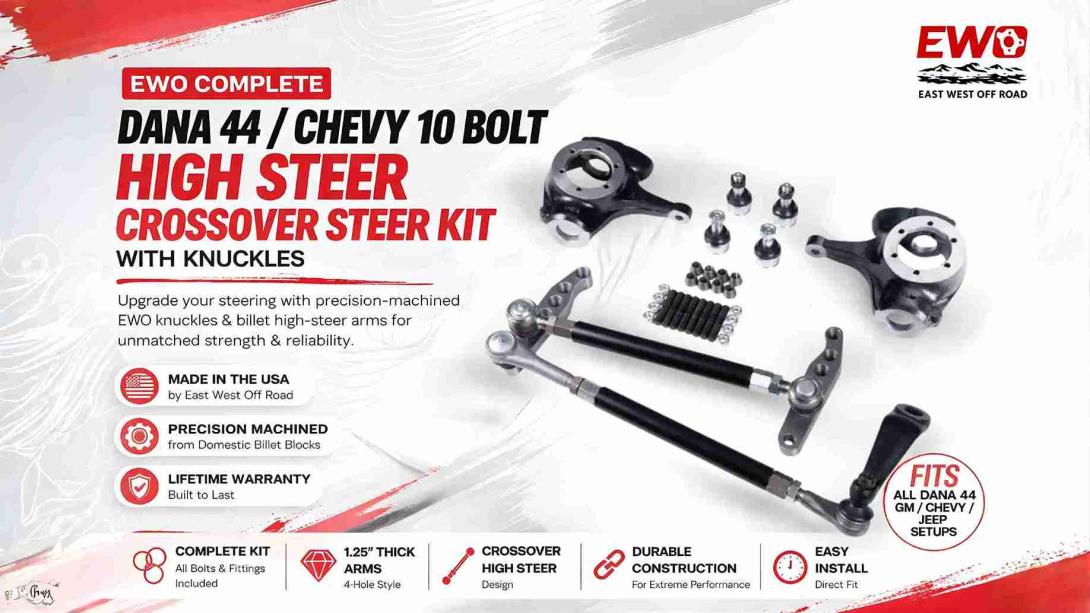
The GM 10-Bolt front axle and the open-knuckle Dana 44 use interchangeable spindles, hubs, brakes, and knuckles. Therefore, a premium upgrade kit like the EWO complete Dana 44 high steer kit serves as a universal, heavy-duty solution for both axle platforms. If you are running a Chevy 10 bolt high steer with knuckles setup or building out a dedicated Jeep Dana 44 high steer upgrade front end, the conversion steps, machining properties, and high-steer arm geometries remain identical.
Structural Breakdown of the East West Off Road Steering Kit
The East West Off Road steering kit is engineered from the ground up to replace every single weak link in your factory front end. Instead of piecing together mismatched junkyard parts and hoping the tapers match, this complete system offers a perfectly matched, bulletproof solution.
USA Made Dana 44 Steering Arms
At the heart of this upgrade are the heavy-duty steering arms. Cut from domestic solid billet blocks, these USA Made Dana 44 Steering Arms are precision CNC-machined in-house by East West Off Road. Measuring an impressive 1.25 inch billet high steer arms thickness, they feature a robust 4-hole mounting pattern engineered to handle severe off-road abuse without shearing or loosening. These premium billet arms are backed by a Lifetime Warranty, providing ultimate peace of mind on the trail.
Precision Machined Flat Top Knuckles
The kit includes premium Dana 44 driver passenger flat top knuckles custom-machined by EWO. Unlike stock knuckles that lack a flat surface or mounting provisions on the passenger side, these heavy-duty knuckles are fully cast, flattened, drilled, and tapped with a "Bottom Up" taper. To maximize installation versatility, the kit includes a specialized split tapered insert, allowing you to change the steering orientation to a "Bottom Down" configuration if required by your custom suspension geometry.
Ultra-Rugged Linkage Tubing
This package completely eliminates thin, hollow factory linkages. It features heavy-duty 1.50 x .250 DOM tubing steering kit materials, including a 54-inch and a 43-inch length of heavy-wall Documented Over Mandrel (DOM) seamless steel tubing. This thickness ensures your tie rod and drag link can take direct rock impacts without deflecting or bending, preserving your alignment under the toughest conditions.
Heavy-Duty Steering Hardware & Ends
To handle the lateral loads of oversized tires, the kit replaces generic tie rod ends with professional-grade, metal-to-metal joints utilizing advanced internal spring technology. This includes:
- ES2026R ES2027L drag link ends for flawless link articulation.
- ES2234L ES2234R tie rod ends designed specifically for rugged 7/8-inch Chevy 3/4-ton tie rod configurations.
- A premium 3 inch dropped pitman arm 32 spline unit that is fully indexable, ensuring perfect alignment with your steering box outputs.
- A complete Dana 44 upper lower ball joints kit featuring heavy-duty metal-to-metal construction to restore structural integrity to your steering knuckles.
Step-by-Step Installation Overview and Critical Requirements
Upgrading to a Bolt-On High Steer Kit GM 10 Bolt or Dana 44 configuration is a structural modification that requires precise execution. Below is the general workflow for completing this high-performance conversion.
1. Axle Teardown and Clean Up
Secure the vehicle on heavy-duty jack stands. Remove the front wheels, brake calipers, rotors, wheel bearings, locking hubs, and spindles. Carefully slide the outer axle shafts out and disconnect the stock tie rod and push-pull drag link. Remove the upper and lower ball joints to free the factory knuckles.
2. Installing the New Knuckles and Ball Joints
Press the premium heavy-duty upper and lower metal-to-metal ball joints into the new EWO flat top knuckles. Install the driver and passenger side knuckles back onto the axle inner Cs, torqueing the ball joint nuts to exact factory specifications. Install the high-strength 9/16-inch studs into the top of the knuckles, seating them firmly.
3. Mounting the High Steer Arms
Place the 1.25-inch thick billet steering arms over the heavy-duty studs on top of the knuckles. Drop the provided conical washers over the studs—these are absolutely critical as they wedge into the steering arm holes to eliminate any lateral movement or play under load. Thread on the locking nuts and torque them down cleanly.
4. Custom Fabricating the DOM Linkages
Because every lifted truck varies slightly in lift height, axle position, and track width, the provided heavy-wall DOM tubing comes in extended lengths. Measure the distance between your high-steer arms for the tie rod, and from the pitman arm to the passenger high-steer arm for the drag link. Cut the DOM tubing to length, bevel the edges, and weld the 7/8-18 left and right weld bungs/tube adapters securely into the tubing ends. (Note: Welding should be performed by a professional or certified structural welder to guarantee trail safety).
5. Essential: The 2wd Steering Box Crossover Setup Requirement
The single most important technical requirement for this conversion is upgrading your steering box output. Factory 4WD steering boxes move the pitman arm in a forward-and-backward motion (push-pull). True crossover steering requires a left-to-right lateral motion. Therefore, a 2wd steering box crossover setup is mandatory. You must swap out your factory 4WD steering box for a 2WD steering box chassis unit to allow the included 3-inch dropped pitman arm to actuate properly from side to side.
The Ultimate Benefit: Why High Steer Changes Everything
Investing in a Square Body Chevy High Steer Upgrade completely transforms the driving dynamics of your vehicle. By elevating both the tie rod and the drag link well above the axle centerline, you gain immediate performance advantages:
- Maximum Ground Clearance: Your vital steering linkages are no longer the lowest points on your front axle, protecting them from trail obstacles.
- Perfect Geometry Alignment: The crossover design allows your drag link to run parallel with your axle housing, minimizing angular stress and entirely neutralizing bump steer.
- No Reaming Required: This K10 Crossover Steering Kit No Reaming package utilizes precision-machined taper specifications matching standard 3/4-ton Chevy hardware out of the box, removing the need for difficult machining work during installation.
Frequently Asked Questions (FAQs)
Why do I need a 2WD steering box for a crossover steering setup?
A factory 4WD steering box operates on a push-pull motion that moves parallel to the frame rail. Crossover steering requires a lateral, side-to-side motion to actuate the drag link across the vehicle width. A 2WD steering box provides the exact sector shaft rotation and swing direction required for crossover setups.
Can I install this kit on a GM 10-Bolt front axle?
Yes, absolutely. The GM corporate 10-bolt front axle utilizes the exact same outer knuckle configurations, spindles, and wheel ends as an open-knuckle Dana 44. The knuckles and steering arms in this kit fit both axle housings flawlessly.
What makes DOM tubing better than standard pipe for steering linkages?
DOM (Drawn Over Mandrel) tubing is seamless steel tubing known for its excellent dimensional accuracy, high structural density, and incredible tensile strength. The 1.50" x .250" wall thickness included in this kit is exceptionally resistant to bending under intense lateral rock crawling loads.
Is welding required for this high steer kit installation?
Yes. While the knuckles, steering arms, ball joints, and tie rod ends are bolt-on components, the heavy-wall DOM tubing is shipped long to accommodate custom lift heights. You must measure, cut, and weld the supplied 7/8-18 threaded tube adapters/weld bungs into the DOM tubing ends.
Will this kit help fix death wobble or loose steering?
Yes. Death wobble and loose steering are caused by worn-out steering joints, loose ball joints, and weak factory components flexing under load. By replacing your setup with brand-new metal-to-metal ball joints, heavy-duty tie rod ends, and ultra-thick billet arms, you remove structural play and stabilize your front-end tracking.