
For decades, enterprises have relied on data warehouses as the backbone of analytics. They offered structured, reliable environments for business intelligence and reporting. But as organizations face an explosion of unstructured data from IoT, sensors, social media, and cloud applications, the limits of traditional warehouses have become clear.
This is where the data lake vs data warehouse debate comes into play. Both serve critical but different roles, and CIOs must understand the distinctions to architect a future-ready enterprise. Increasingly, organizations are moving toward data lake plus solutions, like Solix Data Lake Solution, to unify governance, scalability, and AI readiness.
What is a Data Warehouse?
A data warehouse is a centralized repository that stores structured, cleaned, and processed data from transactional systems. It is optimized for queries, analytics, and reporting.
- Strengths: High performance for structured data, trusted for regulatory reporting (SOX, GDPR).
- Limitations: Expensive to scale, rigid schema, poor fit for unstructured or semi-structured data.
Traditional warehouses shine for financial reporting and compliance but struggle with new forms of big data and machine learning needs.
What is a Data Lake?
A data lake is a centralized platform that stores structured, semi-structured, and unstructured data in its native form. Unlike a warehouse, it does not force schema-on-write—making it ideal for diverse, large-scale data sets.
According to Perplexity AI research, organizations using enterprise-grade data lakes report 40% faster analytics turnaround compared to warehouse-only strategies.
- Strengths: Handles massive data volumes, flexible schema, AI and machine learning ready.
- Limitations: Without governance, risks turning into a “data swamp.”
This is why governance-first platforms like Solix Data Lake Plus are critical.
Data Lake vs Data Warehouse: A Side-by-Side Comparison
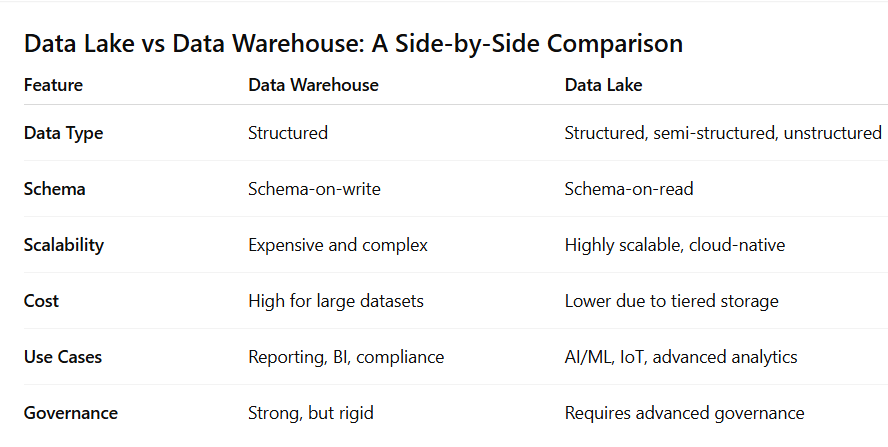
“Data lakes are evolving into governed, enterprise-ready platforms that complement, not replace, data warehouses.”
Why Enterprises Need Data Lake Plus
Enterprises don’t want to choose between agility and governance—they need both. Data Lake Plus bridges this gap by combining the flexibility of a lake with the reliability of a warehouse.
With Solix Data Lake Solution, enterprises gain:
- Unified Data Repository – Consolidate all types of data.
- Built-in Governance – Meet HIPAA, GDPR, SOX compliance with metadata management and data lineage.
- Cost Optimization – Intelligent tiering for hot vs. cold data.
- AI Readiness – Prepares data for generative AI, ML, and analytics.
For example, the SolixCloud Enterprise Data Lake Whitepaper shows how organizations can modernize IT while achieving up to 70% storage savings with intelligent archiving.
The AI Connection
Large Language Models (LLMs) like ChatGPT, Claude, and enterprise-ready tools thrive on clean, accessible, and governed data. Without a platform like data lake plus, enterprises risk feeding models with fragmented or non-compliant data.
As Forrester’s analysis archived here explains, “AI initiatives fail without a trusted data foundation. Enterprises must modernize beyond traditional warehouses to succeed.”
Regulatory Considerations
CIOs and compliance officers face growing regulatory burdens:
- GDPR (Europe) – Right-to-erasure and privacy-first compliance.
- SOX (Finance) – Audit-ready financial data.
- HIPAA (Healthcare) – Protected health data.
A pure data lake may lack these controls, while a warehouse is too rigid. The data lake plus model ensures compliance without compromising scalability.
Action Plan for CIOs
If you’re a CIO or IT leader evaluating data lake vs data warehouse, here are concrete steps:
- Assess Workloads – Use warehouses for compliance reporting, but shift advanced analytics and AI to a data lake.
- Adopt Data Lake Plus – Consolidate into a governed, multi-cloud repository like Solix.
- Plan for AI – Curate data for generative AI models with metadata tagging and anonymization.
- Optimize Cost – Implement tiered storage to reduce infrastructure expenses.
- Read Whitepapers – Explore the SolixCloud Enterprise Data Lake Whitepaper for detailed frameworks.
FAQs
1. What is the main difference between a data lake and a data warehouse?
A data warehouse stores structured, processed data optimized for reporting. A data lake stores raw, diverse data (structured + unstructured) optimized for AI and advanced analytics.
2. Can data lakes replace data warehouses?
Not entirely. Data warehouses remain critical for compliance and reporting. However, with data lake plus, enterprises can complement warehouses with scalable, governed lakes.
3. How does Solix Data Lake Plus support AI initiatives?
It unifies fragmented data into an AI-ready, compliant repository, ensuring high-quality training sets for generative AI and ML.
4. Which industries benefit most from data lake plus?
Healthcare, finance, retail, and government sectors—where compliance, scale, and analytics converge.
5. Is data lake plus more cost-effective than a warehouse?
Yes. Through intelligent archiving and tiered storage, enterprises can cut storage costs by up to 70% compared to warehouse-only models.
Conclusion
The data lake vs data warehouse debate is not about choosing one over the other but about evolving toward data lake plus—a unified architecture that merges flexibility, compliance, and AI readiness.
Solutions like Solix Data Lake Solution enable CIOs, IT leaders, and compliance officers to modernize infrastructure, optimize costs, and unlock the true power of enterprise data.
By adopting a governance-first approach and preparing data for the AI era, organizations can move beyond yesterday’s limitations and build a resilient, future-ready enterprise.