
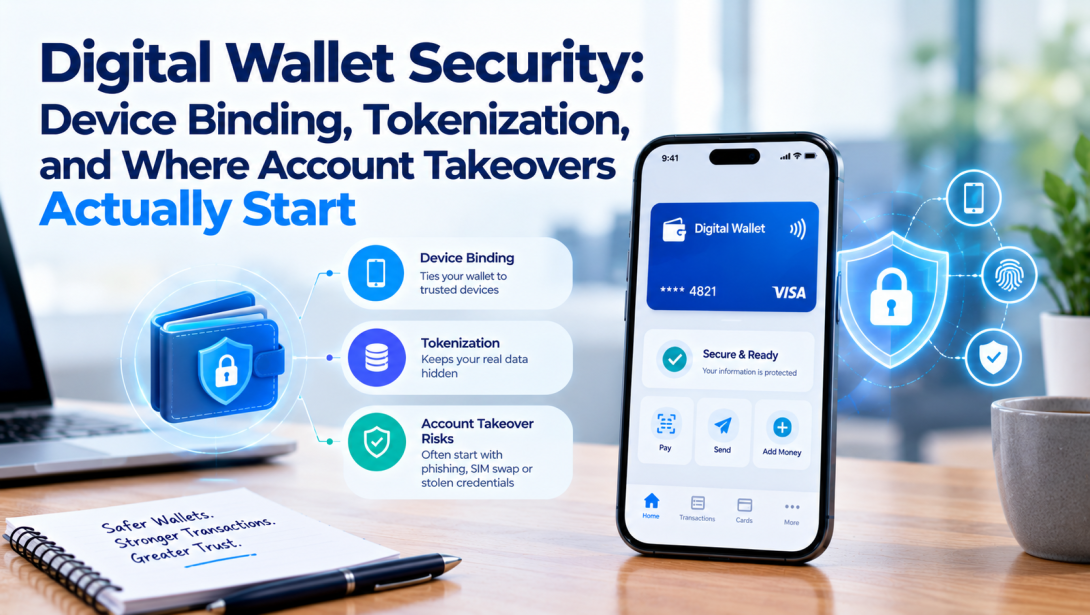
Digital wallets make it easy to store payment methods, transfer money, pay bills, and manage transactions from a mobile phone. But the convenience also makes them a target for fraud. If an attacker gains access to a wallet account, they may be able to view transaction details, add payment methods, change account settings, or initiate unauthorized payments.
The problem is not always a weakness in the payment technology itself. Many attacks begin earlier, through stolen passwords, phishing messages, compromised email accounts, SIM-related fraud, or a fake customer support interaction. Once an attacker gains control of a user's identity or session, even a wallet with strong payment tokenization may remain vulnerable.
Securing a digital wallet therefore requires several layers of protection. Device binding helps establish which device is authorized to access an account. Tokenization reduces exposure of sensitive payment credentials. Strong authentication, session controls, transaction monitoring, and safe account recovery help prevent attackers from turning stolen information into financial loss.
Understanding the Main Security Risks in Digital Wallets
A digital wallet may store payment cards, bank account connections, transaction history, loyalty balances, or funds held within the wallet itself. The security requirements depend on the wallet's design. A wallet that stores tokenized card credentials has different risks from a wallet that holds a cash balance or manages cryptocurrency keys.
One important distinction is between protecting payment information and protecting the account that controls it. Tokenization can reduce the exposure of card numbers during payment processing, but it does not automatically prove that the person accessing the wallet is its legitimate owner.
What an Account Takeover Looks Like
An account takeover occurs when someone gains unauthorized control of a legitimate user's account. An attacker might use a stolen password, a phishing page, a compromised device, or information obtained through social engineering. They may then change recovery details, register a new device, add a payment method, or move funds.
For example, a user receives a message claiming that their wallet account will be suspended unless they verify their identity. The link opens a fake sign-in page, and the user enters their credentials and one-time password. The attacker uses those details to access the real account and attempts to register a new device.
In this situation, the wallet's payment tokenization may still work exactly as designed. The problem is that the attacker has gained access to the account that controls the payment methods. This is why account security must cover the entire user journey, from registration and login to recovery and payment authorization.
Where Account Takeovers Actually Start
Wallet attacks often begin with identity and access weaknesses rather than with the payment transaction itself. Understanding these entry points helps product teams design controls around the actions attackers are most likely to exploit.
Phishing and Social Engineering
Phishing tricks users into sharing passwords, one-time codes, or other sensitive information. Attackers may impersonate a wallet provider, bank, delivery service, or support agent. Some attacks use convincing websites, fake applications, or messages that create a sense of urgency.
Multi-factor authentication can reduce risk, but not every authentication method provides the same protection. A one-time code entered into a fraudulent website can be relayed to the real service. Wallet providers should consider phishing-resistant authentication for sensitive operations where appropriate and should never train users to share authentication codes with support staff.
Stolen Sessions and Compromised Devices
An attacker may steal a session token from a compromised device or exploit malware that can access sensitive application data. If the session remains valid, the attacker may not need the user's password to continue using the account.
Secure token storage, short-lived access credentials, session revocation, device security checks, and server-side authorization help limit this risk. The application should also require additional verification before sensitive operations, such as changing a recovery email address, adding a new payment method, or transferring a large amount.
Weak Account Recovery and SIM-Related Fraud
Account recovery can become the easiest route into an account if it relies on information that attackers can obtain or manipulate. A weak recovery process may allow someone to reset a password after taking control of a phone number or compromising an email account.
Wallet providers should assess recovery methods separately from ordinary login. A request to register a new device, reset credentials, and transfer money immediately afterward should be treated as a potentially risky sequence. Stronger verification, notifications to existing trusted channels, temporary restrictions on sensitive actions, and clear recovery procedures can make these attacks harder.
What Is Device Binding, and How Does It Work?
Device binding links a wallet account or authentication process to a particular registered device. Instead of relying only on a username and password, the system checks whether the request comes from a device that has been enrolled and authorized.
The implementation varies by platform. A wallet may register a device during onboarding, generate a cryptographic key pair, and keep the private key in a protected device storage area. The server stores the corresponding public key or other trusted registration information. During a later authentication or sensitive transaction, the device may need to sign a challenge to demonstrate possession of the private key.
Why Device Binding Helps
If an attacker steals a password, device binding can make it harder to use that password from an unregistered phone. A properly designed cryptographic approach can also provide stronger evidence than a device identifier alone, because identifiers can sometimes be copied or spoofed.
The Reserve Bank of India's digital payment security directions emphasize device binding for mobile payment applications and call for security controls throughout the application lifecycle. The precise obligations depend on the regulated entity and the applicable directions.
Source: Reserve Bank of India — Master Direction on Digital Payment Security Controls.
Device Binding Is Not a Complete Security Solution
A bound device can still be compromised. An attacker may gain control of an already registered phone, exploit an active session, or manipulate a user into approving a fraudulent action. Device binding also creates a recovery challenge when a legitimate customer loses or replaces their phone.
A wallet should therefore combine device binding with secure local storage, server-side authorization, risk-based checks, and a recovery process that does not let an attacker simply register a new device using stolen credentials. A new device should not automatically inherit the trust assigned to the previous one.
Tokenization: Protecting Payment Credentials
Tokenization replaces a sensitive payment credential, such as a card number, with an alternative value called a token. The token is used in supported payment processes instead of exposing the original card number to every participant.
For example, when a supported card is added to a mobile wallet, the payment ecosystem may provision a payment token for use with that wallet or device. The merchant can receive the token during a transaction rather than the underlying card number. Depending on the payment system, transaction cryptograms or other controls may provide additional protection.
The PCI Security Standards Council explains that payment tokens can be presented in place of a primary account number and that the merchant and acquirer do not receive the underlying card number through the payment token itself.
What Tokenization Protects—and What It Does Not
Tokenization reduces the amount of sensitive card data exposed to systems that do not need the original number. If a merchant database is compromised, properly implemented payment tokens may reduce the value of the stolen information. Some payment tokens are restricted to particular use cases, devices, or payment environments.
However, tokenization does not automatically protect a wallet login, prevent social engineering, or stop an attacker who has taken over an account. The security of the token also depends on the tokenization system, its controls, and how the token is used.
Wallet developers should distinguish between payment tokens and authentication tokens. A payment token represents a payment credential in a supported payment ecosystem. An authentication token helps establish or maintain access to an application or API. They solve different problems and must be protected using controls appropriate to their purpose.
How Device Binding and Tokenization Work Together
Device binding and tokenization address different parts of the security problem. Device binding helps control which device can authenticate or perform certain actions. Payment tokenization limits exposure of the underlying payment credential. Together with transaction-level authorization, these controls can reduce several common attack paths.
Consider a user who adds a payment card to a wallet on a registered phone. The wallet uses device-bound credentials to support secure authentication, while the payment system uses a token in place of the card number for supported transactions. If an attacker later obtains the user's password, the attacker may still face additional checks before registering a new device or authorizing a sensitive action.
This layered approach is more useful than relying on one control to stop every type of fraud. Product teams should also consider transaction limits, alerts for new devices, additional verification for unusual activity, and a fast way to revoke sessions or disable a lost device.
Security Decisions During Digital Wallet Development
Security should be part of the initial architecture rather than a feature added just before launch. Teams need to identify what the wallet stores, which services process transactions, how identity is verified, and what happens when a device is lost or an account is compromised.
During ewallet app development, the team should define the wallet's threat model, select suitable authentication methods, protect sensitive credentials, and specify the steps required to enroll or remove a device. The backend must independently enforce permissions and verify sensitive requests instead of trusting the mobile application to make security decisions on its own.
Secure APIs and Session Management
Mobile applications communicate with backend services through APIs. These endpoints may support balance checks, transfers, card management, payment history, and account changes. Every sensitive endpoint needs server-side authorization, input validation, and appropriate abuse controls.
Access tokens should be stored securely, expire according to a suitable policy, and be revocable when a device is lost or suspicious activity is detected. Refresh-token rotation and detection of token reuse can also help identify compromised sessions, depending on the authentication design.
OWASP advises developers to avoid relying on spoofable device identifiers for authentication and to use secure storage, server-side checks, and controlled session management.
Source: OWASP — Mobile Application Security Cheat Sheet.
Fraud Monitoring and Transaction Controls
A wallet should look beyond individual login events. A successful login may still be suspicious if it is followed by a device change, an update to account recovery details, the addition of a new payment method, and an unusually large transfer.
Risk systems can combine device signals, account history, transaction patterns, and other lawful, proportionate indicators to decide when additional verification is appropriate. Teams should measure false positives as well as fraud detection because excessive challenges can prevent legitimate customers from using the wallet.
Special Considerations for Multi-Currency Wallets
Wallets that support multiple currencies introduce additional operational and security requirements. The system may manage separate currency balances, exchange rates, international transfers, conversion fees, and payments processed by different providers. Each of these functions needs clear authorization and reliable transaction records.
A well-designed multi-currency wallet architecture should maintain accurate balance records, prevent duplicate processing, and ensure that conversions and transfers follow defined rules. Currency balances should not be treated as interchangeable values without recording the currency, amount, rate, fees, and transaction status.
Security controls must also apply across currency operations. For example, an attacker who takes over an account might attempt to convert funds and move them through several payment routes. Risk checks should consider the sequence of actions, not just whether each individual transaction falls below a fixed limit. Depending on the business model and jurisdictions involved, additional licensing, identity verification, anti-money-laundering, and sanctions obligations may also apply.
Testing and Maintaining Wallet Security
Security controls must be tested under conditions that resemble real attacks. Testing should include stolen credentials, unauthorized device enrollment, lost-device recovery, expired sessions, repeated payment requests, compromised authentication tokens, and attempts to bypass transaction limits.
A wallet provider should maintain a documented incident response process. If a user reports a compromised device, the support team should be able to revoke sessions, disable the affected device, restrict suspicious transactions, and guide the user through account recovery. Monitoring should capture relevant security events without collecting unnecessary sensitive information.
For teams working on app development for fintech, security reviews should continue after launch. Operating systems change, third-party libraries receive updates, fraud methods evolve, and new payment integrations create new risks. Regular dependency updates, penetration tests, access reviews, incident exercises, and monitoring help ensure that protections remain effective as the product grows.
Conclusion
Digital wallet security depends on protecting both the payment credential and the account that controls it. Device binding helps establish trust in a registered device, while tokenization reduces exposure of sensitive payment details during supported transactions. Neither control can stop every attack, particularly when fraud begins with phishing, stolen sessions, weak recovery procedures, or a compromised device.
A secure wallet combines these controls with strong authentication, protected API access, transaction monitoring, session revocation, and safe device recovery. Teams should test the complete user journey rather than focusing only on payment processing.
In digital wallet app development, the strongest approach is to build security into the architecture, define how each sensitive action is authorized, and continue reviewing those controls after launch. This makes it harder for an attacker to turn a stolen credential into account control and unauthorized financial activity.