

Introduction: From Manual Testing to AI-Driven Intelligence
Traditional software testing models often required thousands of manual test cases, repetitive scripting, and long regression cycles that delayed software delivery and drained budgets. But with digital transformation accelerating across every sector, businesses can no longer afford inefficiencies in testing. Enter Software Testing with Generative AI, an innovation that is redefining quality assurance by leveraging machine learning, NLP, and large language models to automate test generation, execution, and optimization. Unlike traditional test automation which relies heavily on predefined rules, generative AI learns from software behaviour and user stories, enabling it to create intelligent test scenarios dynamically. V2Soft’s latest solutions powered by SANCITI AI combine generative models with real-time analytics, offering intelligent test coverage, instant bug detection, and reduced defect leakage. According to MarketsandMarkets, the global AI-based testing market is expected to reach USD 1.6 billion by 2027, growing at 20 percent CAGR. US-based enterprises still struggle with fragmented testing tools and skill shortages, while India’s testing centers excel with access to AI-trained engineers and 24/7 agile testing delivery. Whether you're building ERP platforms, mobile apps, or enterprise SaaS, generative AI not only saves time but enhances software reliability, ultimately ensuring faster time-to-market and better user experience.
Generative AI Is Reinventing Testing Frameworks at Scale
The adoption of Next Gen AI-driven automation Testing is not just a trend—it’s a necessity for businesses seeking speed and accuracy in delivery. These systems learn from past test runs, user interactions, and bug histories to automatically generate tests with greater precision and adaptability. AI-driven automation reduces human bias, expands test case coverage, and significantly accelerates time-to-deploy. V2Soft has developed AI-first testing pipelines that auto-correct failing test cases, generate reusable test suites, and self-prioritize based on impact analysis. In contrast to rigid frameworks in the US that demand continuous manual scripting, Indian providers are embracing AI to deliver faster cycles with greater consistency. Gartner estimates that companies using next-gen testing frameworks report 40 percent fewer production bugs and 30 percent lower QA costs. For instance, a leading fintech client of V2Soft saw regression time cut from 3 days to 6 hours after integrating SANCITI AI. India’s ability to scale AI implementations using its vast pool of data scientists and DevOps professionals offers a substantial edge over global markets. As AI algorithms mature, they are not only reducing tester workload but also enabling shift-left testing, empowering developers to test smarter and earlier. Organizations that embed AI into their QA pipelines are already outperforming their competitors on release velocity, quality metrics, and cost optimization.
Elevating Test Design with Generative AI
One of the most complex tasks in testing is designing comprehensive, realistic test cases that mimic user behaviour. Traditional automation often falls short here, requiring significant manual intervention to update and maintain tests for every code change. But Test automation using Generative AI solves this challenge by using AI to interpret code changes, predict outcomes, and generate relevant test cases. These models continuously evolve, learning from production data and user journeys to simulate real-world conditions more accurately. V2Soft’s integration of SANCITI AI enables contextual test generation that adapts in real time as software changes, dramatically improving coverage and speed. Unlike static test libraries used in many US enterprises, AI-led test generation allows for adaptive regression testing with minimal human input. A recent Capgemini survey revealed that 61 percent of enterprises deploying generative AI in testing observed improved test quality and reduced time-to-market by at least 25 percent. In India, testing teams are leveraging Gen AI to automatically create negative tests, corner cases, and exploratory scenarios, pushing quality thresholds beyond traditional boundaries. With shorter development sprints and increased CI/CD adoption, the need for smart test automation is higher than ever. Generative AI allows testing teams to stay ahead of the curve by transforming static test repositories into living, breathing systems that evolve with the application.
QA Automation Transformed by Generative AI
The use of Generative AI in QA automation is drastically altering how organizations perceive the value of testing. It’s not just about bug detection anymore—it’s about predictive quality engineering. Generative models can analyse historical defect data, user behaviour, and performance metrics to identify potential failure zones even before code is executed. V2Soft’s SANCITI AI leverages these capabilities to build risk-based test strategies that maximize ROI. For US-based teams burdened by fragmented test environments and siloed tools, AI offers a unifying approach to test orchestration. Indian QA teams are utilizing these systems to implement smart reruns, identify redundant cases, and optimize test frequency based on code volatility. According to Infosys, QA teams using AI have seen a 45 percent boost in automation effectiveness and a 60 percent reduction in redundant test cases. In practice, AI-powered bots now autonomously update test documentation, report anomalies, and trigger alerts for potential integration failures. This eliminates manual handovers, accelerates delivery, and strengthens collaboration between testers, developers, and product managers. As demand for continuous testing grows, AI enables enterprises to achieve coverage at scale while improving traceability, compliance, and risk visibility across product lines.
Gen AI in Test Automation for Smarter Delivery
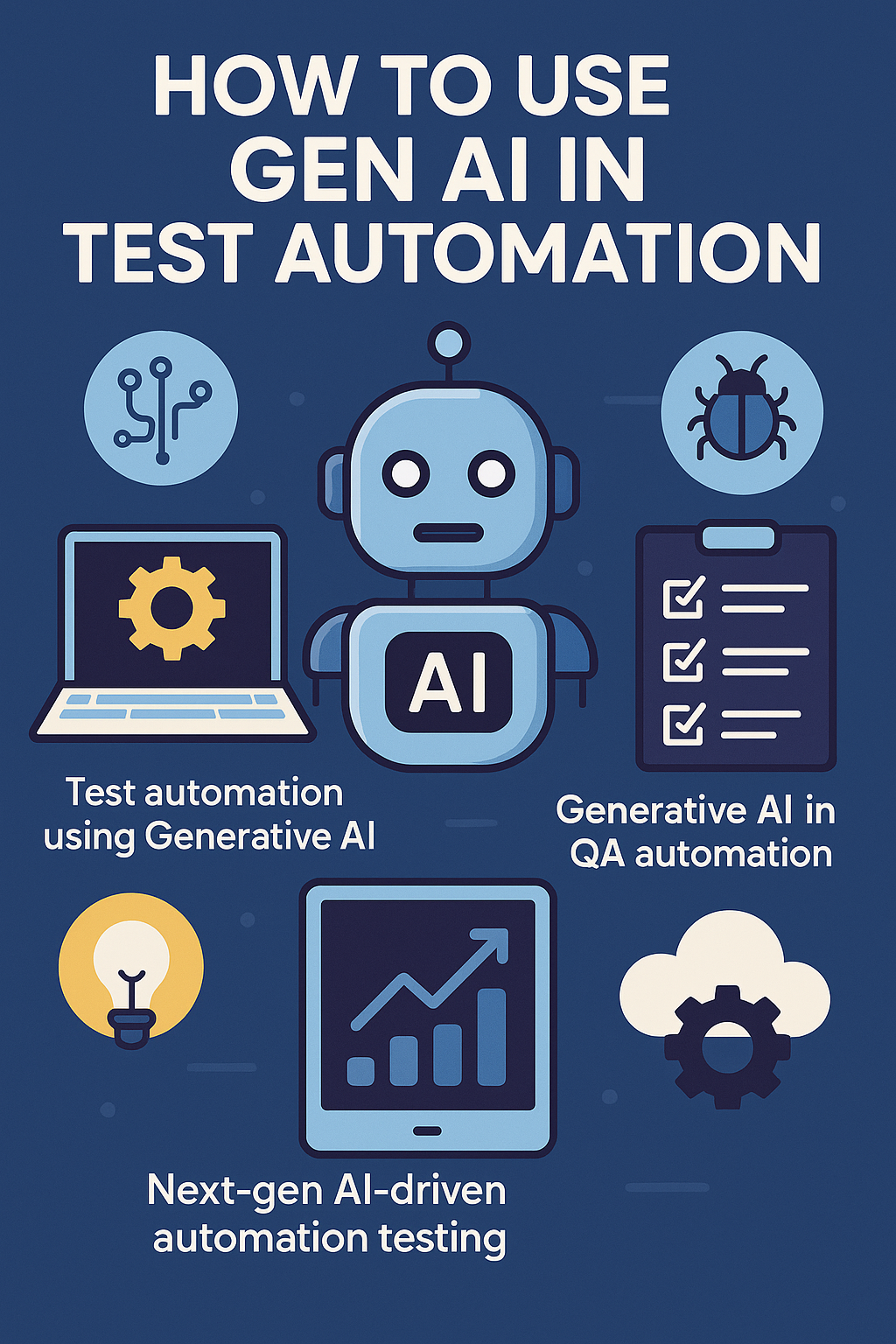
Many companies now ask how exactly to implement generative AI into their QA pipelines for maximum efficiency. The answer lies in combining smart planning with the right AI models. Understanding How to use Gen AI in Test automation involves mapping software modules, creating intent-based test cases, and training models with failure data and business rules. Generative AI doesn’t replace testers—it enhances them by doing the heavy lifting of creating, maintaining, and adapting tests in real time. V2Soft’s training modules for global clients include guided onboarding, AI model customization, and ongoing optimization audits to ensure value. While enterprises in the US spend weeks integrating fragmented testing tools, Indian companies deliver turnkey AI testing stacks using open-source tools, cloud-native scripts, and data-powered learning models. KPMG reports that AI-led test delivery reduced production defect rates by up to 52 percent in 2024. In industries like telecom and insurance, where compliance and customer experience are paramount, generative AI enables smart automation that meets both technical and business objectives. Enterprises that adopt AI across test planning, execution, and analysis are witnessing unprecedented gains in accuracy, agility, and scalability. The ability to generate hundreds of realistic scenarios within minutes ensures products are robust, compliant, and ready for market.
Future Trends in AI-Powered Testing
Looking ahead, the Future of AI in Test automation points to continuous evolution, where test environments will become autonomous systems with self-healing, self-reporting, and self-optimizing capabilities. These future-ready systems will simulate production scenarios, collect user feedback, and auto-tune performance scripts without human involvement. V2Soft is already experimenting with reinforcement learning models within SANCITI AI that reward accurate bug detection and penalize false positives. As these models mature, AI will not only improve test coverage but also optimize product decisions by linking testing with business KPIs. The US testing market is cautiously exploring these trends, while India is fast emerging as a global hub for AI-powered QA innovation, backed by academic collaboration, large QA communities, and AI-first startups. McKinsey predicts that by 2027, over 70 percent of enterprise test cases will be written or executed by generative models. AI will also reshape roles in QA, evolving testers into strategists and AI trainers who validate outputs and tune performance. The next decade of QA is not just about automation—it’s about intelligence, autonomy, and alignment with business value. For enterprises, embracing these trends will mean higher product quality, improved delivery velocity, and stronger customer trust in a digital-first world.
V2Soft’s SANCITI AI: Powering QA Transformation Globally
V2Soft has become a trailblazer in AI-led testing services by embedding SANCITI AI across its QA portfolio. This proprietary platform supports intelligent test case generation, failure pattern recognition, and continuous test optimization. Clients in the US, Europe, and Asia rely on V2Soft to deploy AI-powered test pipelines across domains like automotive, fintech, and healthcare. One major success story involved reducing software release delays by 40 percent for a leading US automotive OEM by replacing their legacy testing framework with SANCITI AI. This shift not only reduced downtime but significantly improved compliance reporting. India’s strong base of AI engineers and quality specialists makes V2Soft’s offshore model highly scalable and adaptable. Additionally, V2Soft’s AI academy equips QA professionals with skills in LLM tuning, ML pipelines, and automated model validation. SANCITI AI integrates with open-source tools like Selenium, Cypress, and Appium, allowing clients to enhance existing frameworks with minimal reengineering. Its cognitive dashboards offer real-time insights into test progress, risk hot spots, and release readiness. By bringing together domain knowledge, technology excellence, and global delivery expertise, V2Soft continues to redefine software quality in the generative AI era.
India vs US: Comparing AI Testing Capabilities
India and the US both lead global QA markets, but their approach to generative AI in testing differs significantly. In the US, enterprises are cautious and invest heavily in compliance, certifications, and tool customization. Indian firms, however, are more agile, offering faster adoption, broader tool integration, and cost-efficient services. India’s QA workforce is trained on AI platforms from academic institutions and industry certifications, while many US companies still face a talent gap in AI expertise. A study by NASSCOM highlighted that Indian firms deliver AI-based QA services at 35 percent lower cost with equal or better quality. Moreover, Indian companies like V2Soft are spearheading innovation by collaborating with AI research labs and investing in real-time learning pipelines. US firms rely more on traditional enterprise tools with slower adaptation cycles. Indian testing centers also offer multilingual, round-the-clock support that enables faster global rollouts. These differences give Indian QA providers a strategic edge in delivering future-ready, AI-augmented software testing solutions at scale.
Industry Case Study: How Generative AI Reduced Go-to-Market Time
A global healthcare provider struggled with long testing cycles and production issues that delayed feature releases. Partnering with V2Soft, they deployed a generative AI testing model via SANCITI AI that reduced test creation time by 70 percent and improved coverage for critical modules. Regression time dropped from 4 days to 8 hours, while bug leakage was reduced by 50 percent within the first quarter. The model adapted automatically to API changes, UI updates, and schema variations. This initiative enabled the client to release more frequently, meet compliance faster, and deliver better user experience. Such examples prove how generative AI is not just a technical improvement—it’s a business advantage.
Conclusion: Why Generative AI Is the Future of Testing
The adoption of Software Testing with Generative AI is no longer a question of “if” but “when.” As businesses strive for faster releases, smarter coverage, and better quality, generative AI will become the backbone of modern QA. V2Soft’s global success with SANCITI AI proves that AI-powered testing delivers measurable value in speed, cost, and software quality. With India leading the AI QA revolution through scale, expertise, and cost advantages, enterprises worldwide are turning to providers like V2Soft for competitive edge. By embedding AI into test planning, design, execution, and analysis, companies are transforming their quality assurance from a cost center to a value-driving function. As AI continues to evolve, it will push the boundaries of what’s possible in software testing, unlocking a future where intelligent QA supports every line of code, every release, and every customer experience.
Want to explore more and transform your business?
Have Questions? Ask Us Directly!
Send your queries or challenges to:
vtusoftbglr@gmail.com / info@v2soft.com