
Introduction: The Evolution of Software Development and the Rise of Generative AI
Software development has evolved significantly over the last two decades, driven by increasing technological demands, changing user expectations, and global economic shifts. What began as a manual, code-intensive process has now become a highly automated, intelligence-driven ecosystem. Among the most transformative technologies reshaping this space is generative AI. This subset of artificial intelligence leverages algorithms to create new content, solutions, or code patterns, enhancing speed, quality, and consistency across the Software Development Life Cycle (SDLC). With the increasing complexity of applications, development teams are under immense pressure to deliver faster without compromising on performance or security. Generative AI offers a solution to this challenge, reducing development timelines, minimizing bugs, and promoting intelligent decision-making at every SDLC phase. By 2027, Gartner predicts that over 70 percent of software engineering tasks will involve some form of AI assistance. As companies in India and the US increasingly adopt AI-based development practices, the global software industry is witnessing a seismic shift toward automation and smart coding. India, in particular, is playing a pivotal role by integrating generative AI models into both enterprise and start-up environments, driven by a robust pool of developers and forward-looking policies.
Why Generative AI in SDLC Is More Than Just a Trend
Generative AI is not a passing trend. It is becoming an integral component of development workflows by augmenting the capabilities of developers and optimizing software processes. Whether it's code generation, test case automation, or documentation creation, generative AI tools are improving productivity while maintaining quality standards. Developers can now rely on generative models to generate code snippets, detect redundancies, and suggest improvements in real-time. One of the major strengths of generative AI in SDLC is its adaptability across various programming languages and platforms, making it universally deployable. A McKinsey report indicates that companies implementing AI in development cycles experience a 30 to 40 percent increase in team productivity. Additionally, Indian software firms are gaining global recognition for integrating AI solutions earlier in the SDLC phases, such as requirement gathering and design, which were previously untouched by automation. The introduction of platforms like V2Soft’s SANCITI AI provides businesses with scalable AI tools that learn from patterns and continuously improve software outcomes. Compared to traditional development practices, the inclusion of AI enables more efficient resource allocation, better stakeholder collaboration, and faster time-to-market.
Leverage the full potential of Generative AI in SDLC to gain speed and innovation in your software projects.
How AI in SDLC Enhances Each Phase of Development Lifecycle
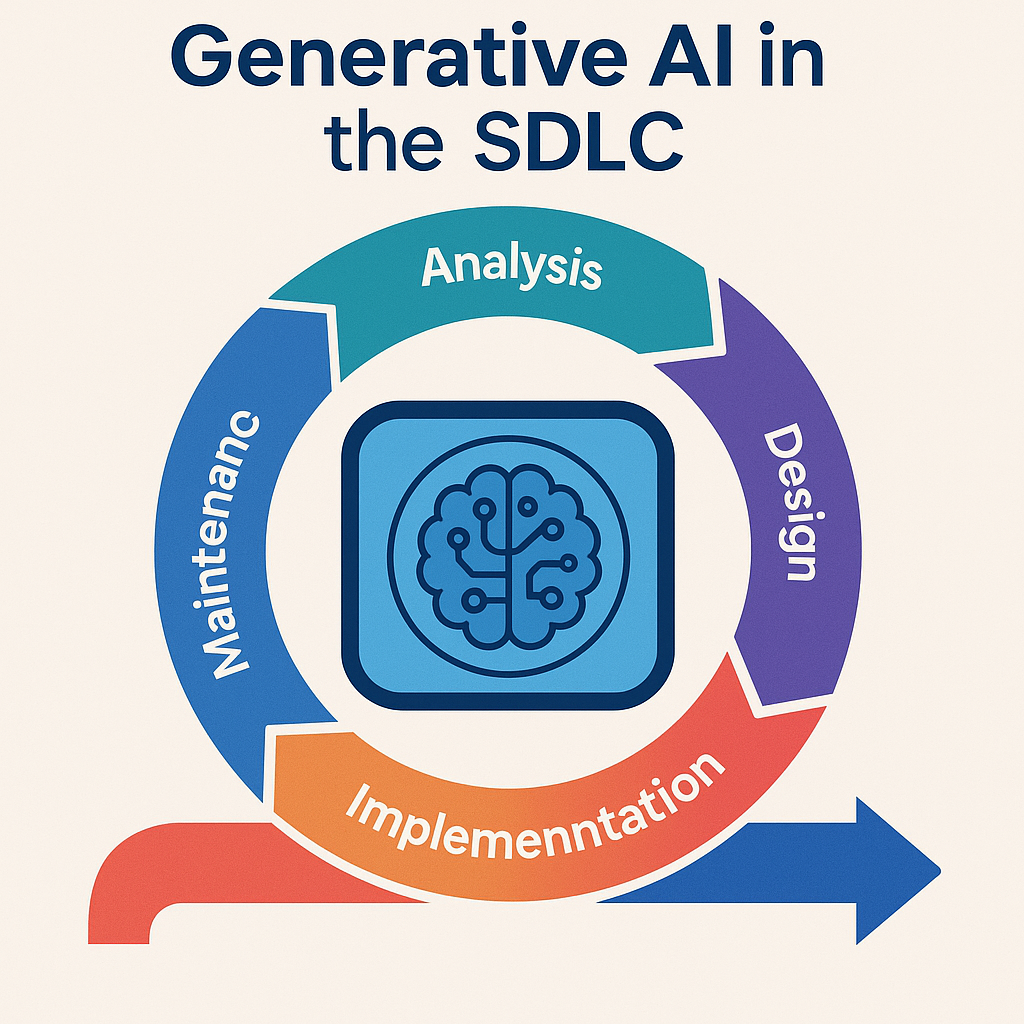
The Software Development Life Cycle is typically segmented into planning, designing, developing, testing, deploying, and maintaining. AI technologies, especially generative AI, are now touching each of these stages with transformative impact. During planning, AI analyses past project data to forecast risks and estimate timelines accurately. In the design phase, AI-driven design assistants can automatically create wireframes based on user stories or business needs. During coding, AI tools suggest real-time improvements and prevent redundant logic by analysing repositories. Testing, perhaps the most labour-intensive stage, is now simplified by AI-powered tools that automatically create, execute, and optimize test cases. Maintenance, which involves identifying and fixing bugs, is faster due to predictive analysis that detects issues before they affect users. A comparison between Indian and US enterprises reveals that Indian companies are now more aggressive in adopting AI across all SDLC phases, leading to better output in shorter timelines. For example, Indian companies using V2Soft’s SANCITI AI have reported a 25 percent improvement in defect detection and 40 percent faster development cycles. While the US market remains a tech leader in volume, India is gaining a clear edge in agility and innovation by embedding AI deep into the SDLC architecture.
By incorporating AI in SDLC, organizations can streamline workflows and improve quality at every development stage.
Unlocking Real-World Benefits of Gen AI in Software Development
 The benefits of generative AI are no longer theoretical. Businesses across sectors have already experienced measurable improvements in software quality, development speed, and customer satisfaction. For instance, one of India’s largest e-commerce firms integrated generative AI into its SDLC pipeline to handle seasonal demand. The result was a 50 percent reduction in response time and 35 percent fewer errors during peak traffic periods. In the US, a leading banking institution implemented generative AI to automate test case creation and documentation, saving nearly 3,000 hours annually. The rise of platforms like GitHub Copilot and Google’s Codey have shown how mainstream AI has become in assisting developers. But it's Indian firms that are showing a unique advantage. With a large population of AI engineers and government incentives promoting AI development, India is positioning itself as a global innovation hub. V2Soft’s SANCITI AI is a standout example of an enterprise-ready platform designed to generate real-time code recommendations, predict system bottlenecks, and streamline collaboration. As industries move towards agile and DevOps models, generative AI in software development ensures continuous delivery without compromising compliance or security.
Harness the innovation of Gen AI in Software Development to reduce manual effort and enhance development agility.
Comparing Global Markets: India’s Edge in AI-Driven Development
When comparing how different regions adopt AI in SDLC, India is showing remarkable progress both in terms of speed and depth. While the US has historically led in tech innovation, India is catching up by focusing on rapid integration of AI into daily workflows. According to a NASSCOM report, over 45 percent of Indian software firms have integrated AI tools in their development processes, compared to 32 percent in the US. India’s cost-efficiency, combined with its large English-speaking workforce and STEM graduates, provides companies with a dual advantage: affordability and expertise. Indian firms are also more inclined to customize AI tools to match local project requirements, resulting in higher satisfaction among clients. The use of SANCITI AI by V2Soft is an example of India’s strength in producing enterprise-grade AI that is context-aware and scalable. On the other hand, US companies often rely on third-party AI tools without significant localization. India’s approach of embedding AI into customized agile environments is producing better outcomes, particularly for industries like retail, BFSI, and healthcare. With government initiatives like Digital India and the rise of AI-focused startups, India’s AI ecosystem is expanding rapidly and sustainably.
By applying strategies focused on AI in Software Development, global enterprises can benefit from India’s tech ecosystem for transformative results.
Forecasting the Future: Trends, Tools, and Talent
The AI revolution in software development is just beginning. Market analysts predict that by 2030, over 80 percent of code will be AI-assisted, if not AI-generated. Tools that combine natural language processing and deep learning are making it easier for non-programmers to contribute to software development through no-code and low-code platforms. This democratization is expected to expand software development beyond IT teams to include product managers, designers, and even end-users. Additionally, the demand for AI-savvy developers is rising sharply. According to Indeed India, job postings requiring AI development skills increased by 70 percent in 2024 alone. India’s talent pipeline, with over 1.5 million engineering graduates annually, is well-positioned to meet this demand. Companies like V2Soft are investing in skilling initiatives and AI-based platforms to train professionals in integrating AI across SDLC stages. US companies, though leading in R&D, are increasingly outsourcing AI development tasks to Indian vendors for better cost and time management. The future will also see increased convergence between AI, cloud computing, and cybersecurity in the development process, creating a comprehensive intelligent development environment.
Investing in the Benefits of using AI in SDLC can future-proof development operations and accelerate digital transformation.
Enterprise Case Study: V2Soft and SANCITI AI in Action
To truly understand the power of AI in SDLC, it is essential to examine real-world applications. V2Soft’s SANCITI AI is one such platform that has consistently delivered measurable impact across industries. In a case study involving a multinational logistics company, SANCITI AI was used to optimize route planning and update backend systems automatically during real-time operations. The result was a 40 percent improvement in application responsiveness and a 60 percent reduction in downtime during maintenance windows. In another scenario, a US healthcare tech firm used the same platform to reduce testing cycles by half, significantly accelerating time-to-market for a new patient management system. What makes SANCITI AI unique is its adaptability. It can be seamlessly integrated with existing DevOps pipelines and can interpret historical project data to provide context-specific recommendations. Its predictive engine identifies bugs even before deployment, minimizing customer-impacting incidents. The platform also supports multilingual code generation, opening avenues for global enterprises with diverse development teams. V2Soft’s success in combining AI expertise with business needs exemplifies how Indian innovation is shaping the global software narrative.
Conclusion: The Strategic Value of Generative AI in Software Development
The integration of generative AI into the SDLC is no longer optional but essential for businesses aiming for speed, quality, and innovation. From planning to deployment, generative AI enhances every phase of software development by reducing human error, improving consistency, and accelerating delivery. As global enterprises adapt to these changes, India is proving to be a strategic partner by offering cost-effective, innovative, and scalable AI solutions. Platforms like SANCITI AI from V2Soft demonstrate how AI can be aligned with business goals to create value at every touchpoint. Whether you are an enterprise leader or a developer, understanding and implementing generative AI in your SDLC processes can be a game-changer for operational efficiency and digital transformation. As we move forward, businesses that adopt and evolve with AI will not only survive but thrive in the future of software development.
Have Questions? Ask Us Directly!
Want to explore more and transform your business?
Send your queries to:
vtusoftbglr@gmail.com / info@v2soft.com