

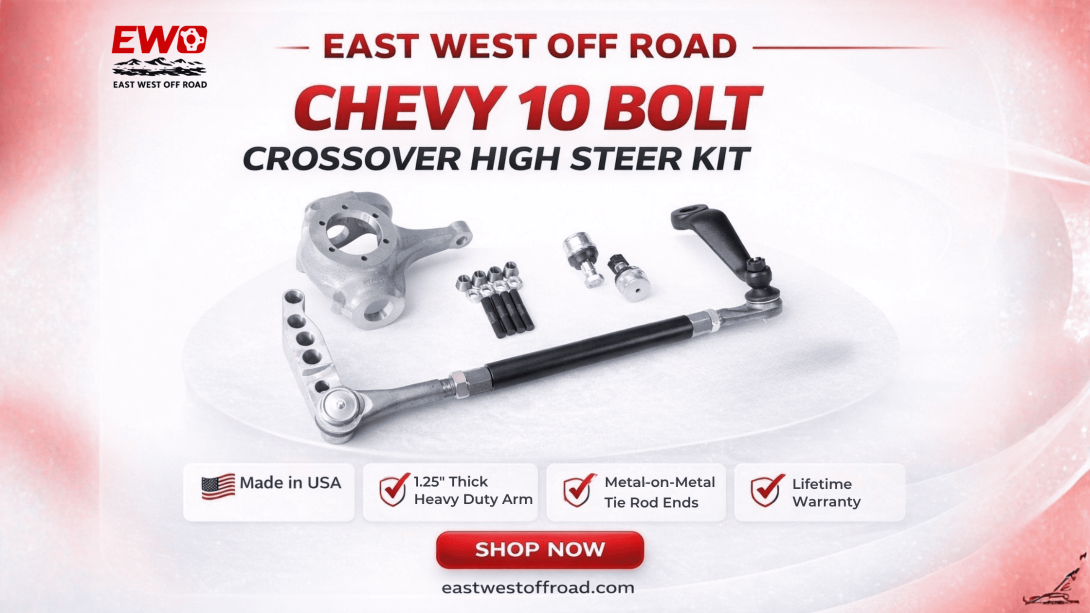
Buy Now: https://www.eastwestoffroad.com/product/ewo-chevy-10-bolt-complete-crossover-high-steer-kit
If you own a lifted classic GM truck, K5 Blazer, or Suburban, you already know the terrifying feeling of steering slop, bump steer, and binding drag links when navigating rough terrain. Installing a high-quality HD Crossover Steering Kit is the single most effective modification you can make to restore precision, strength, and confidence to your rig. Factory push-pull steering systems were never designed to handle large off-road tires, suspension lifts, or intense trail articulation. When you lift your truck, the drag link angle becomes dangerously steep, severely reducing your turning radius in one direction and multiplying the forces transferred from the road back into your steering wheel.
By converting your old setup to a true crossover configuration, you decouple the suspension’s vertical movement from the steering geometry. This completely transforms how your vehicle handles both on the highway and on technical trails. In this comprehensive technical guide, we will break down exactly how an engineered steering system eliminates factory weaknesses, what components are required for a bulletproof conversion, and why the East West Off road steering kit stands out as the ultimate solution for hardcore off-roaders.
## Understanding the Mechanics: Why Factory Steering Fails on Lifted Trucks
To understand why upgrading to a heavy-duty crossover system is necessary, you first have to look at the structural limits of vintage solid-axle geometry. Classic GM vehicles built from 1969 to 1987 (and up to 1991 for Blazers and Sub urbans) utilized a push-pull steering design. In this configuration, the steering box outputs motion front-to-back, pushing a short drag link forward and backward to rotate a steering arm mounted on the driver's side steering knuckle.
### The Curse of Push-Pull Steering Geometry
When a truck remains at stock height, the push-pull drag link sits relatively level, allowing it to function adequately for standard street driving. However, as soon as you install a suspension lift, the axle moves further away from the frame. This forces the drag link into a severe downward angle.
When you hit a bump, the axle moves upward, forcing the steep drag link to push back against the steering box sector shaft. Because the steering box is securely bolted to the frame, it cannot move. The energy has nowhere to go except to violently jerk the steering wheel out of your hands. This dangerous phenomenon is exactly what it means to Eliminate Bump Steer Lifted Chevy setups, restoring structural predictability and absolute driver control. Furthermore, because of the extreme angularity, turning left pushes down on the axle instead of pivoting the knuckle, drastically reducing your actual steering leverage and cutting your turning radius in half.
### The Crossover and High Steer Solution
A crossover steering configuration changes everything. Instead of running front-to-back on the driver's side, a crossover setup routes the drag link completely across the vehicle—from a revised steering box pitman arm on the driver's side over to a dedicated steering arm mounted on the passenger-side knuckle. This places the drag link parallel to the front axle housing.
When the axle cycles up and down over rocks or potholes, the drag link moves in a wide, flat arc that mimics the track of the axle housing. The result? Zero unwanted steering input, full turning radius in both directions, and a massive increase in mechanical leverage.
When you step up to a Chevy 10 Bolt Crossover High Steer Kit (or as some builders look up online, an hd crossover steering kit), you elevate the steering geometry even further. A high steer configuration mounts both the drag link and the tie rod above the leaf springs using specialized high-clearance billet arms. This keeps your vital steering linkages completely out of harm's way, safely tucked up near the oil pan where jagged rocks, stumps, and trail debris cannot strike them.
## Engineering a Bulletproof Front End: Anatomy of the Ultimate Upgrade
When you are torturing your rig on 35-inch, 37-inch, or larger mud-terrain tires, standard factory replacement components will flex, bend, or snap under load. Upgrading your front end requires a fully integrated system engineered from premium materials. Let's look at the critical components that comprise a professional-grade Chevy 10 bolt crossover steering kit conversion.
## The Heart of the System: Flat Top Knuckles and Billet Arms
The structural foundation of any high steer conversion rests on the steering knuckle itself. Standard factory passenger-side knuckles on GM 10-bolt and Dana 44 axles lack the flat, machined mounting pad and threaded holes required to accept an aftermarket steering arm. Executing a successful Flat Top Knuckle Conversion Kit requires replacing the stock passenger knuckle with a heavy-duty, precision-machined unit.
The East West Off road steering kit includes a premium Dana 44 crossover steering setup foundations: a passenger knuckle proudly made in the USA by EWO. This heavy-duty Dana 44 high steer knuckle features a specialized "Bottom Up" taper machined directly into it for perfect taper matching. For maximum build versatility, the kit also provides a precision slit tapered insert, giving builders the flexibility to alter the steering linkage orientation to a "Bottom Down" configuration if their custom suspension clearances demand it.
Bolting directly to this heavy-duty knuckle is an ultra-rugged passenger-side high steer arm. While competitors often cut corners using thin, imported cast iron or low-grade steel, East West Offroad fabricates these arms from domestic billet steel blocks, machined entirely in-house to back them with an absolute Lifetime Warranty. These massive 1.25 inch billet high steer arms feature a rock-solid 4-hole mounting pattern. They come perfectly tapered to accept ultra-strong 7/8-inch Chevy 3/4-ton tie rod ends, providing unparalleled clamping force and elimination of structural deflection.
### Unyielding Linkages: DOM Tubing and Heavy-Duty Weld Bungs
The drag link is the mechanical bridge that transfers every ounce of your steering input to the wheels. Thin-walled factory sleeves will bow and flex like a noodle when trying to force large tires over trail obstacles. To eliminate this weakness, a premium system utilizes a heavy-duty link built from cold-drawn DOM (Drawn Over Mandrel) seamless mechanical steel tubing.
The EWO complete crossover high steer kit supplies a massive 43-inch long piece of 1.50-inch outside diameter (OD) tubing boasting a thick 0.250-inch wall. This DOM tubing drag link kit provides more than enough material length to custom-fit almost any lifted application, ensuring absolute resistance to bending, crimping, or snapping under extreme structural loads.
To join this heavy-duty link with your steering joints, the kit includes heavy-duty 7/8–18 left-hand and right-hand threaded weld bungs (tube adapters), paired with matching left and right-hand jam nuts. This dual-thread design allows you to adjust your steering wheel centering perfectly by simply loosening the jam nuts and rotating the drag link tube, eliminating the need to disassemble your steering linkage to make minor geometry adjustments.
### Extreme-Duty Tie Rod Ends: Metal-on-Metal Spring Technology
The ultimate weak links in any steering geometry are the tie rod ends. Standard auto parts store replacements rely on soft plastic or nylon internal sockets that quickly deform, sag, and develop sloppy play when subjected to off-road forces.
To solve this, a true commercial-grade front-end overhaul must integrate a GM 1 Ton Tie Rod Upgrade. The kit utilizes premium ES2026R ES2027L drag link ends. These specific heavy-duty 1-ton ends feature an advanced metal to metal tie rod ends internal design combined with integrated spring-loaded tensioning technology.
Unlike nylon-lined joints that compress permanently under load, these joints self-adjust continuously as they wear, maintaining tight tolerances and smooth, slop-free steering feedback. Each joint comes fully equipped with a built-in grease fitting for effortless servicing, along with heavy-duty castle nuts and cotter pins for absolute mechanical retention on the trail.
Component Factory GM 10-Bolt/Dana 44 Spec East West Off road (EWO) HD Kit Spec Performance Advantage Steering Configuration Push-Pull (Driver's Side Only)Full Heavy duty crossover steering Dana 44 Setup Eliminates bump steer, equalizes left/right turning Passenger Knuckle Cast iron, no mounting pad Made in USA EWO Flat-Top (Bottom-Up Taper)Provides rigid mounting foundation for high steer arms Steering Arm Thickness N/A1.25" Thick Domestic Billet Steel (4-Hole)Zero arm flex, lifetime warranty, maximum clearance Drag Link Material Thin-walled hollow tube1.50" x 0.250" Heavy Wall DOM Tubing Ultra-high impact resistance, will not bend on rocks Tie Rod Joints Small 1/2-ton nylon-lined joints Heavy-Duty ES2026R / ES2027L 1-Ton Metal-on-Metal Spring-loaded wear compensation, maximum durability Pitman Arm Flat factory arm3" Drop Forged Pitman Arm (32-Spline Indexable)Corrects drag link angle, preserves steering box travel
## Step-by-Step Cross-Axle Optimization: Installation Strategy
Upgrading to a high-performance steering layout requires careful planning and precise mechanical execution. Whether you are building a dedicated rock crawler or refreshing a classic trail vehicle, executing a proper Chevy 10 bolt steering conversion ensures your vehicle operates reliably in the harshest environments.
### Phase 1: Sourcing the Critical 2WD Steering Box Swap
The most important prerequisite for installing any crossover steering system on a classic GM 4WD truck is replacing the factory steering box. Standard 4WD steering boxes use a sector shaft that rotates front-to-back, which cannot accommodate a side-to-side crossover layout.
Before installing your new components, you must complete a 2wd steering box crossover swap. A 2WD steering box features a sector shaft that rotates side-to-side, which is exactly what is required to push and pull the new transverse drag link across the chassis. The EWO kit optimizes this conversion by including a premium 3 inch drop forged pitman arm 32 spline. This pitman arm is fully indexable, meaning it can be rotated and clocked perfectly onto the sector shaft to match your exact suspension lift height and steering box center position, maintaining equal steering throw from lock to lock.
### Phase 2: Preparing the Axle and Ball Joints
With the correct steering box in place, you can begin teardown on your front axle housing. This is the perfect window to completely refresh your steering axis infrastructure. The EWO kit comes standard with an ultra-premium Dana 44 upper lower ball joint kit. Replacing weak, worn-out plastic-isolated ball joints with heavy-duty metal-on-metal units prevents camber deflection and death wobble under the massive leverage of oversized off-road tires.
- Raise the front axle, secure the vehicle on heavy-duty jack stands, and remove the passenger wheel and braking assemblies.
- Disconnect the factory outer tie rods and remove the stock passenger-side steering knuckle from the outer axle C-structure.
- Press out the old ball joints and install the new heavy-duty metal-on-metal upper and lower ball joints into the axle C.
- Install your brand-new, USA-made EWO flat-top passenger knuckle onto the ball joints, torqueing the lower and upper ball joint nuts strictly to manufacturer load specifications.
### Phase 3: Securing the Billet High Steer Arm
Now, mount your heavy-duty steering arm to the top of the newly installed flat-top knuckle. This connection point must withstand immense lateral forces on the trail.
- Thread the four high-strength Dana 9/16-inch studs included with the kit into the machined pad on top of the EWO knuckle.
- Slide the massive 1.25-inch thick billet passenger-side arm over the studs.
- Drop the provided precision-tapered conical washers over the studs—these are vital because they center the arm under load and eliminate any micro-shifting or shearing forces.
- Install the locking nuts and torque them to spec to lock the high steer arm permanently in place.
### Phase 4: Mocking, Welding, and Dialing the Drag Link
Because every custom-lifted truck features a slightly different axle position and ride height, the Heavy Duty Drag Link Kit Chevy linkages must be custom-cut and welded to fit your exact vehicle geometry.
- Center your steering wheel and ensure your new 2WD steering box is perfectly centered in its travel (count total turns from lock-to-lock and divide by two).
- Set your front tires pointing perfectly straight forward.
- Thread your ES2026R and ES2027L drag link ends halfway into the left and right weld bungs, then insert them into the pitman arm and your new high steer arm.
- Measure the precise distance between the shoulders of the two weld bungs. Cut your 1.50-inch OD x 0.250-inch wall DOM tubing to this exact length.
- Bevel the edges of the DOM tubing, slide the weld bungs inside, and professionally TIG or MIG weld the bungs to the DOM tubing, ensuring deep heat penetration for maximum structural integrity.
- Once cooled, paint or powder coat the drag link tube, slip it into place, tighten the castle nuts, insert the safety cotter pins, and cinch down the left and right 7/8–18 jam nuts securely.
## Maximizing Axle Adaptability: Choosing Your Ideal Platform Layout
One of the greatest benefits of the East West Off road engineering ecosystem is its incredible adaptability across vintage solid axle assemblies. Whether you are performing a Chevy 10 bolt steering upgrade or working on an Off road crossover steering Dana 44 project, this kit offers a universal layout that unifies steering specifications across the two most popular front axles in GM history.
### Executing the Dana 44 to 10 Bolt Steering Swap
Over the years, GM swapped between using the Dana 44 front axle and the corporate GM 10-bolt front axle interchangeably across their light truck lines. These two axles share identical outer assemblies from the inner knuckles outward. This means if you are looking to standardize your steering or perform a Dana 44 to 10 Bolt Steering Swap, the EWO kit serves as a seamless crossover bridge.
Because the EWO passenger knuckle is engineered to bolt onto either axle housing seamlessly, you can confidently source this package knowing it fits all Dana 44 and Chevy 10-bolt variations. This versatility eliminates the headache of trying to source rare, hard-to-find vintage factory flat-top knuckles from salvage yards, delivering a modern, bulletproof steering interface in a single box.
### Elevating the K5 Blazer High Steer System
For short-wheelbase classic rigs like the legendary K5 Blazer, maintaining absolute steering stability is paramount. Lifted short-wheelbase trucks are incredibly sensitive to steering feedback, where a minor bump steer event can quickly cause the vehicle to veer out of its lane.
Upgrading to a dedicated K5 Blazer High Steer System utilizing the complete EWO kit provides an instantaneous upgrade in safety, handling predictability, and trail performance. By positioning the steering linkages high above the axle centerline, you gain the confidence to crawl through deep ruts and jagged boulder fields without the constant fear of crushing a drag link or leaving yourself stranded on the trail with bent steering components.
## Frequently Asked Questions (FAQs)
## Why do I specifically need a 2WD steering box for a crossover steering swap?
A factory 4WD steering box is designed strictly for a push-pull steering system, meaning its sector shaft rotates forward and backward. A crossover steering setup requires the pitman arm to cycle side-to-side (transversely across the frame). A 2WD steering box features the correct internal gear orientation to provide this side-to-side motion, making it an absolute requirement for any crossover steering installation.
## What is the structural difference between a standard crossover kit and a high steer kit?
A standard crossover steering kit repositions only the drag link, moving it from a push-pull setup to a cross-vehicle setup that connects to a new arm on top of the passenger knuckle. The main tie rod, however, remains in its factory position below the leaf springs. A complete high steer kit raises both the drag link and the main tie rod, mounting all steering components above the leaf springs using extra-tall billet arms. This provides ultimate protection against rocks and trail obstacles.
## Why does the EWO kit utilize metal-on-metal tie rod ends instead of nylon-isolated ends?
Standard nylon-isolated tie rod ends contain heavy plastic seats that quickly deform, compress, and develop internal play when subjected to the high leverage of large 35" to 40" off-road tires. East West Offroad integrates premium ES2026R and ES2027L metal-on-metal tie rod ends with spring-loaded tension technology. This design self-adjusts continuously to compensate for internal wear, ensuring a slop-free steering feel and unmatched structural longevity.
## Will this kit work on both a Chevy 10-bolt and a Dana 44 front axle?
Yes! The outer steering components, ball joint spacing, and spindle mounting configurations are identical between the GM corporate 10-bolt front axle and the Dana 44 front axle. The USA-made EWO flat-top knuckle and 1.25" thick billet arms included in this kit are engineered to fit all Dana 44 and Chevy 10-bolt configurations seamlessly.
## Do I need professional welding skills to install this heavy-duty crossover steering kit?
Yes, high-quality professional welding is required. The heavy-duty 1.50" OD x 0.250" wall DOM tubing must be custom-cut to fit your specific suspension lift, and the 7/8–18 left- and right-hand threaded weld bungs must be structurally welded into the tube ends. Because your steering system is a critical safety item on both the highway and the trail, these welds must be executed with deep heat penetration by a qualified professional welder.