

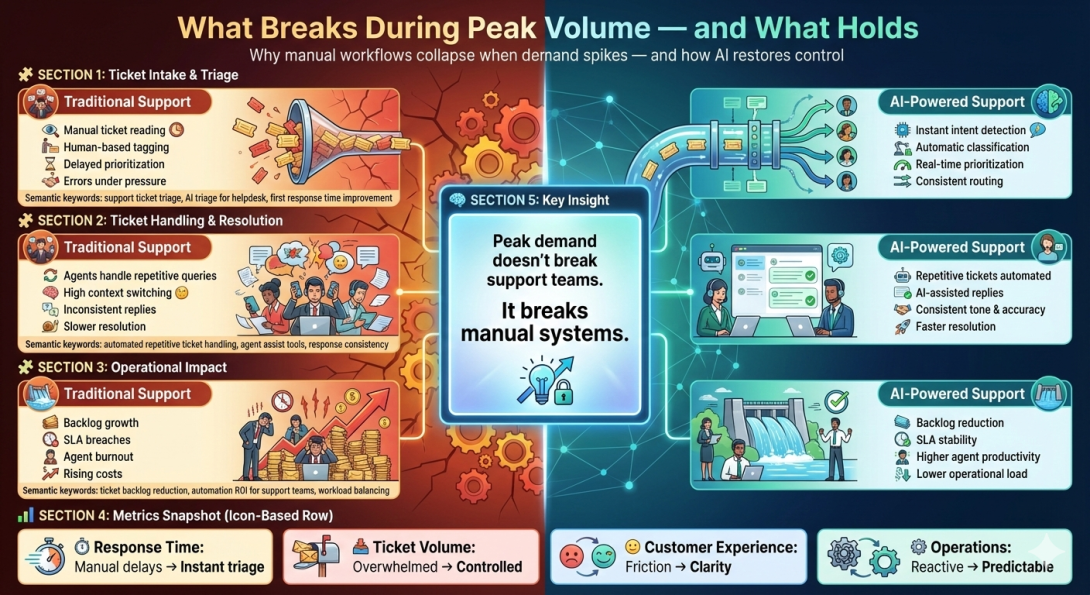
December places customer support under extreme pressure. Ticket volumes surge, response times slow, and customer expectations intensify — often at the same time, teams are already stretched thin.
The breakdown rarely comes from a lack of effort. It comes from workflows that depend too heavily on manual triage, repetitive handling, and human intervention at every step. Under high volume, these systems struggle to keep up.
AI changes how support operations absorb this pressure. Incoming messages are classified instantly, urgency is detected automatically, and repetitive requests are resolved without entering agent queues. Human teams spend less time sorting and more time solving.
Agent-assisted workflows further stabilize operations by reducing context switching, maintaining consistent tone, and accelerating responses without sacrificing quality. Proactive updates prevent issues from escalating into tickets, reducing overall volume when it matters most.
The result is not just faster support, but calmer, more predictable operations during periods that typically cause disruption. Teams operate with structure rather than urgency, and customers experience clarity rather than delay.
For organizations looking to build support systems that hold steady under peak demand, there’s far more to explore beneath the surface.