

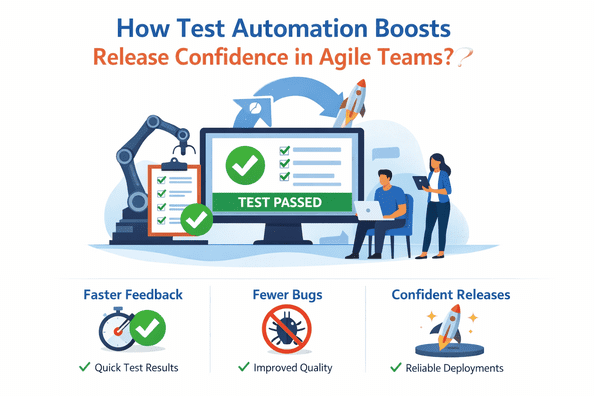
In today’s fast-paced software development environment, Agile teams release updates frequently. With continuous integration and rapid deployment cycles, maintaining quality while moving fast is a constant challenge. This is where test automation becomes critical. By automating repetitive tests and integrating them into CI/CD pipelines, teams can reduce risk, catch defects early, and gain confidence in their releases.
The Role of Test Automation in Agile
Agile emphasizes small, incremental releases. While this accelerates delivery, it also increases the chances of introducing defects into existing functionality. Manual testing alone cannot keep up with these rapid cycles.
Test automation addresses this challenge by:
- Running repetitive regression tests quickly
- Providing immediate feedback on code changes
- Ensuring critical workflows continue to function after each iteration
By integrating automated tests into each sprint, teams can detect issues early and avoid last-minute surprises before release.
Key Benefits for Release Confidence
- Early Defect Detection
Automated tests run as part of CI/CD pipelines, checking new code against existing functionality. This early feedback helps teams identify and fix defects before they escalate, reducing the risk of production failures. - Consistent Regression Testing
Regression testing ensures that previously working features continue to perform as expected. Automated regression tests can run frequently, covering critical workflows such as payment processing, user authentication, and data handling. This consistency increases trust in the stability of the release. - Faster Feedback Loops
Rapid feedback is a hallmark of Agile. Automated tests provide almost instant results, enabling developers and QA teams to address issues quickly. Faster detection reduces bottlenecks and prevents minor issues from snowballing into major problems. - Improved Test Coverage
Automation allows teams to cover more scenarios than manual testing alone. By testing multiple input combinations, edge cases, and workflows, teams can identify issues that might otherwise remain hidden. This broader coverage strengthens confidence that the software will perform as expected. - Reduced Human Error
Manual testing is prone to mistakes, especially when repeating the same steps across multiple releases. Automation ensures tests are executed consistently and accurately every time, improving reliability and trust in the results.
Integrating Test Automation Into Agile Workflows
To maximize the benefits, test automation must be integrated thoughtfully into Agile practices:
- Continuous Integration (CI): Automated tests should run with every code commit to catch defects early.
- Regression Suites: Maintain a suite of automated tests for critical features that runs regularly.
- Test Prioritization: Focus automation efforts on high-risk areas and frequent user flows.
- Collaboration: Developers and testers should work together to identify scenarios suitable for automation.
By embedding automation into the Agile workflow, teams create a safety net that allows faster and more confident releases.
Real-World Examples
Many leading tech companies use test automation to maintain release confidence in Agile environments:
- Spotify leverages automated regression tests to ensure that new features don’t break existing playlists or subscription flows.
- Netflix integrates automated testing into CI/CD pipelines to validate content delivery and recommendation algorithms before deployment.
These companies demonstrate how automation supports frequent releases without sacrificing quality.
Common Challenges
Despite its benefits, test automation comes with challenges:
- Initial Investment: Creating and maintaining automated tests requires upfront effort.
- Flaky Tests: Unstable or unreliable tests can erode confidence rather than build it.
- Maintenance Overhead: As features evolve, automated tests must be updated to remain relevant.
Agile teams overcome these challenges by regularly reviewing test suites, prioritizing critical workflows, and combining automation with manual exploratory testing.
Metrics to Measure Automation Effectiveness
To ensure automation genuinely boosts release confidence, teams should track meaningful metrics:
- Test Pass Rate: The percentage of automated tests passing on each build.
- Defect Detection Rate: How many defects are caught by automation compared to total defects.
- Regression Coverage: Percentage of critical workflows covered by automated tests.
- Flaky Test Rate: Frequency of tests failing without real defects.
Monitoring these metrics helps teams optimize their test automation strategy and continuously improve quality.
Final Thoughts
For Agile teams, test automation is more than a time-saver—it’s a confidence builder. By automating regression tests, increasing coverage, and providing rapid feedback, teams can release frequently without sacrificing quality. Integrating automation thoughtfully into CI/CD pipelines and Agile workflows ensures that releases are both fast and reliable.
Ultimately, when automation focuses on critical workflows, tracks meaningful metrics, and complements manual testing, it transforms uncertainty into confidence, allowing teams to deliver software that meets user expectations consistently.