

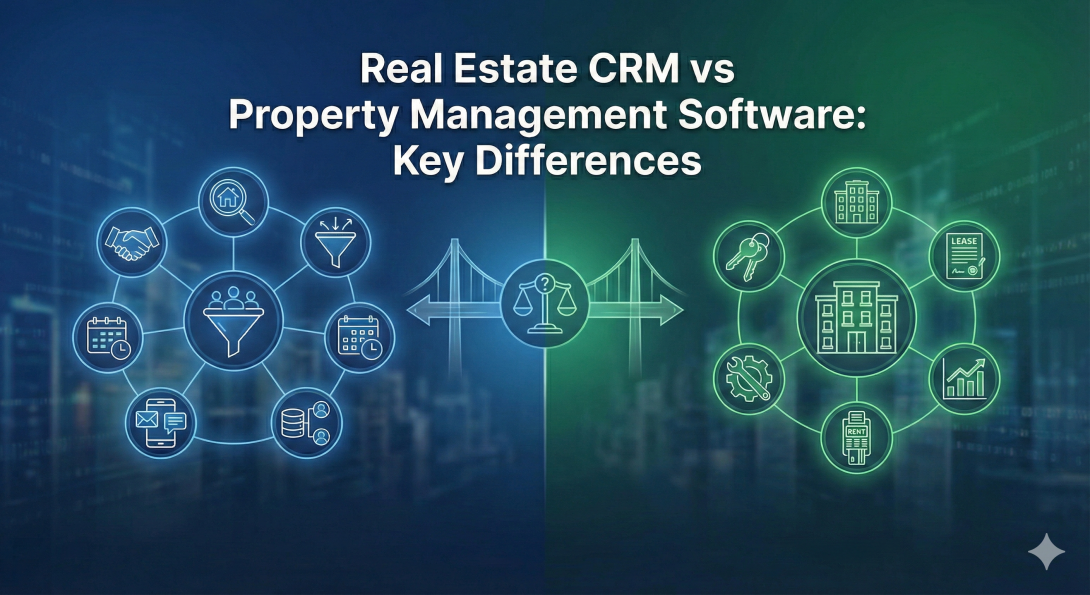
The real estate industry is rapidly shifting toward smarter, digital-first operations. As a part of this digital transformation, and in the case of real estate, companies increasingly depend on software to generate leads, take care of tenants, optimize workflows, and better analyze data/support decision making.
Real Estate CRM and Property Management Software are two of the most important tools in this environment. Despite the fact that both work for real estate businesses, they are produced for very different purposes. Knowing these differences will better guide you to the solution that works best for you.
What Is Real Estate CRM Software?
A Real Estate Customer Relationship Management (CRM) system is designed to help real estate agents, brokers, and sales teams manage leads, automate follow-ups, track communication, and streamline the sales pipeline.
In simple terms, it is a tool that supports everything from the first inquiry to the final closing.
Core Purpose of Real Estate CRM
A real estate CRM focuses primarily on:
- Lead management
- Sales funnel tracking
- Automated communication
- Client nurturing
- Performance analytics
It ensures that no lead is lost, follow-ups happen on time, and agents can deliver more personalized communication.
Many companies consult real estate CRM development experts to build tailored systems aligned with their workflow.
Who Benefits Most From CRM?
Real estate CRM solutions are most useful for:
- Real estate agents
- Brokerage firms
- Developer sales teams
- Marketing agencies targeting property buyers
If your primary goal is to sell properties faster and communicate more efficiently with buyers, a CRM is essential.
What Is Property Management Software?
Property Management Software (PMS) is designed for landlords, property managers, and building owners who need to manage properties, tenants, payments, and maintenance activities.
While it includes communication tools, it focuses more on operational management rather than sales.
Core Purpose of Property Management Software
A PMS typically handles:
- Tenant onboarding and screening
- Rent collection and financial tracking
- Property maintenance and service requests
- Lease management
- Compliance documentation
Real estate firms that want full operational control often choose to develop a property management software tailored to their portfolio size and business model.
Who Should Use Property Management Software?
PMS is ideal for:
- Landlords managing multiple units
- Commercial property managers
- Co-living operators
- Residential societies
- Real estate investment firms
If your team deals with tenants regularly or handles recurring operational tasks, PMS is the right choice.
Key Differences Between Real Estate CRM & Property Management Software
Although both tools belong to the real estate ecosystem, they support very different functions. Here is a closer look at the major distinctions:
1. Objectives and Use Cases
- CRM: Focuses on attracting, nurturing, and converting leads into customers.
- PMS: Focuses on managing tenants, properties, and operational workflows.
A CRM supports sales teams, while PMS supports property managers.
2. Customer vs Tenant Management
A CRM helps track:
- Prospects
- Buyers
- Investors
- Referrals
On the other hand, PMS handles:
- Tenants
- Renters
- Lease renewals
- Maintenance complaints
3. Workflow Differences
CRM workflow includes:
- Lead capture
- Automated email/SMS follow-ups
- Site visit scheduling
- Deal negotiation
- Sales closing
PMS workflow includes:
- Rent reminders
- Payment tracking
- Maintenance coordination
- Tenant communication
- Property inspections
4. Communication Style
- CRM: Communication is oriented toward persuasion and sales.
- PMS: Communication centers around issue resolution and operational transparency.
5. Reporting & Analytics
CRM analytics include:
- Lead source performance
- Conversion rates
- Agent productivity
- Sales forecasts
PMS analytics include:
- Occupancy rates
- Maintenance costs
- Rent trends
- Tenant satisfaction
6. Integrations
CRM integrates with:
- Marketing automation tools
- Lead marketplaces
- Call/SMS platforms
PMS integrates with:
- Payment gateways
- Maintenance vendors
- Accounting tools
Conclusion
Real Estate CRM and Property Management Software might appear to do the same thing, but they fulfil two very different roles. CRM is focused on sales and lead nurturing, PMS is about operation management and tenant workflows. Which solution is right for you depends on whether your main objective is to sell more property or manage it better.
Now, as the digital transformation of real estate accelerates, companies that implement a combination of these two systems built specifically for their operations have a huge advantage.
By collaborating with real estate CRM development professionals or developing a customized PMS, your property business operates more effectively and grows steadily.