

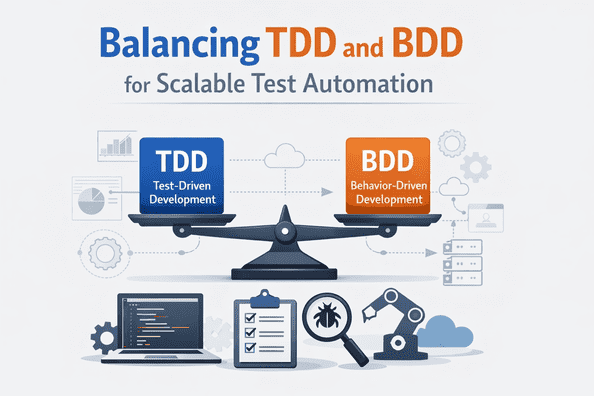
Microservices architecture has transformed how modern applications are built and scaled. By breaking systems into smaller, independent services, teams can develop and deploy features faster. However, this flexibility also introduces complexity in testing. Ensuring that each service works correctly—both independently and as part of a larger system—requires structured testing approaches. This is where understanding tdd vs bdd becomes essential.
Both Test-Driven Development and Behavior-Driven Development play a key role in building scalable testing workflows for microservices. In this article, we’ll explore how tdd vs bdd supports microservices testing and how teams can use them effectively.
Challenges in Microservices Testing
Before diving into solutions, it’s important to understand the challenges:
- Multiple independent services
- Complex inter-service communication
- Frequent deployments and updates
- Difficulty in end-to-end validation
These challenges require a testing strategy that is both flexible and scalable.
Role of TDD in Microservices Testing
TDD focuses on testing individual components before implementation, making it highly suitable for microservices.
1 Service Level Testing
Each microservice can be tested independently.
Benefits
- Ensures correctness of individual services
- Detects issues early in development
- Simplifies debugging
2 Encourages Loose Coupling
TDD promotes designing services with minimal dependencies.
Impact
- Easier testing
- Better scalability
- Improved maintainability
3 Supports Continuous Development
TDD provides fast feedback during development.
Outcome
- Faster iterations
- Reduced defects
- Reliable codebase
Role of BDD in Microservices Testing
BDD focuses on behavior and workflows, making it ideal for validating interactions between services.
1 Scenario Based Testing
BDD defines how services should behave in real-world scenarios.
Example
- User places an order
- Payment service processes the transaction
- Notification service sends confirmation
2 Validates End to End Workflows
BDD ensures that multiple services work together correctly.
Benefits
- Detects integration issues
- Ensures business logic accuracy
- Improves user experience
3 Enhances Collaboration
BDD involves developers, testers, and business stakeholders.
Result
- Clear understanding of requirements
- Better alignment across teams
Combining TDD vs BDD for Scalable Workflows
The real strength lies in combining both approaches.
How They Work Together
- TDD ensures each microservice works correctly
- BDD ensures services work together as expected
Example Workflow
1 Define system behavior using BDD scenarios
2 Break workflows into individual services
3 Use TDD to implement and test each service
4 Validate interactions through BDD tests
This combination creates a robust and scalable testing strategy.
Benefits of Using TDD vs BDD in Microservices
- Improved service reliability
- Better integration validation
- Faster defect detection
- Enhanced scalability
- Reduced risk in deployments
These benefits are critical for complex distributed systems.
Integration with CI CD Pipelines
Microservices environments rely heavily on CI CD pipelines.
TDD Contribution
- Unit tests run on every code change
- Immediate feedback on service-level issues
BDD Contribution
- Scenario tests validate workflows
- Ensures system-wide correctness
Together, they enable continuous testing across services.
Best Practices for Scalable Testing Workflows
To effectively use tdd vs bdd in microservices:
- Keep services small and independent
- Focus TDD on unit and service-level testing
- Use BDD for integration and workflow validation
- Automate tests for continuous execution
- Maintain clear and reusable test scenarios
These practices ensure scalability and efficiency.
Common Challenges
Teams may face challenges such as:
- Managing test environments
- Handling service dependencies
- Maintaining large test suites
- Balancing speed and coverage
Addressing these challenges requires proper planning and tooling.
Role of Modern Tools
Modern tools simplify microservices testing by:
- Automating test execution
- Managing distributed systems
- Capturing real interactions
For example, platforms like Keploy can generate test cases from real API calls, helping validate both individual services and their interactions.
Real World Example
Consider an e-commerce platform built with microservices.
Services
- Product service
- Order service
- Payment service
- Notification service
Without TDD and BDD
- Integration failures
- Difficult debugging
- Unreliable workflows
With TDD and BDD
- Each service is tested independently
- Workflows are validated end to end
- System becomes scalable and reliable
This demonstrates the effectiveness of combining both approaches.
Conclusion
Understanding tdd vs bdd is essential for building scalable microservices testing workflows. TDD ensures the reliability of individual services, while BDD validates interactions and business workflows across the system.
When used together, they provide a comprehensive testing strategy that supports scalability, improves reliability, and enables faster, more confident releases in modern microservices architectures.