

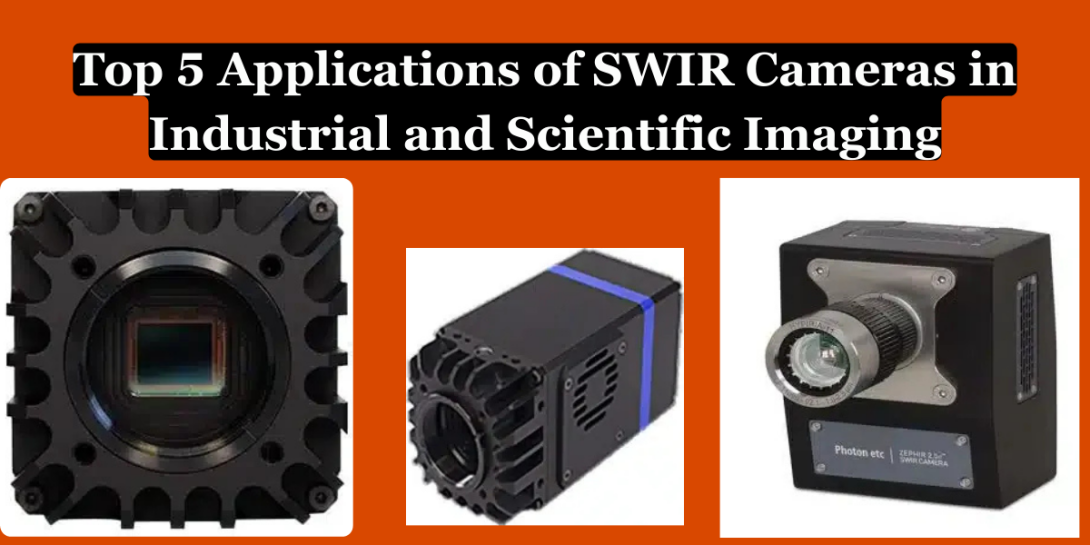
Short-wave infrared (SWIR) cameras have become the most powerful imaging tools in industry and the scientific realm, performing tasks that were unattainable with traditional imaging systems. Generally speaking, wavelengths between 900 nm and 2500 nm qualify these cameras for the term short-wave infrared visibility, making them see what cannot be perceived by the human eye or standard visible-light cameras. The special feature of being able to pass through specific materials, such as moisture detection, temperature mapping, and composition dissimilarities within constituents, gives them their importance in modern imaging.
However, the technology required to make these devices has advanced significantly, but the cost has become increasingly affordable with innovations in sensor design and increased demand from several sectors. Here is a detailed analysis of the five most typical applications of SWIR cameras in industrial scientific imaging.
Semiconductor Inspection and Wafer Analysis
The semiconductor industry requires tools of ultra-precise inspection to ensure yields and efficiency are kept high. SWIR cameras can perform extremely well within this space, particularly when inspecting silicon wafers.
- Why SWIR? Silicon becomes transparent at SWIR wavelengths; hence, cameras can see into the substrate, enabling the detection of micro-cracks, voids, or defects under the surface that may otherwise not be detected in the visible spectrum.
- Use Cases: Inspections of photovoltaic cells, wafer alignment, and detecting internal bonding failures created during production.
- Benefits: Early detection equals less waste, better quality, and less time lost on machinery when it is down.
Detection of Moisture in Agriculture and Food Processing
Moisture content has a significant role in the quality and, consequently, the shelf life of agricultural products as well as processed food. SWIR imaging provides a non-contact, real-time manner for the detection of water content in biological materials.
- Why SWIR? Water absorbs light very well in the SWIR spectrum (especially around 1450 nm and 1950 nm), and this absorption forms an excellent method for visualizing the area with various moisture levels.
- Use Cases: Differentiating fruits from their stage of ripeness or oven dryness, monitoring drying processes of grains, and inspecting baked goods for moisture uniformity.
- Benefits: Better food safety, enhanced automation in the process, and a significant reduction of wasted raw materials.
Thermal Imaging at High Temperatures
While LWIR cameras are widely used for thermal imaging, SWIR cameras excel in specific high-temperature industrial applications where LWIR sensors may saturate.
- Why SWIR? An SWIR sensor can detect emitted light from extremely hot objects radiating in both the visible and SWIR bands above 250°C. Better imaging results can be obtained in processes involving intense heat.
- Use Cases: Monitoring glass furnaces, steel forging, and heat treating processes known to produce conditions where conventional IR sensors can saturate.
- Benefits: It provides a correct representation of how glowing hot components look, helps create temperature profile data, and ensures safety at work.
Laser Beam Profiling and Optical Alignment
SWIR cameras are used to map an invisible laser beam using an optical collimator lens that focuses the beam into its detection area. Such analysis is important in optics manufacturing, telecommunications, and quantum computing.
- Why SWIR? Most industrial lasers emit light in the 1064 or 1550 nanometers range – wavelengths invisible to traditional cameras, but which can be detected by SWIR.
- Use Cases: Beam diagnostics for fiber lasers, alignment of optical components, and characterization of laser mode patterns.
- Benefits: Guarantees much accurate alignment, avoidance of very expensive mistakes due to misalignment, and an overall reliability of optical systems.
Biological and Chemical Imaging in Scientific Research
Scientific imaging usually takes place in cases where samples have to be viewed without killing them. Such is SWIR imaging, as it allows researchers to distinguish one organic material from another based on the specific absorption and reflection characteristics.
- Why SWIR? Several tissue types, compounds, or materials reflect in SWIR wavelengths differently, allowing chemical contrast.
- Use Cases: Imaging soil germs, visualising tissue hydration, and analysing pharmaceutical coatings.
- Benefits: Non-invasive, chemical-specific imaging supports breakthroughs in environmental science, life sciences, and drug development.
Conclusion
SWIR cameras are not just for specialists. They are now necessary in the industrial world for automation, quality assurance, scientific research, and safety. From analysing silicon wafers to monitoring food quality and profiling high-energy lasers, SWIR is opening up a hidden world. As technology matures and the price of SWIR cameras lowers, so will the speed of adoption across industries. It will be a strategic necessity for organisations that intend to remain competitive and push frontiers in science.