
Introduction: Rethinking Software Development in the Age of Intelligence
The way software is developed, tested, and delivered is undergoing rapid transformation as artificial intelligence, particularly Generative AI, embeds itself into every phase of the Software Development Life Cycle (SDLC). Traditional development models are often time-consuming, error-prone, and dependent on repetitive manual processes. In contrast, Generative AI is introducing automation, intelligence, and context-aware decision-making into workflows. These changes are not just evolutionary. They are revolutionary. Companies across sectors are realizing that to stay competitive, they must modernize their SDLC with intelligent technologies. India is emerging as a global leader in this transformation. With its rich pool of AI talent, cost-effective development models, and strategic investments in AI education and infrastructure, India is driving a new era of smart software delivery. Leading firms like V2Soft are at the centre of this evolution. Their AI innovation platform, SANCITI AI, supports end-to-end SDLC modernization by integrating Generative AI into requirement analysis, design generation, code synthesis, testing, and post-deployment optimization. In this blog, we explore how organizations are using Generative AI not only to accelerate development timelines but also to reduce costs and improve software quality. We will also compare adoption trends between India and the United States while showcasing how businesses can leverage this shift to gain a sustainable edge in the digital economy.
Enabling Faster and Smarter Development with AI in SDLC
The incorporation of artificial intelligence into software development is no longer a theoretical exercise. Businesses globally are actively using AI to accelerate and optimize every part of the development cycle. One of the most compelling examples is AI in SDLC which refers to the use of AI tools and models to automate planning, code generation, testing, debugging, and more. India, which already accounts for more than 45 percent of global software development outsourcing, has shown faster AI adoption than the US in areas like test automation, bug detection, and coding suggestions. While US companies are investing heavily in AI infrastructure, Indian IT firms like V2Soft have a head start due to their early embrace of hybrid delivery models that include cloud-native AI deployment. V2Soft’s platform SANCITI AI has helped businesses reduce manual testing by 60 percent and improve requirement-to-code traceability through NLP-driven tools. Generative AI further augments development by converting business logic into prototype code, making developers more efficient and reducing errors. Compared to traditional SDLC methods where test cycles could take weeks, AI-enabled pipelines now deliver releases in a matter of days. The rise of low-code platforms powered by AI is further streamlining backend and frontend development. Indian developers are increasingly skilled in AI tools like Copilot, Bard, and TensorFlow which supports India's global position as an innovation hub. As AI becomes embedded into enterprise architecture, development will increasingly depend on intelligent collaboration between human engineers and machine learning algorithms.
Exploring the Benefits of Using AI in SDLC for Efficiency
The business case for integrating AI into software engineering is compelling. From reducing manual work to improving predictability, the Benefits of using AI in SDLC are becoming increasingly essential to modern software practices. One of the most important advantages is the ability to generate real-time feedback loops across SDLC stages. This means developers and testers receive continuous insights, resulting in fewer errors and faster iterations. In India, where teams work across multiple time zones and verticals, AI enables consistent productivity without increasing headcount. According to IDC, companies that integrated AI into their SDLC saved an average of 35 percent on project delivery costs and reported a 27 percent improvement in code quality. These benefits are further amplified when using AI to generate user stories, automate regression testing, and simulate security attacks for vulnerability assessments. In the US, large enterprises are slowly integrating AI through in-house R&D programs. In contrast, Indian firms, led by agile SMEs and mid-sized IT service providers, are deploying pre-built AI frameworks across client projects. This flexibility enables quicker proof-of-concept rollouts and industry-specific AI applications. V2Soft’s implementation of SANCITI AI demonstrates these benefits through smarter issue tracking, self-healing test cases, and AI-driven sprint planning. In fact, one of their BFSI clients reduced release delays by 52 percent and accelerated customer onboarding by 40 percent after full SDLC AI integration. These numbers confirm that businesses no longer view AI as optional but essential for long-term success and operational resilience.
How Generative AI at Different Phases of SDLC Is Revolutionizing Development
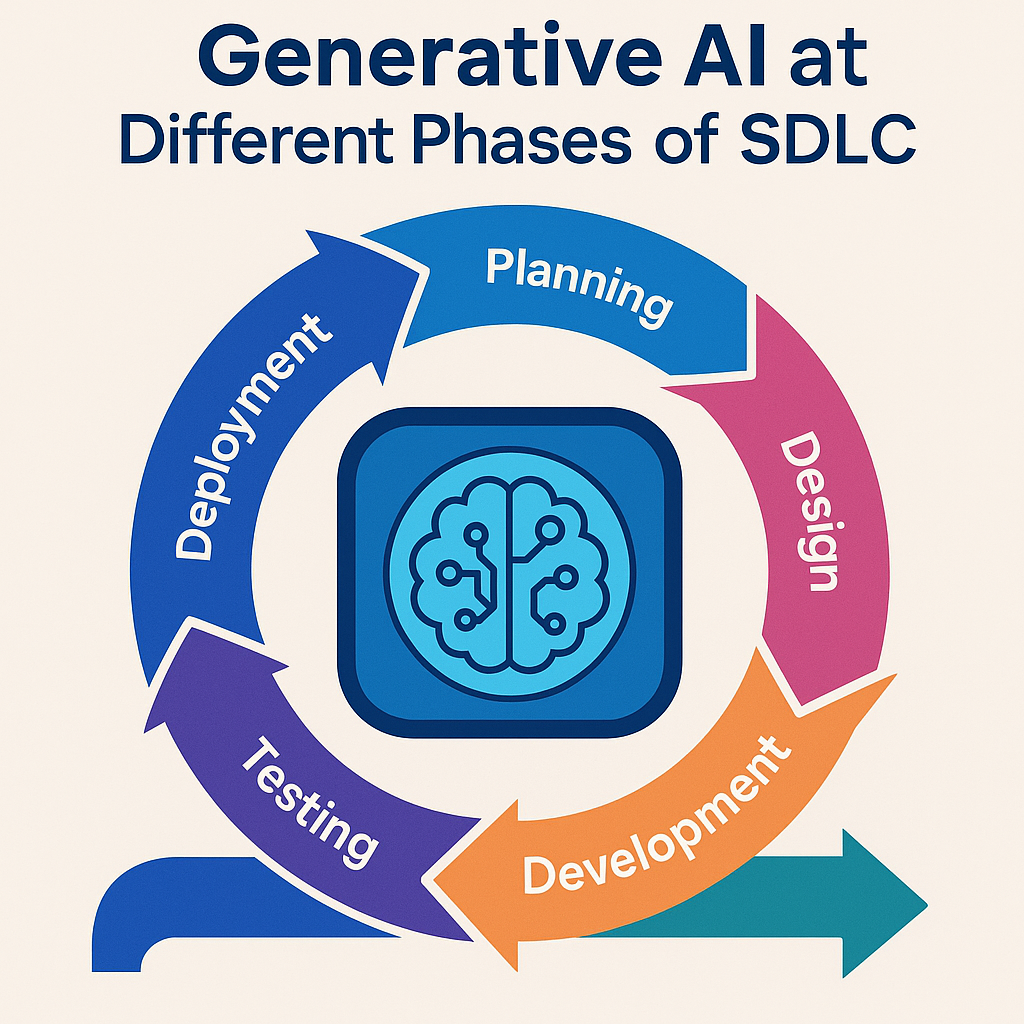
The true power of Generative AI lies in its adaptability across multiple stages of software development. Companies are now integrating Generative AI at different phases of SDLC such as planning, design, coding, testing, and maintenance. In the initial planning phase, AI can process business documentation to generate requirement templates and user flows. During the design phase, tools use image recognition and UX models to auto-generate wireframes or design suggestions. In coding, Generative AI synthesizes code snippets or full modules based on prompt inputs. This significantly reduces time spent on writing boilerplate code. In testing, AI enables intelligent test case generation and failure prediction. During deployment, AI assists in performance optimization and root cause analysis. V2Soft has operationalized this with its SANCITI AI engine which plugs into each SDLC layer. Clients can customize AI behaviour to match regulatory needs or industry compliance frameworks. In India, cross-functional teams are trained to adopt Generative AI via integrated workflows using open-source LLMs and proprietary APIs. US teams, although advanced in research, are often segmented into specialized units which creates silos and delays integration. This gives Indian firms an edge in holistic adoption. Generative AI doesn’t just speed up delivery, it also brings consistency and predictive accuracy to SDLC. Whether it’s transforming user stories into sprint-ready tasks or auto-documenting code and change logs, its potential to redefine how software is built is vast and growing.
Strategic Transformation with Software Development Life Cycle with Generative AI
Many CIOs are now aligning their digital strategies around Software Development Life Cycle with Generative AI because it supports scalability, innovation, and operational continuity. A recent survey by Accenture found that 62 percent of software leaders expect Generative AI to be embedded across their SDLC within the next three years. Companies that begin adopting it today will lead in speed, innovation, and service delivery tomorrow. V2Soft’s implementation strategy includes combining AI models with business domain knowledge to generate more accurate technical outcomes. Their clients have reported a 40 percent faster go-to-market timeline and over 70 percent reduction in change request errors. The secret lies in Generative AI’s ability to auto-learn from domain-specific repositories and apply logic across multiple projects. In India, software developers are quickly moving from code-based work to AI model curation roles. This shift is opening new career paths while also helping companies maintain quality with fewer resources. US firms are investing heavily in compliance and ethics frameworks to deploy Generative AI responsibly. While this is essential, it also slows initial adoption. Indian firms, under the guidance of government-backed AI initiatives and flexible sandbox testing environments, are accelerating rollout with proper safety checks in place. This proactive environment makes India a strong global contender for AI-first software development.
Integrating Intelligence with Generative AI in SDLC for Quality Assurance
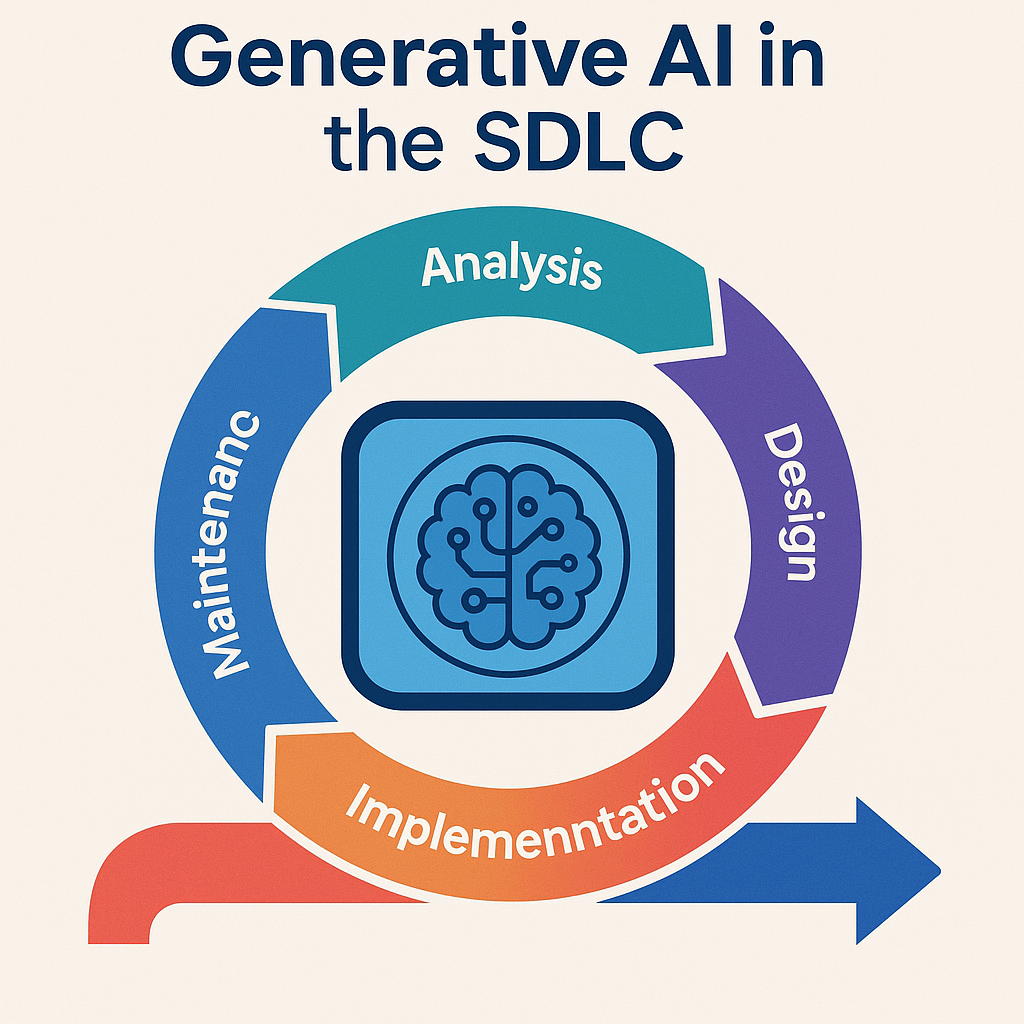
Quality assurance is no longer limited to detecting bugs at the end of development. With Generative AI in SDLC embedded from the beginning, QA becomes a continuous, intelligent, and data-informed process. AI models can now analyse commit history, flag potential defects, and recommend test optimizations before testing even begins. This saves both time and effort while improving code reliability. V2Soft uses its SANCITI AI platform to build real-time QA dashboards and generate automated reports based on live data feeds. These features allow QA engineers to focus on edge cases and strategic test planning rather than routine tasks. In India, developers now undergo AI-driven training programs that include machine learning integration and QA optimization using generative frameworks. Compared to the US, where QA remains somewhat isolated from core development functions, Indian workflows are more integrated and agile. This helps Indian teams deliver faster while maintaining compliance and quality. Clients working with Indian outsourcing firms have reported an average of 47 percent improvement in release stability after adopting AI-enabled QA strategies. As AI continues to evolve, its contribution to QA will include anomaly detection, root cause mapping, and even ethical bias assessments. These capabilities ensure that AI-enhanced software development is not only fast but also ethical and trustworthy.
Conclusion: Generative AI Is the Future of Smart Software Development
The evolution of software development is entering a new phase. Generative AI is transforming how teams design, build, test, and deploy applications. With intelligent automation and predictive modelling now embedded in SDLC, companies are achieving results faster, with fewer errors, and with more business value. India stands at the forefront of this revolution by offering a powerful mix of talent, cost efficiency, and technical agility. V2Soft and its SANCITI AI platform represent how Indian innovation is setting global benchmarks in smart development. Compared to traditional practices still used in some Western firms, Generative AI enables faster decision-making, continuous learning, and scalable operations. Businesses that act now to integrate AI across their SDLC will lead the digital economy. The future belongs to organizations that not only build software but also build intelligence into every step of development.
Have Questions? Ask Us Directly!
Want to explore more and transform your business?
Send your queries or challenges to:
vtusoftbglr@gmail.com / info@v2soft.com