

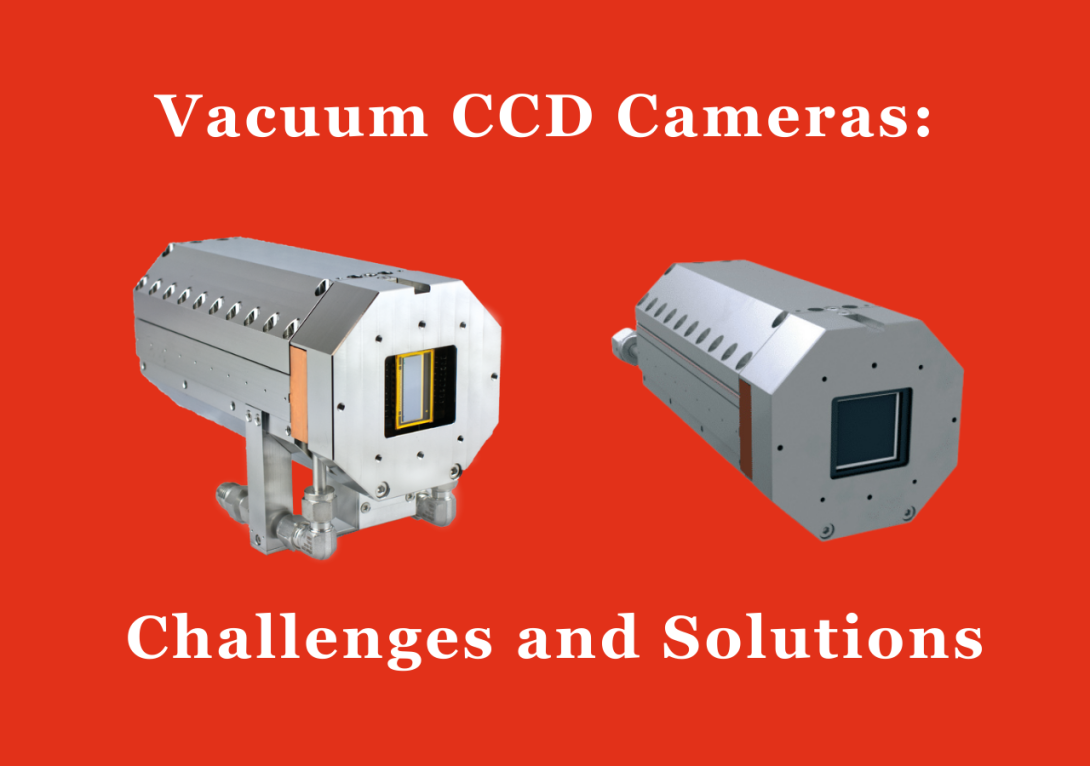
In science and high-tech industries, imaging devices often need to be designed to operate in environments where standard electronics are expected to fail. An example would be the use of in-vacuum charge-coupled device (CCD) cameras, which are indispensable for experiments inside ultra-high vacuum (UHV) chambers, synchrotrons, and accelerators. Unlike common cameras, these must operate in a vacuum, facing high radiation doses and extreme thermal gradients, requiring creativity and durability.
Why Go In-Vacuum?
Scientific research primarily utilises external cameras that observe through chamber windows. Although it is a workable solution, various factors, including distortion, signal loss, and alignment issues, persist. Inserting a camera into the vacuum space enables scientists to achieve superior sensitivity, higher resolution, and greater accuracy in object positioning. This direct approach minimises optical compromises and allows for clearer imaging of delicate processes, such as particle collisions, X-ray scattering, or cryogenic experiments.
Core Challenges
For CCD cameras to function under vacuum conditions, technical manoeuvres must be performed that would generally be untenable in all commercial environments.
- Vacuum compatibility: Ordinary polymers, adhesives, and lubricants emit vapours (outgassing) under vacuum that may contaminate experiments. Only metals, ceramics, or vacuum-approved plastics are permitted. Connectors must be engineered to prevent leakage or degradation.
- Thermal regulation: CCD sensors are extremely sensitive to temperature variations. In a vacuum, a lack of convection means heat will build up fast. Without regulation, electronic noise will increase. Solutions depend on conduction pathways, liquid nitrogen cold fingers, or thermoelectric coolers connected to chamber walls.
- Radiation exposure: Radiation degrades the semiconductors in the CCD, increasing dark current while decreasing sensitivity. Cameras must be protected inside lead or tungsten shields, and often, only the sensor head is positioned inside the vacuum, while other electronics are kept on the outside.
- Limited accessibility: Once sealed and evacuated, maintenance will be challenging and not straightforward. Cameras must incorporate a long-life design, extensive reliability testing, and, in some cases, a modular design to allow independent replacement of sensor heads.
- Signal transmission: For direct extraction of larger volumes of image data, stable high-bandwidth feedthroughs are required. While metal cabling tends to be the norm, fibre-optic feedthroughs are gaining preference due to their superior noise immunity and reliability.
Solutions and Innovations
The successful commissioning of in-vacuum CCDs is a fine balance of intelligent material solution and stout engineering:
- Housing units are made out of stainless steel or aluminium alloys, and all components are pre-baked to reduce outgassing.
- Thermal design is treated as the heart: in most systems, Peltier cooling is used along with carefully managed heat sinks, and in advanced designs, liquid nitrogen is fed directly into the cooling channel.
- To prevent overstressing the imaging system, radiation-hardened modular designs keep delicate electronics away from the hostile environment, placing only the imaging sensor inside the chamber.
- Thanks to the development and use of fibre optics for data handling, high-speed transmission with electromagnetic cleanliness has been ensured.
- Designing the systems under the "no service guaranteed" philosophy has ensured reliability. Each chamber is practically sealed, tested, and expected to operate for years unattended.
Where They're Used
These cameras have opened completely new experimental possibilities in several challenging terrains:
- Synchrotrons: recording fast and faint X-ray diffraction patterns without losing photon efficiency.
- Particle accelerators, for instance, are used for research, diagnostics and alignment of particle beams.
- Cryogenic experiments: capturing processes very close to absolute zero, where normal optics fail.
- Space simulation facilities: testing spacecraft components under extremes of deep vacuum and temperature.
Looking Ahead
As demands in physics and materials are increasing, new fixes are on the way for the in-vacuum imaging of tomorrow:
- CCDs are gradually being replaced by CMOS sensors, which are highly radiation-tolerant, less power-hungry, and more efficient in terms of speed.
- An advanced thermal management scheme is being developed using nanomaterials, such as graphene, which enable lightweight and ultra-efficient conductivity.
- Smart cameras that can adapt to changing conditions through AI-based calibration are being developed for enhanced reliability in long-term experiments.
- Miniaturised modules are being designed for nanotechnology and quantum research setups, where space is a premium.
Conclusion
Vacuum CCD cameras embody the fine balance between necessity and invention. By engineering materials, rewiring cooling, shielding electronics, and implementing resilience-directed design, engineers have developed tools to execute modern high-energy physics, synchrotron science, and space testing. Their evolution is again a testament to humankind's pushing into ever more severe frontiers—where capturing even one clear photon can illuminate the path to understanding the universe itself.