
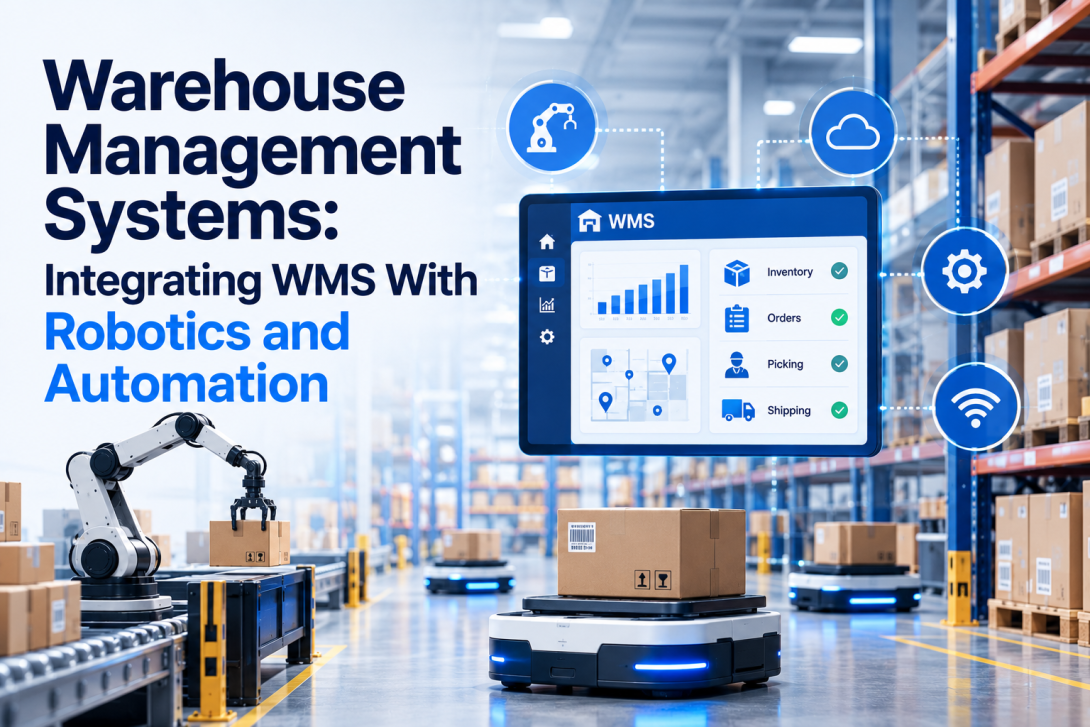
Warehouses are no longer managed only through manual picking, paper-based inventory records, and fixed workflows. Growing order volumes, shorter delivery expectations, labor shortages, and the need for better inventory accuracy are pushing warehouses toward connected systems. Warehouse Management Systems, robotics, automation, IoT devices, and data platforms are increasingly being used together to manage warehouse operations.
A Warehouse Management System, commonly called WMS, acts as the central software layer that manages inventory, warehouse locations, receiving, picking, packing, replenishment, shipping, and other warehouse activities. Robotics and automation add the physical capabilities needed to move, pick, sort, scan, and handle goods. When these technologies work together, the WMS can coordinate warehouse activities while automated equipment performs physical tasks.
What Is a Warehouse Management System?
A Warehouse Management System is software that helps businesses control and coordinate warehouse operations. It provides visibility into where products are stored, how much inventory is available, what orders need to be fulfilled, and which warehouse activities should happen next.
A modern WMS can manage the complete flow of goods from receiving to shipping. When products arrive at a warehouse, the system can record the receipt, assign storage locations, update inventory, and create tasks for warehouse workers or automated equipment. When an order is placed, the WMS can determine what inventory should be picked, where it is located, and how the picking process should be performed.
This makes the WMS more than an inventory database. It becomes an operational control layer that connects warehouse employees, business systems, machines, and data.
Why WMS Has Become the Center of Warehouse Operations
Modern warehouses often contain many systems operating at the same time. ERP software manages business and financial information. Order management systems manage customer orders. Transportation systems manage shipments. Conveyor systems move products. Autonomous mobile robots transport goods. Barcode scanners and IoT sensors collect operational data.
Without a central coordination layer, these systems can create disconnected workflows. The WMS helps bring them together by translating business requirements into warehouse tasks and sending instructions to the appropriate workers, machines, or automation systems.
Why Robotics Is Becoming Part of Warehouse Operations
Robotics can automate repetitive physical activities that traditionally required warehouse workers. Depending on the operation, robots can move inventory, transport containers, assist picking, sort packages, unload goods, or support pallet handling.
The International Federation of Robotics reported that 542,000 industrial robots were installed worldwide in 2024, more than twice the number installed ten years earlier. While industrial robots are used across many industries, the growth of professional service robots for transportation and logistics shows how strongly automation is also moving into warehouse and distribution operations.
Warehouse automation is not about replacing every human task. In many facilities, the practical goal is to move repetitive and physically demanding activities to machines while allowing employees to focus on exception handling, quality checks, supervision, problem solving, and tasks that require judgment.
Types of Robotics Used in Warehouses
Different warehouse activities require different types of robotic systems. Autonomous Mobile Robots can transport products or totes between locations. Robotic arms can perform picking, placing, palletizing, or depalletizing. Automated guided vehicles can move materials along predefined paths. Sorting robots can route packages according to destination or order information.
There are also robotic systems designed for specific warehouse tasks, such as unloading cartons from containers or assisting workers with picking. The correct technology depends on product characteristics, warehouse layout, order volumes, SKU variety, required throughput, and the level of automation already present in the facility.
How WMS and Robotics Work Together
The most important part of warehouse automation is not simply purchasing robots. The robots need to receive the right tasks at the right time. This is where WMS integration becomes important.
The WMS understands the business requirement. For example, it knows that an order needs five products picked from different warehouse locations. A robotics control system then determines which automated equipment can perform the required physical movement. The robot receives a task, performs it, and sends status information back to the warehouse system.
This creates a continuous communication cycle between software and physical operations. The WMS can create tasks, automation systems can execute them, and real-time updates can be returned to the WMS.
The Basic Integration Flow
A typical workflow may begin when an order enters the warehouse management system. The WMS checks inventory availability and determines the required picking activities. It then sends tasks to workers or automated equipment. A robot may transport a tote to a picking station, while another automated system moves completed orders toward packing.
Once the activity is completed, scanners, sensors, robots, or warehouse employees provide confirmation. The WMS updates inventory and order status and then creates the next required task.
This flow allows warehouse operations to respond to actual activity instead of relying only on predefined schedules.
Key WMS Integrations Required for Automation
WMS integration becomes more complex as the number of automated systems increases. A warehouse may have robots from different vendors, conveyors from another supplier, automated storage and retrieval systems, barcode scanners, weighing equipment, packing machines, and warehouse control systems.
The WMS therefore needs a reliable integration architecture that can communicate with these technologies without making the entire system dependent on one device or vendor.
WMS, WCS, and Robotics Control
A common architecture separates business-level warehouse decisions from equipment-level control. The WMS determines what needs to happen, while a Warehouse Control System or robotics orchestration layer can determine how automated equipment should execute the task.
This separation is useful because the WMS does not need to understand every technical detail of every robot. Instead, an integration layer can translate warehouse tasks into commands that individual automation systems understand.
DHL has highlighted the importance of this type of architecture. Its Logistics Trend Radar notes that adding more robotic systems increases integration and monitoring complexity and that APIs can connect different robots from different vendors to a single WMS.
Important Data That Must Move Between Systems
Successful automation depends on reliable data exchange. The WMS needs information from robots and automation equipment, while the automation layer needs accurate instructions from the WMS.
Important information can include inventory location, item identification, order number, task status, robot availability, storage location, picking priority, destination, error codes, and completion status.
Real-time information is particularly important when warehouses operate at high volume. If a robot reports that it cannot reach a particular location, the WMS or orchestration layer needs to know quickly so that the task can be reassigned rather than leaving the order waiting.
APIs and Event-Based Communication
APIs can support direct communication between warehouse software and external systems. Event-based architecture can also be used so that systems respond to operational events as they occur. For example, an inventory update can trigger a replenishment task, or the completion of a picking activity can trigger the next movement.
A well-designed integration layer should also handle errors. If a robot goes offline, an API request fails, or a task is interrupted, the system should record the problem and determine what should happen next.
Where Automation Adds the Most Value
Warehouse automation provides the most practical value when it addresses repetitive, measurable, and high-volume activities. Moving inventory between picking and storage areas is one example. Sorting packages, transporting totes, scanning products, and assisting repetitive picking operations are other areas where automation can reduce manual effort.
These figures show that warehouse automation is not limited to experimental facilities. Large logistics networks are increasingly treating robotics and connected systems as part of their regular operational infrastructure.
Improving Picking and Order Fulfillment
Picking is often one of the most labor-intensive warehouse processes. A WMS can optimize picking sequences and group orders, while robots can transport goods or assist workers. This combination can reduce unnecessary walking and allow employees to spend more time performing actual picking or exception-related activities.
The objective is not simply to make robots move faster. The complete process needs to be coordinated so that inventory, picking stations, robots, workers, packing areas, and shipping operations remain balanced.
WMS Development for Automated Warehouses
WMS development for an automated warehouse requires a different approach from building a basic inventory management system. The software needs to work with real-time warehouse events, machine availability, task priorities, inventory movements, and equipment failures.
A scalable WMS should support configurable workflows because different warehouses operate differently. One facility may use autonomous mobile robots, while another may use conveyors, automated storage systems, robotic arms, or goods-to-person solutions. The software should be able to accommodate these differences without requiring a complete redesign every time new equipment is introduced.
Choosing the Right Technology Partner
Businesses planning an automated warehouse also need to consider the capabilities of their technology development partner. The partner should understand warehouse processes as well as software architecture, APIs, automation systems, inventory management, and real-time data exchange. Citrusbug develops logistics software that can support businesses looking to connect warehouse operations with digital systems, automation technologies, and third-party logistics platforms.
The development process should begin with warehouse process mapping rather than immediately selecting a technology stack. Teams need to understand receiving, putaway, replenishment, picking, packing, returns, cycle counting, and shipping before deciding how automation should be connected. This helps ensure that the WMS is designed around actual operational requirements instead of being built as a generic inventory application.
Building for Future Automation
Warehouse technology changes quickly. A WMS designed around one specific robot or machine may become difficult to maintain when new equipment is introduced.
A better architecture separates core warehouse logic from device-specific integrations. This allows new automation technologies to be added through connectors or integration services rather than changing the complete WMS.
DHL reported that its use of a plug-and-play robotics integration platform allowed robotics integrations to be deployed up to 12 times faster than traditional custom coding setups. The company described the integration layer as a connection between its WMS and broader digitalization efforts.
How Integration in Logistics Connects the Wider Supply Chain
Integration in logistics goes beyond connecting robots to a WMS. Warehouses are part of a larger supply chain that includes suppliers, manufacturers, transportation providers, retailers, marketplaces, and customers.
A warehouse management system may need to exchange information with ERP platforms, transportation management systems, order management systems, e-commerce platforms, carrier systems, and customer-facing applications. When these systems are connected, inventory and order information can move across the supply chain with fewer manual handoffs.
For example, an order received from an e-commerce platform can enter the WMS automatically. The WMS can check inventory, generate picking tasks, coordinate robots, confirm packing, and send shipment information to the transportation system. The customer-facing platform can then receive an updated order status.
Using AI and Data With Warehouse Automation
Automation produces large amounts of operational data. Every movement, scan, delay, equipment failure, inventory change, and completed task can create information that can be analyzed.
AI can use this information to support demand forecasting, inventory planning, slotting, predictive maintenance, task prioritization, and anomaly detection. For example, if a particular robot repeatedly experiences failures in a specific operating condition, an analytics system can identify the pattern and help maintenance teams act before a larger disruption occurs.
From Automation to Agentic Logistics
The next stage is moving from fixed automation toward systems that can make decisions within defined operational boundaries. This is where the shift from automation to agentic logistics becomes relevant.
Traditional automation generally follows predefined rules. An agentic system can evaluate information, select an action, use connected systems, and respond to changing conditions within approved limits. In a warehouse, this could mean an AI agent identifying a delayed order, checking inventory, evaluating available robots and workers, and recommending or initiating a new task sequence.
However, agentic systems should not be given unrestricted control over warehouse operations. Important decisions need clear permissions, monitoring, audit trails, fallback procedures, and human oversight.
Digital Logistics Solutions and the Future of Warehousing
Digital logistics solutions are increasingly bringing warehouse software, robotics, IoT, analytics, transportation systems, and AI into a connected technology environment.
The future warehouse will not depend on one technology. Its performance will come from how well different technologies work together. A robot can move a product quickly, but the WMS needs to know where that product belongs. The WMS can create a task, but the robotics system needs to execute it. AI can recommend a better workflow, but the system needs accurate data to make that recommendation useful.
What Businesses Should Prioritize
Businesses planning warehouse automation should avoid starting with the question, “Which robot should we buy?” The better starting point is understanding which warehouse problems need to be solved.
The technology strategy should consider order volume, SKU characteristics, warehouse layout, labor requirements, existing systems, integration capabilities, expected growth, and return on investment. Automation should then be selected around these requirements.
A strong WMS should also provide visibility into performance. Managers need to understand inventory accuracy, order cycle time, picking productivity, equipment utilization, task completion, downtime, and exceptions. These metrics help determine whether automation is actually improving warehouse performance.
Conclusion
Warehouse Management Systems are becoming the software foundation for connected and automated warehouse operations. Robotics can handle physical movements, while the WMS coordinates inventory, orders, tasks, and warehouse processes. Integration connects these capabilities so that the warehouse can operate as one system rather than as a collection of independent technologies.
The growth of warehouse robotics shows that automation is becoming a practical part of logistics operations. However, buying robots alone does not create an automated warehouse. Businesses need reliable WMS architecture, API-based integrations, real-time data, automation orchestration, monitoring, security, and processes that can handle exceptions.
The next stage will involve greater use of AI and agentic systems that can support decisions and coordinate operations within controlled boundaries. Businesses that build flexible WMS and integration architectures today will be better positioned to add new robots, AI capabilities, IoT devices, and other warehouse technologies as their operational requirements change.