
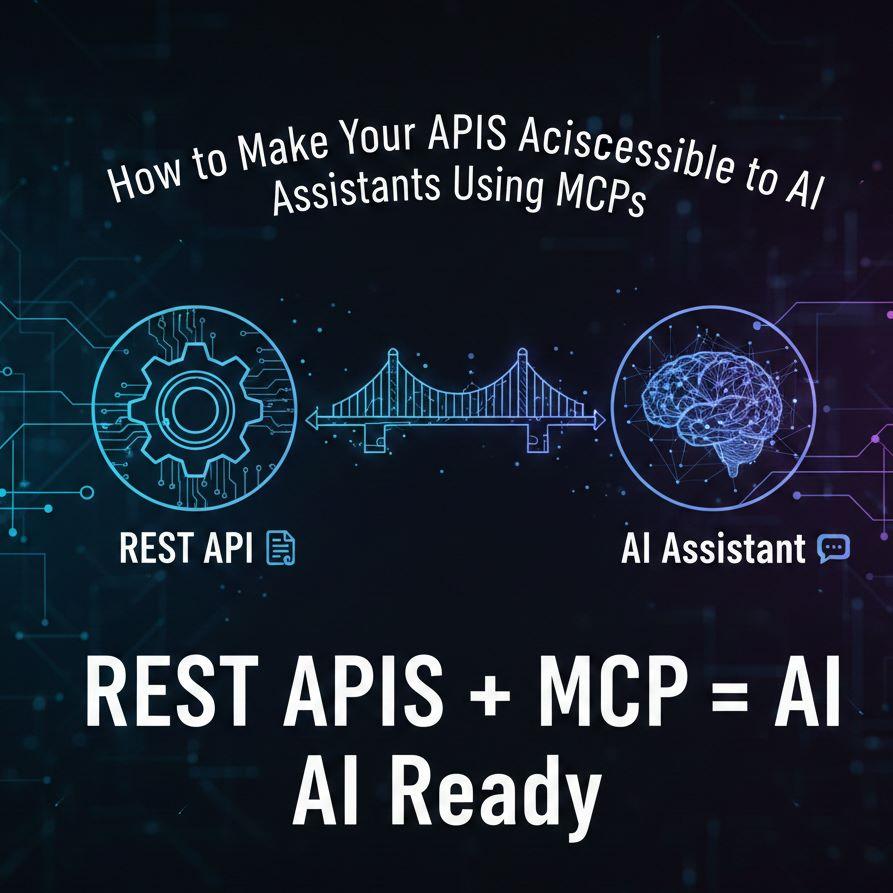
APIs have quietly powered the modern internet for over a decade. From payments and weather data to financial markets and messaging platforms, REST APIs sit behind nearly every digital experience we rely on today. But as artificial intelligence assistants become central to how users interact with software, an uncomfortable truth emerges:
Most APIs are invisible to AI.
AI assistants like Claude, ChatGPT, and others can reason, summarize, and generate content , but without structured access to your APIs, they’re stuck guessing or working with outdated data. If APIs are the engines of modern software, then Model Context Protocols (MCPs) are the ignition system that lets AI assistants actually drive them.
In a recent step-by-step guide, I explain exactly how to make your REST APIs accessible to AI assistants using MCPs , and why this shift is one of the most important changes API builders should care about today.
👉 Read the full guide here:
https://blog.apilayer.com/step-by-step-guide-how-to-make-your-rest-apis-accessible-to-ai-assistants-using-mcps/
The Problem: APIs Were Never Designed for AI
Traditional REST APIs assume a human developer in the loop. Someone reads documentation, understands endpoints, writes client code, and handles responses. That workflow breaks down when the “user” is an AI assistant.
AI systems don’t read documentation like humans do. They need APIs to be:
- Self-describing
- Machine-discoverable
- Explicitly callable through structured schemas
Without these qualities, even the best AI model can’t reliably interact with live systems. This is why most AI assistants today rely on scraped data, plugins, or hardcoded integrations , solutions that don’t scale.
MCPs change this completely.
What Are Model Context Protocols (MCPs)?
At a high level, MCPs provide a standardized way for AI assistants to discover what your API does, understand how to call it, and execute actions safely. Instead of writing custom plugins or SDKs for each AI platform, MCPs define a clear contract between your service and the AI.
Think of MCPs as a universal language that lets AI assistants say:
“I know what this API offers, I know how to call it, and I know what kind of response I’ll get.”
This abstraction unlocks something powerful: APIs that AI can use autonomously.
From Static Endpoints to Intelligent Tools
In the full article, I walk through how an ordinary REST API can be transformed into an MCP-enabled service. The process doesn’t require rewriting your backend or abandoning REST. Instead, it layers an MCP server on top of your existing API.
You’ll learn how to:
- Define API capabilities in a way AI assistants can understand
- Expose endpoints as callable “tools”
- Provide structured inputs and outputs
- Safely handle authentication and rate limits
- Test your API directly with AI assistants like Claude
One of the most compelling examples in the guide uses a market data API, where an AI assistant retrieves real-time stock information simply by interpreting a user’s natural-language request. No glue code. No brittle prompts. Just clean, structured interaction.
👉 See the full implementation here:
https://blog.apilayer.com/step-by-step-guide-how-to-make-your-rest-apis-accessible-to-ai-assistants-using-mcps/
Why This Is Bigger Than a Technical Detail
Making your APIs accessible to AI assistants isn’t just about convenience , it’s about distribution and relevance.
As AI assistants become the default interface for searching, planning, and decision-making, users won’t browse dashboards or documentation as often. They’ll ask an AI to do things for them.
If your API isn’t AI-accessible, it risks becoming invisible.
On the other hand, MCP-enabled APIs gain:
- New usage channels via AI assistants
- Higher engagement without additional frontend work
- Faster adoption by developers and AI platforms
- A competitive edge in an AI-first ecosystem
This is especially important for SaaS platforms, data providers, fintech APIs, and automation services. When an AI assistant can directly call your API, your product becomes part of the user’s everyday workflow.
Who Should Read the Full Guide?
This isn’t just for AI researchers or early adopters. The guide is valuable if you are:
- A backend or API developer building modern services
- A product manager planning AI-driven features
- A founder looking to future-proof your platform
- A technical lead exploring agent-based architectures
- Anyone curious about where APIs and AI are heading next
The article breaks concepts down clearly, avoids unnecessary theory, and focuses on practical implementation.
The Shift Has Already Started
We’re moving away from apps that require users to click through interfaces and toward systems that understand intent. AI assistants are becoming the operating layer, and APIs are becoming the action layer beneath them.
MCPs are the missing link between those layers.
The question is no longer if AI assistants will interact with APIs , it’s which APIs will be ready when they do.
If you build APIs today, understanding MCPs puts you ahead of the curve instead of playing catch-up tomorrow.
Read the Full Step-by-Step Tutorial
This Medium post only scratches the surface. The full article dives deep into architecture, tooling, and real examples you can adapt to your own APIs.
📖 Read the complete guide here:
👉 https://blog.apilayer.com/step-by-step-guide-how-to-make-your-rest-apis-accessible-to-ai-assistants-using-mcps/
If you care about building APIs that thrive in an AI-driven world, this is one guide you don’t want to skip.